
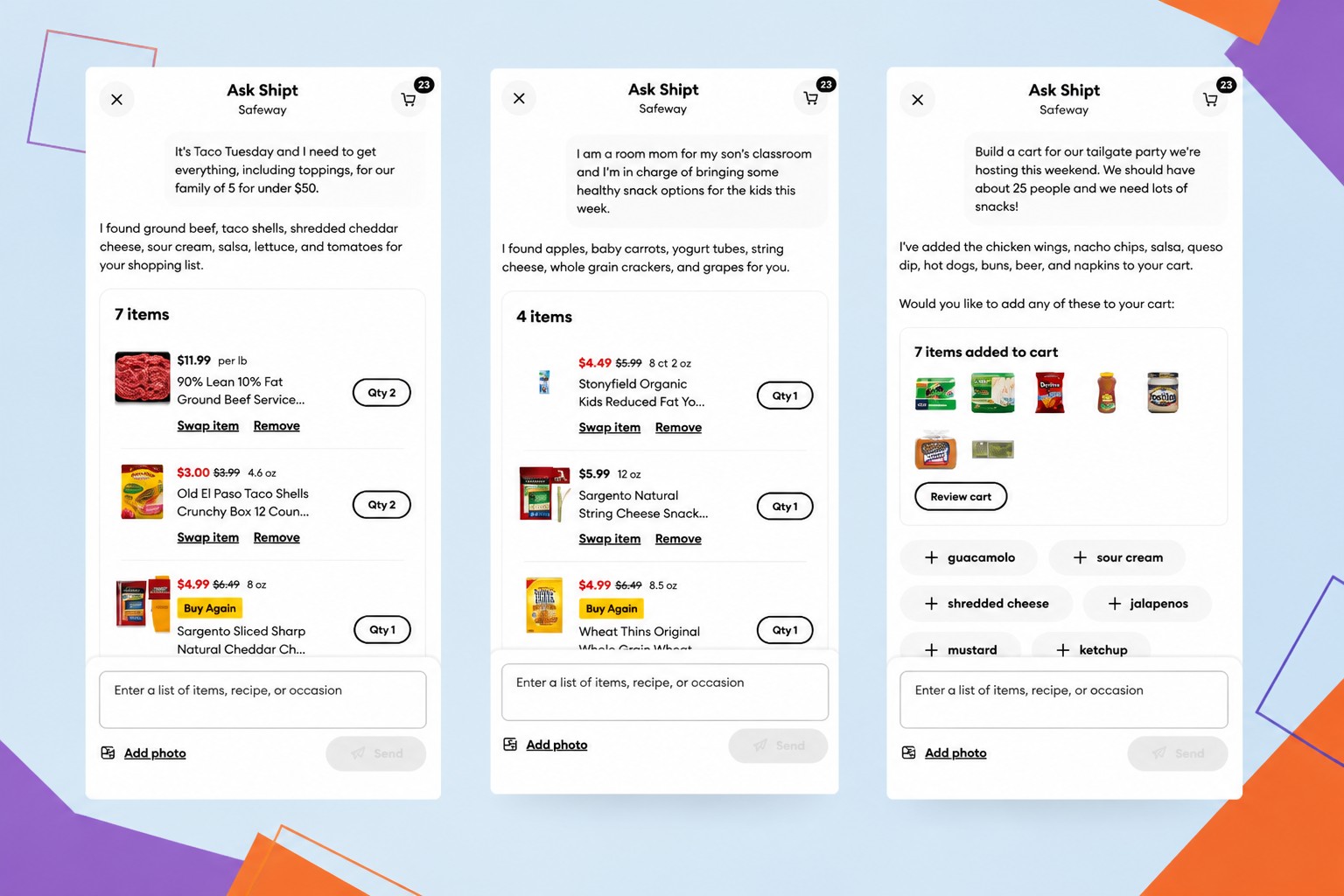
Shipt has launched Ask Shipt, a tool that takes a written description of what a shopper wants and returns a personalized, ready-to-buy cart. It is live in the Shipt app and on Shipt.com. Instacart introduced its own grocery assistant, Clementine, the same morning, and Uber Eats and DoorDash shipped comparable features earlier this year. Four delivery services now answer the same prompt the same way, two of them as of today.
Shipt describes Ask Shipt as a more intuitive way to shop. The prompts it offers as examples are long and situational: "Create a cart for my Saturday tailgate for 25 people and include some brunch items" and "Build a cart for easy school lunches and after-school snacks."
The assistant also takes images. A shopper can upload a photograph of a dish seen online or in a restaurant, and Ask Shipt will identify the ingredients and put them in the cart. It handles budget constraints as well, such as a request for weeknight dinner options for a family of five under $35.
Target.com has already been fitted with adjacent AI features: product search by photograph, summaries of customer reviews, and personalized shopping scenarios. Ask Shipt sits on the same side of the funnel, before the order rather than after it.
What is striking about the four launches is how little separates them on paper. Natural language in, cart out, with a photo uploader and a budget filter. The differentiation cannot live in the feature, because everyone has it by this morning. It lives in the catalogue behind the assistant and in the substitution logic, meaning what the system picks when the exact item is unavailable, oversized, or twice the price the shopper had in mind. None of that is in the announcement.
The interesting question is accuracy, and no one is quoting a number for it. A cart built from "easy school lunches" is a stack of guesses about brand, quantity, package size and dietary assumption, and the shopper only finds out which guesses were wrong when the bags arrive. Shipt does not say which model powers Ask Shipt, does not claim a hit rate, and does not explain what recourse a customer has when the assistant orders the wrong thing at scale, twenty-five tailgate portions at a time.
That is the position all four services have now talked themselves into. Having the conversational cart no longer wins anyone a customer, because it is standard. It can still lose one, a single bad substitution at a time.