
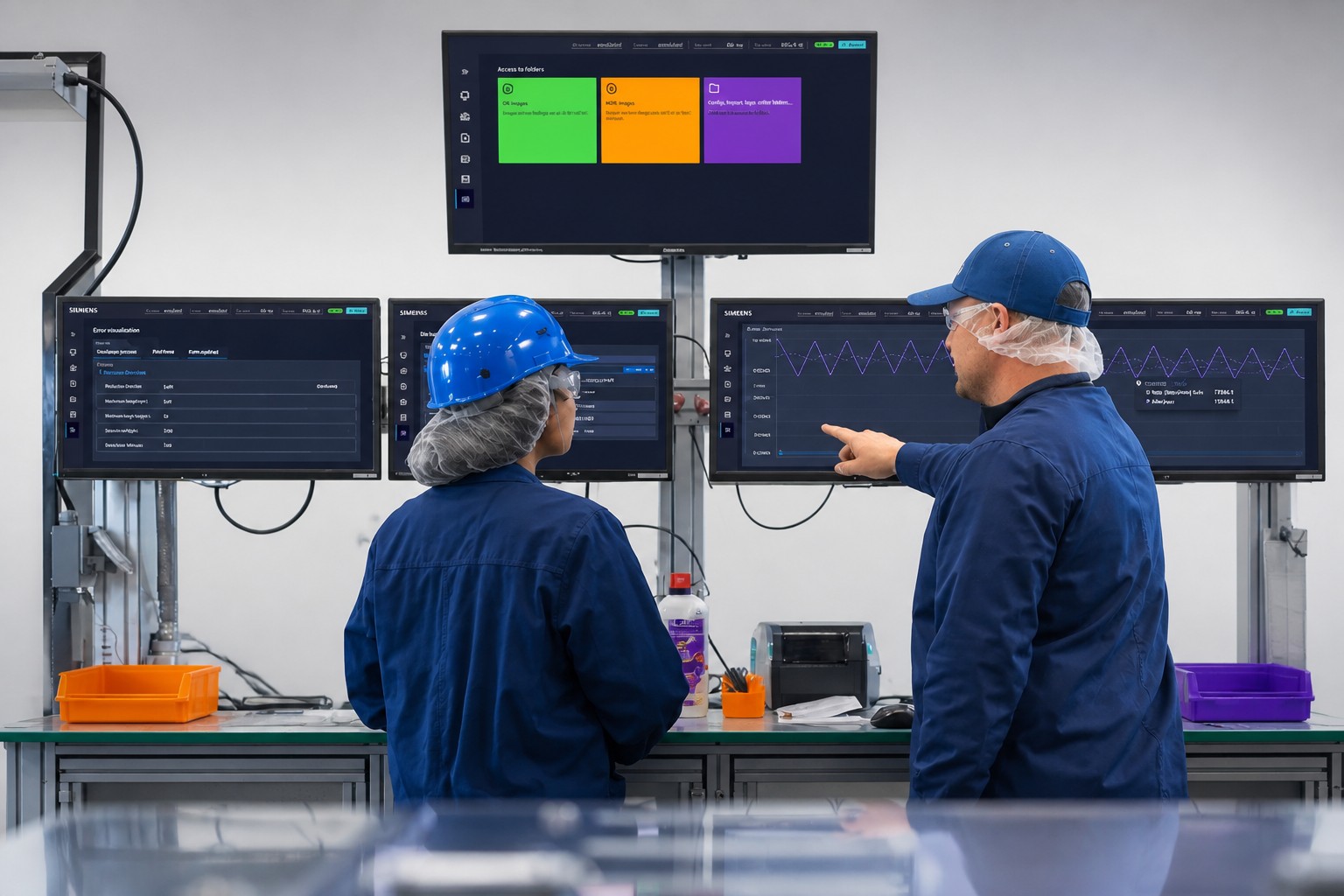
Manufacturers are moving beyond isolated robotics and AI projects toward systems that can monitor quality, adjust operations and coordinate more of production with limited human involvement. This week, Siemens and Procter & Gamble announced a global expansion of their AI quality-control system, which the companies say has cut manufacturing waste by 10–20%. The broader shift reaches consumer goods, cars, pharmaceuticals and defense: automation is becoming a question not just of labor costs, but of whether a factory can keep pace with competitors.
From inspection tools to production systems
P&G first developed its deep-learning inspection system in-house and deployed it more than 150 times. It then partnered with Siemens to expand the system and scale its use across the company’s global manufacturing network.
The jointly developed Visual Inspection Cockpit analyzes live camera images of products moving along production lines. It detects defects on flexible materials, textured surfaces and complex packaging—objects that can challenge conventional machine-vision systems. Processing happens on computing equipment near the machines, allowing the system to trigger an alert or remove defective products without stopping production.
The reported results are notable, but so is the implementation speed: Siemens says new installations can be brought online five to ten times faster than traditionally custom-built machine-vision systems. The harder test is whether that performance can be reproduced across a global network of factories.
Other consumer-goods companies are pursuing related approaches:
The common thread is a move to treat AI as an operating system connecting equipment, quality control and production decisions—not as a standalone software application.
Three stages of factory automation
Chris Stevens, president of Siemens’ US industrial automation business, described a progression from traditional automation to adaptive and then autonomous production.
Traditional automation carries out predefined tasks, such as moving parts between workstations. Adaptive production responds to changing conditions—for example, by detecting a defect and directing equipment to remove it. Autonomous production combines these capabilities, coordinating machines, material flows and processes with less continuous human involvement.
Stevens said the technology to build highly autonomous factories already exists for some types of manufacturing. But feasibility depends on the process: cost, technical complexity and the constraints of the work still make some deployments impractical.
The steps toward more capable production are visible beyond consumer goods:
None of these examples demonstrates a fully autonomous factory. They do show automation moving from controlled demonstrations toward real production—and buyers increasingly asking suppliers for complete manufacturing capabilities rather than individual components.
The economics are changing
The case for automation is no longer limited to reducing labor costs. A 2024 study by Deloitte and The Manufacturing Institute estimated that US manufacturing would need about 3.8 million additional workers between 2024 and 2033. Up to 1.9 million positions could remain unfilled if employers do not address hiring and skills shortages.
Stevens said automotive executives discuss production lines that cannot run at full capacity because of staffing shortages. In that setting, automation can sustain output and expand capacity, rather than simply replace workers.
My read is that labor scarcity may start the investment, but competitive pressure could keep it going. If automated plants produce faster and more cheaply, manufacturers without staffing problems may still feel compelled to follow. The uncomfortable question is whether companies that do not invest in robotics will be able to compete.
Pharmaceutical companies are exploring a deeper version of the same shift. Automating repetitive lab work could let researchers run more experiments, get data faster and move successful processes into manufacturing sooner. In January, Eli Lilly and Nvidia announced plans to invest up to $1 billion over five years in a joint AI research lab combining pharmaceutical research with accelerated computing, robotics and physical AI.
Autonomous labs would connect computational drug discovery, experimental validation and production. But those steps must form reliable processes that meet drug-quality and regulatory requirements. What I’d want to know is how the companies plan to demonstrate that reliability—not just whether they can automate more individual tasks.
Manufacturers are beginning to buy connected production systems, not just machines or software. That may make integrated suppliers more valuable, while raising the cost of standing still: the competitive divide could form between factories that can adapt their operations and those that still depend on isolated automation projects.
Daily AI news
Every day we pick what actually matters in AI and explain it plainly — no hype, no filler. Subscribe if you want to follow where the industry is going.
Only what matters — every day
Follow on X