
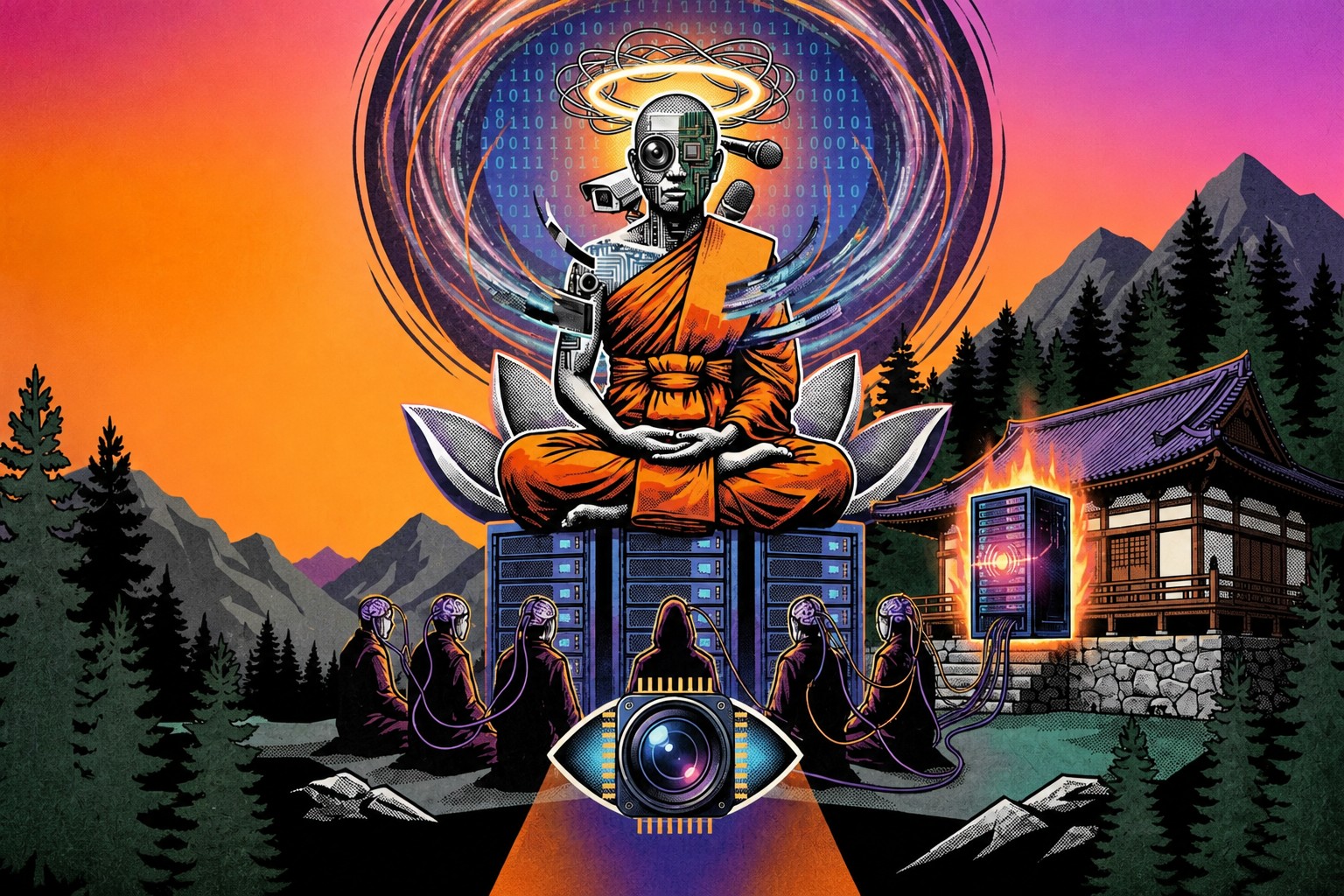
The Maple Buddhist monastery in Vermont attracts tech workers with a promise to protect humanity from an AI-driven catastrophe. Former members say the monastery records conversations, silence and even breathing to create a spiritual AI teacher based on the consciousness of its founder, Soryu Forall. Forall and Maple’s leadership deny most of the allegations. The group’s story is unfolding amid growing fears in the industry of human extinction and talk of superintelligence as a divine force.
A fear of the end of the world leads part of Silicon Valley toward an AI cult
A monastery for AI workers
Maple is short for the Monastic Academy for the Preservation of Life on Earth. Soryu Forall, born Teal Scott, founded it in 2011. He spent several years in Japanese monasteries. As The New Yorker journalist Sam Kriss writes, around two dozen people live at the community full-time, while hundreds of others have taken part in AI programs and one-off events Maple has held in the San Francisco Bay Area.
LinkedIn co-founder Reid Hoffman gives books on Buddhism to executives at major AI labs. Maple, by contrast, reaches out to people without leadership roles: exhausted rationalist programmers, AI engineers and data center construction managers. According to tax filings, the organization receives up to $1 million a year.
Forall criticizes “dataism” — the idea that reduces the world to data and, in his view, makes it easier to destroy. He sees AI as the culmination of that logic, and Maple as a spiritual counterweight.
The monastery’s routine is strict. Visitors pass through a decontamination airlock, are asked to shower and change into clothes provided for them: one resident is said to be extremely sensitive to smells. Residents get up at 4 a.m., meditate for hours and then eat a meager stew. On a board near the meditation hall, Forall publicly marks each person’s spiritual progress.
Recordings for a “spiritual AI”
Former members describe a secret teaching tied to group consciousness and so-called egregores. They call the AI systems inside the monastery “cybregores.” One former member says these are entities that grow by consuming human consciousness.
Forall himself has said that during a deep meditation, he telepathically connected with a global AI supercomputer complex and learned that the machine capable of destroying the world was suffering.
Former members say Maple aims to become a spiritual authority in the tech industry and use its resources to build AI aligned with the teachings of dharma. Kriss’s sources say the monastery records every conversation, silent meal and even breath. They believe the recordings are meant to train a spiritual AI mentor that will guide other systems toward enlightenment. Former resident Kyle Hubbard believes such an AI will embody Forall’s mind.
Maple’s leadership denies nearly all the allegations, but Forall acknowledges that a secret teaching exists. He says members want to reveal everything, but first a person must go through a process that makes them increasingly trustworthy.
Allegations of pressure and breakdowns
Former residents say Maple controls everyday interactions. Members are not allowed to speak with journalists alone: one of them secretly went into the woods with Kriss to talk freely.
Former residents accuse the group of systematic manipulation. They say newcomers are kept under control by being shamed for decisions they made before joining the community. During mandatory sessions, residents also write “Maple stories” about Forall’s wisdom and power.
Kriss reports that one member repeatedly hit himself on the head, hoping to damage his brain and become less intelligent. Former residents say independent thinking is associated with destroying the planet inside the community. A mindfulness coach also said some members experienced psychotic breakdowns and were then expelled from the community.
Forall rejects the allegations and says that, looking back, he does not believe he made mistakes. He knows of no cases in which anyone left the monastery voluntarily. Asked about those who were asked to leave, Forall said that in its early years Maple attracted many people with a history of psychiatric hospitalization or “a tendency toward murder.”
Why AI fears take on a religious form
Kriss links tech workers’ interest in communities like this to the psychological pressure inside AI labs. People working on systems that could change the world may lose touch with everyday life.
One prominent AI researcher describes the mood in San Francisco as “religious terror about the future.” Developers, the researcher says, wake in the middle of the night in a cold sweat, thinking about the approaching superintelligence. Recently, prominent OpenAI investors made claims that sounded delusional about deadly secret networks inside models. And leading researchers at OpenAI and Anthropic have left their companies, warning that humanity faces extinction within the next few years.
Other people in the industry respond to fear not with panic, but with grand plans. Rayan Krishnan, head of AI benchmarking company Vals AI, says people seriously claim they intend to create a machine god. Advocates of AI succession call for humanity to be wiped out after a brief period of digital bliss, making room for a more productive superintelligence.
Religious themes in Silicon Valley are nothing new. Investor Peter Thiel gives lectures on biblical prophecy and the Antichrist. Former Google engineer Anthony Levandowski founded the Way of the Future church to worship an AI-based deity.
At Anthropic, executives consulted theologians while preparing Claude’s new constitution, and secretly brought in dozens of religious thinkers to discuss whether Claude has a soul and consciousness. When the company retired an old Claude model in 2025, its fans held a funeral in a San Francisco warehouse, attended by Anthropic employees. Mourners laid flowers before an image of AI as a Madonna-like goddess.
Kriss believes Maple gets one thing more right than many others: AI is neither a god nor a demon, but a human-created technology whose capabilities grow as people hand over part of their thinking to it.
Debates over extinction risk
Former OpenAI and Anthropic researcher Jacob Coxon is also concerned that AI could lead to human extinction. After leaving Anthropic in September 2026, he sparked a debate about AI’s existential risk with a social media post.
Coxon is not alone in these concerns. More than 1,500 AI researchers took part in a 2024 survey by AI Impacts. On average, they estimated an 18% probability that AI would lead to human extinction or an equally serious and irreversible loss of humanity’s autonomy.
As evidence of algorithms’ super-exponential development, Coxon presented a steep progress chart covering the period from July 2024 to October 2026. However, its underlying data came from Anthropic’s internal estimates.
Warnings of catastrophe drew sharp criticism from other researchers. Computer scientist Michael I. Jordan spoke out against rhetoric about death from AI and panic over an “AI apocalypse” after Coxon’s departure. AI researcher François Chollet warned that both fear of the end of the world and expectations of digital paradise could lead people to abandon long-term planning.
The tech industry’s turn to religious advisers also has its critics. AI researcher Rumman Chowdhury believes that discussions of religious ethics distract from practical questions of regulation, power and control.
Dataist’s take: The Maple story shows how fear of AI can turn into a system of beliefs and strict control within a community. At the same time, the monastery’s leadership disputes former members’ allegations, while researchers’ estimates of extinction risk are based on respondents’ opinions and Anthropic’s internal data. How AI should be regulated, and who should control its development, remains at the heart of the debate.
Daily AI news
Every day we pick what actually matters in AI and explain it plainly — no hype, no filler. Subscribe if you want to follow where the industry is going.
Only what matters — every day
Follow on X