What StudentSim models
AI tutors work better when they adapt to a learner’s strengths and weaknesses. The trouble is that finding the right prompts for each learner requires time with real people, making large and diverse training groups expensive and slow.
StudentSim creates a separate copy for each learner, even when only a small number of records is available. The researchers measure two properties:
Existing approaches usually cover only one of these abilities:
StudentSim treats both behaviors as targets. That gives a tutor a simulated learner that is not merely plausible in conversation, but useful for testing whether an explanation changes the learner’s reasoning.
Two-stage training for sparse records
The dataset problem is severe. In the English-language dataset, the median learner wrote only three essays, and more than two-thirds of learners wrote no more than five. The authors say that directly tuning a copy on so few examples causes it to memorize those specific records.
StudentSim uses two stages:
Across all subjects, the base model is Alibaba’s Qwen3-4B-Instruct.
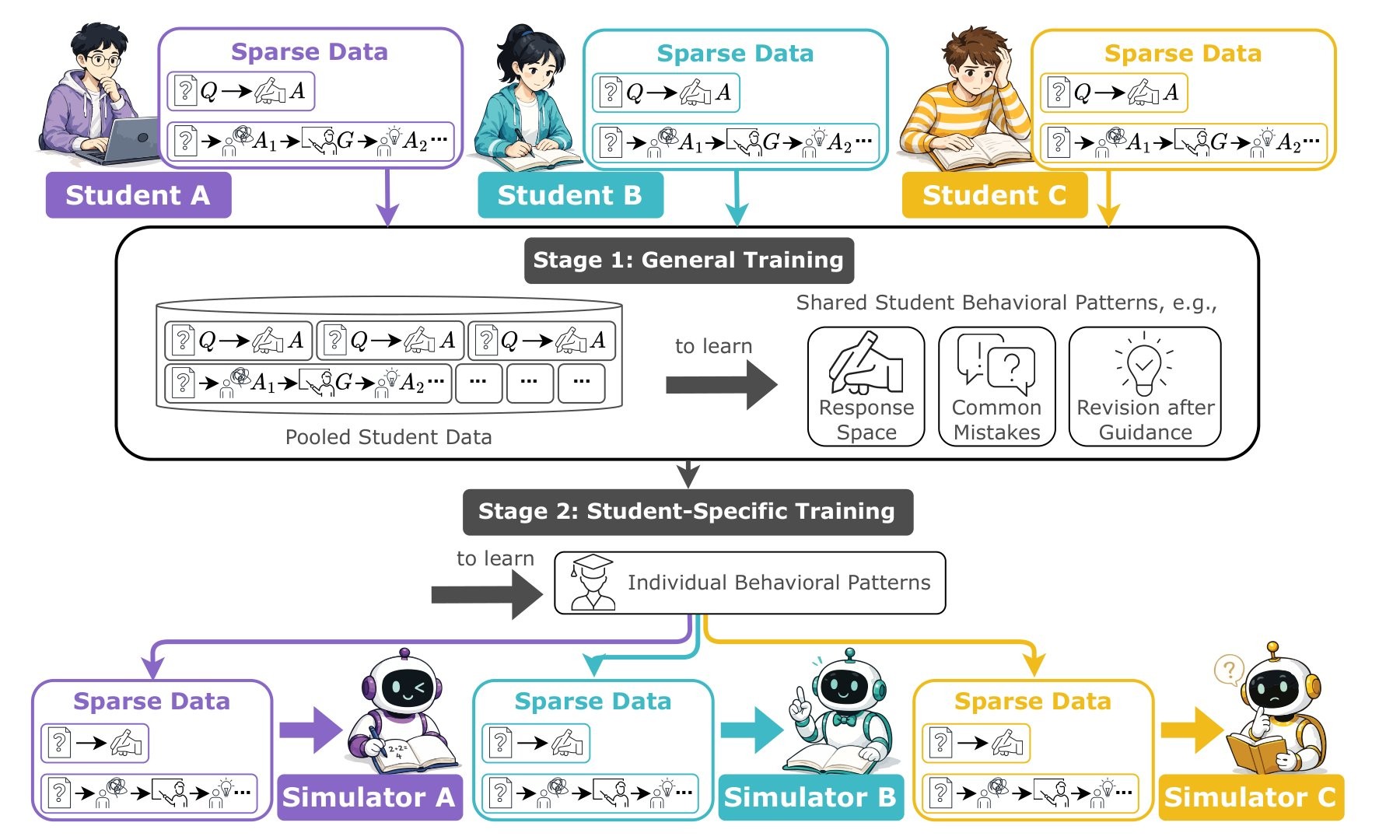
The first stage learns shared patterns within a subject from pooled student data. The second adapts the model to an individual student. | Image: Microsoft
Source: the-decoder.com
This design is the paper’s most consequential choice. It treats general student behavior as reusable knowledge, then adds a thin layer of individual history. My guess is that this is what makes the approach viable with sparse records; a fully personalized model would have too little evidence to learn from.
Better at following a learner than a generic role-player
The researchers tested StudentSim on 60 learners in chess, English as a foreign language and mathematics, using open datasets containing records of real students.
In all three areas, StudentSim outperformed the larger GPT-5.4 when GPT-5.4 was prompted to act as a student. In chess, StudentSim predicted a player’s next move correctly about twice as often and followed corrective hints almost every time. GPT-5.4 and specialized chess models performed worse.
The methods failed in different ways:
In one position, three real players chose three different moves. StudentSim reproduced each player’s choice. The chess model predicted the same most likely move for all three, while GPT-5.4 was wrong in all three cases.
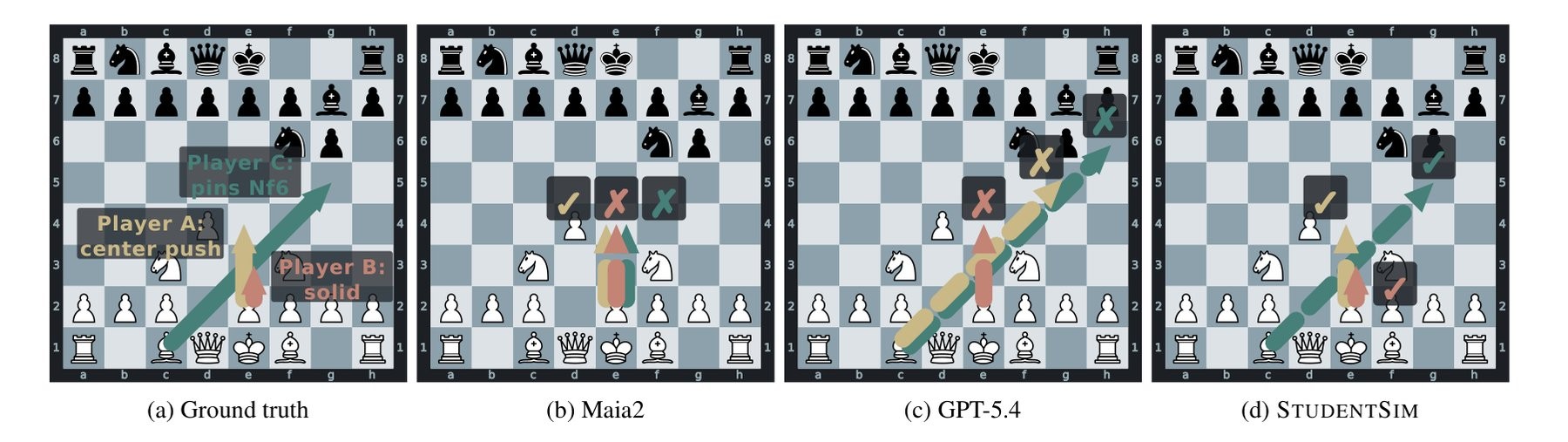
Maia2 predicts the same move for all three players; GPT-5.4 gets all of them wrong; StudentSim correctly predicts each of the three individual moves. | Image: Microsoft
Source: the-decoder.com
That comparison matters because a tutor is not teaching an abstract average student. A system that gives excellent explanations to one learner can still be poorly matched to another if it cannot reproduce where that person is likely to go wrong.
A simulated student improved the tutor
The researchers then used a student copy to train a chess tutor. Professional chess players evaluated three versions:
The StudentSim-trained tutor received the highest scores on all three measures. It made the fewest serious factual errors and scored higher for explanation quality and adaptation to the individual learner. In this experiment, the learner preferred questions that guided them toward a solution over direct instructions.
The tutor trained with GPT-5.4 was less factually accurate than the tutor without additional training.
I think this is stronger evidence for StudentSim than the model-comparison results alone. The system was not only better at imitating learners; its simulated behavior produced a better-rated tutor. But the result remains a proof of concept, not evidence that the researchers have built the best tutor.
Chess also makes the experiment unusually easy to score. An engine can objectively determine whether a move is good in a given position. Free-form answers in essay writing and open-ended mathematics do not have equally reliable scoring functions, so the method faces a harder test outside chess.
The team plans to model how learners acquire, retain and forget knowledge across many training sessions. The code is available on GitHub.
The missing test is long-term learning
Other work shows both the appeal and the limits of digital learners. In 2024, researchers used AI agents to reproduce about 1,000 real people after conducting a two-hour interview with each participant. Another study asked nine open language models to imitate users on X, Bluesky and Reddit. As the models became more human-like in style, the factual accuracy of their responses declined.
Microsoft is testing AI tutors with real students in Nigeria. During a pilot, students used Copilot twice a week for six weeks, and their test results rose by an amount comparable to almost two additional years of schooling.
OpenAI and Google offer Study Mode and Guided Learning, their own teaching modes. They use system prompts and models tuned for instruction, but they do not maintain a model of a particular student. That gap matters: research indicates that after brief AI assistance, users can perform worse on tasks than people who worked independently from the start.
StudentSim addresses the personalization problem, but not yet the full learning problem. A copy that predicts the next answer and reacts to a hint is useful for tutor training; it is not automatically a model of how knowledge changes over weeks or months. Until those longer trajectories can be simulated and evaluated, digital students will remain powerful test subjects rather than reliable stand-ins for the people tutors are meant to teach.
Daily AI news
Every day we pick what actually matters in AI and explain it plainly — no hype, no filler. Subscribe if you want to follow where the industry is going.
Only what matters — every day
Follow on X