
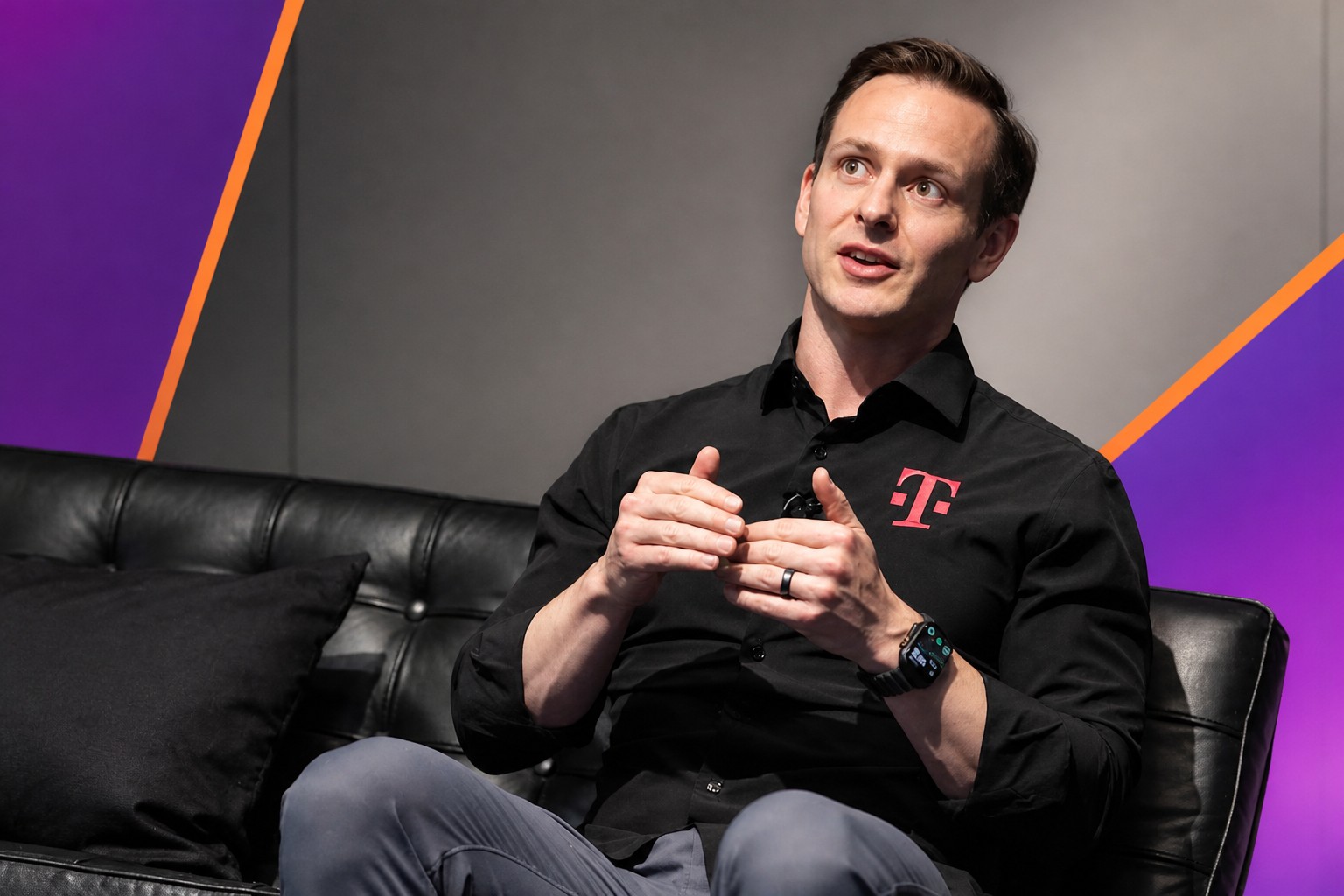
T-Mobile replaced a knowledge graph and loading all documentation into AI agents’ context with a mapping table that links common ways customers phrase questions to the right service workflow. Early approaches confused agents with contradictory instructions or slowed them down. In a VentureBeat Intelligence survey, 78% of 97 respondents whose organizations use AI agents to work with enterprise data said that in the past six months they had encountered at least one confident but incorrect answer caused by missing or conflicting context.
T-Mobile dropped its knowledge graph to get agents to answer customers faster
How T-Mobile chooses context
Since 2024, T-Mobile has been building AI agents that communicate with customers via chat, text message and voice. The company focused on coordinating agents rather than training its own models. According to Chief Information Officer Jeff Simon, as models improved, the company added new agents: the models got better at coordinating their work and tool calls. Before a request reaches a model, T-Mobile removes information that may be irrelevant. Simon called this one of the company’s most important lessons.
T-Mobile first tried loading all its support documentation into an agent, expecting a larger context window to let it answer like an expert. But documents at a company of this scale contain conflicting instructions, and a customer’s words can refer to different processes. For example, a request for a new device might mean a new phone for an existing line or adding another line. If the context includes several possible routes at once, the model may choose the wrong one.
The next attempt was a knowledge graph. It proved slow: agents had to search through many relationships to find the right information, and they did not have enough time. Customers also ask the same question in different ways. If an agent interpreted a request incorrectly, it could take the wrong route through the graph and get lost—even when T-Mobile tried to guide it.
Instead of a graph, the company uses a key-value cache in a database. The table links common ways of phrasing questions to the agent’s next route; the team updates it when customers ask questions in new ways. The table is for agents, not people. A coordinator agent clarifies which path the customer needs and passes the request only to an agent with the context for that scenario. Simon said the solution is simple, fast, responsive and scales well; so far, the agents are working efficiently.
The agents also have limited ability to make changes to customer accounts. They can be used to buy an international data package or add other services. Before a purchase, the system checks that the customer really intends to make it.
How T-Mobile detects incorrect answers
In every chat and voice session, T-Mobile runs a small language model alongside the main one. It evaluates the agent’s work and flags cases where it may have made a mistake or the customer is getting angry. Employees review those sessions: given the volume of interactions, it is impossible to check every conversation—or even a large sample—manually.
The additional model increases costs, Simon acknowledged. The company considers the expense justified because it is impossible to anticipate every unusual way customers might phrase a request.
Once, the monitoring model reported background hold music on many calls. T-Mobile was surprised: the company does not play such music. Engineers spent several weeks investigating the call systems and interactive voice response menu before discovering that the customer-facing model was making it up. This happened when the model paused its response to find information or call a tool. The model’s prompts now specifically tell it not to invent hold music—a problem the team had not previously expected.
What context errors lead to
The October VB Pulse survey on context levels for AI agents included 97 people from organizations using such agents to work with enterprise data. Of those, 78% said they had encountered at least one case in the past six months where an agent confidently gave an incorrect answer because business context was missing or conflicting. The survey calls such a case a context failure.
Among the 76 respondents who reported a context failure, the consequences of the most serious case were:
Respondents were also asked how they usually detect confident but incorrect answers. They could select multiple methods. The most common were automated checks that compare an agent’s answer with a trusted source: 57%. Subject-matter experts’ spot checks were cited by 55%, and dashboard alerts by 52%. Another 19% learn of an error from a customer, partner or supplier.
All 55 respondents who cited automated checks track whether an error was caused by context or by the model itself. Among the 42 participants who did not select such checks, 10 people—24%—do not track the source of incorrect answers at all.
Adobe tailors context to the task
At the Agentic Infrastructure Stack summit, Adobe Senior Vice President of Engineering Anjul Bhambhri described Adobe’s marketing agent, CX Enterprise Coworker, as a system that needs carefully selected context. What goes into that context depends on the task.
To prepare an email for customers in Europe, the agent needs mailing requirements, EU consent rules and the company’s own rules on who can be contacted. Adding US rules would increase the risk of an error.
By contrast, refining a holiday campaign requires several years of data: without it, the answer may be too generic. Bhambhri gave an example from the company’s history: during a Black Friday sale, free shipping drove more purchases than a 20% discount among repeat customers.
Adobe reduces the context before passing the prompt to the main model. First, it sets a fixed foundation for the company, such as brand rules needed by every user. Then a retrieval stage uses keywords, semantic indexes and knowledge graphs. These show relationships between marketing materials, when they were used and what results followed. After that, a merging and ranking stage determines what goes into the context window. Natural language understanding systems and a cheaper model handle this work before the main model runs.
Why Uber’s experience with graphs is different
Uber’s results show that a knowledge graph can be useful for a different task. In an engineering blog post dated August 27, the company said an agent using its AI Context Graph found a table with data in 38 seconds. The same model, without the graph, took more than 20 minutes and incorrectly concluded that it was impossible to retrieve the data.
As VentureBeat reported on Thursday, Uber’s engineering agents use a graph to find the right systems and, when needed, retrieve documents or code. T-Mobile’s agents had to consult a graph during live customer interactions, where delays are especially noticeable.
Which context sources companies choose
In the VB Pulse survey, participants were asked to name the primary source of business context for their agents. The results were:
Teams building agents on enterprise data still face practical questions: which documents in the context contradict each other; whether the team will notice an answer based on the wrong instruction; who is responsible for the table, index or graph that determines what information an agent can access; and how long a customer can wait while the system finds it.
Dataist’s take: T-Mobile’s experience shows that the amount of information available to a model does not, on its own, guarantee accuracy. Conflicting instructions can send an agent down the wrong path, while complex retrieval can delay an answer. The company’s approach makes route selection simpler, but the table must be updated as new ways of phrasing questions emerge. Additional checks help catch errors, but increase costs and do not eliminate the need to investigate unusual cases.
Daily AI news
Every day we pick what actually matters in AI and explain it plainly — no hype, no filler. Subscribe if you want to follow where the industry is going.
Only what matters — every day
Follow on X