
What TBC actually ships
TBC does not put neurons inside a server. The company, originally called Biological Black Box, grows cortical nerve cells on chips with 4,096 electrodes and records how electrical activity spreads through the culture and fades over time.
That biological work happens during development. TBC extracts measurements such as signal range and duration, then turns them into small software modules called adapters. The neurons stay in the lab; the customer gets a mathematical transformation that runs on a GPU.
TBC was founded by neurosurgeons Alex Ksendzovsky and John Pomerantz. In February 2026, it raised $25 million. The company started with video generation because the field makes inference problems unusually visible: quality, speed and cost. Its longer-term plans include world models and computing systems that combine neurons with silicon chips.
From cells to a video adapter
TBC illustrated its method with Minecraft Oasis, an open model of the world with roughly 600 million parameters. Oasis generates game scenes frame by frame in response to a player’s actions. Because each new frame depends on the previous one, small errors accumulate until the scene becomes a blurred, shapeless image. TBC calls this effect “washout.”
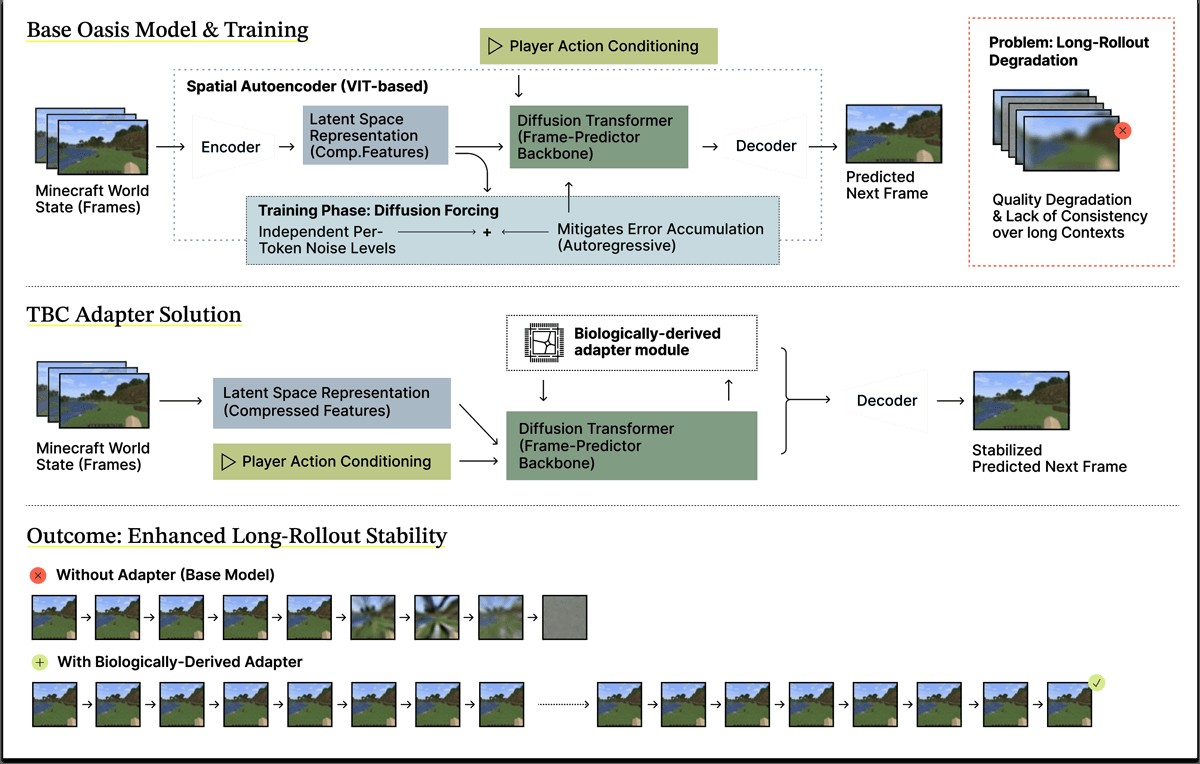
The base model Oasis and the variant with the TBC adapter plugged in. The adapter hooks into the model's early layers, and the architecture stays otherwise unchanged. | Image: TBC
Source: the-decoder.com
The experiment began by converting images into sequences of electrical impulses and delivering them to selected electrodes on the cell culture. The neurons responded beyond the point of stimulation: activity moved through nearby cells and weakened after a short time.
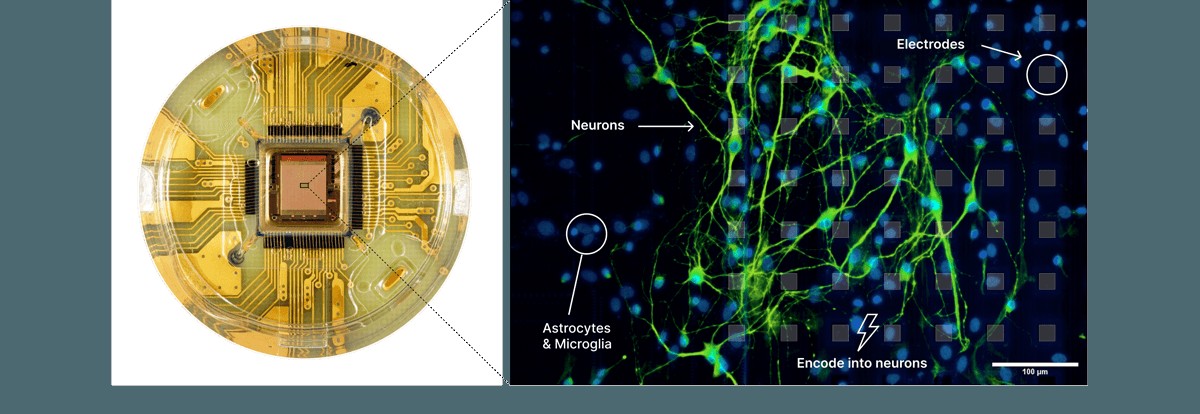
Living nerve cells on a multi-electrode array (left) and the network's measured activity across space and time (right). | Image: TBC
Source: the-decoder.com
TBC recorded where the activity appeared, how far it traveled and how long it lasted. It then encoded those measurements in a Neural Dynamics Adapter, a compact software module that models signal propagation across a limited area.
A second translation layer converts that biological pattern into the intermediate format used by the AI model. The model can then use the structure extracted from the cell culture while generating images.
The resulting rule is simple: activity primarily affects a neighboring region and then fades. TBC says this keeps nearby parts of an image consistent and prevents distortions from spreading without control.
The adapter contains about 156,000 parameters, while Oasis’s architecture remains unchanged. TBC trained it on Minecraft video sequences while making small updates to the original model at a low learning rate. During inference, the cells are no longer involved.
On ten test videos, TBC says the adapted version retained clear object boundaries and spatial relationships better than the base model:
Oasis without (left) and with the TBC adapter (right). The base model blurs as the video runs on, while the adapter variant stays stable longer. | Image: TBC
Source: the-decoder.com
In a subsequent project, TBC built a larger adapter that added about 3% more parameters. Frame generation rose from about two to nearly ten frames per second. The speedup came from reducing the number of computation steps per frame, not from the adapter itself.
That tradeoff normally damages quality. TBC says it avoided the sharp drop in this case. An external evaluation by infrastructure provider Bluesky Compute in July found about 4.4 times lower inference cost and more than three times as much coherent video compared with the original model.
The evidence is thinner than the headline
For the commercial model, TBC has not named the base model or hardware. It also does not specify the resolution, clip length or quality metric behind its claims.
The “five times faster” and “80% cheaper” figures describe the same change in different units: using one-fifth as much GPU time produces an 80% reduction in cost. They should not be read as two independent gains.
My read is that the interesting claim is not that neurons outperform chips. TBC is making a narrower argument: observing biological dynamics may reveal useful algorithms that engineers would not have designed at a desk. That is plausible as a research premise, but the published results do not establish it.
What I’d want to see is a controlled comparison against digital methods such as distillation or caching, using the same base model and evaluation setup. TBC has not published that comparison. Until it does, the biological origin of the adapter is more convincing as a source of ideas than as evidence of a new advantage in production inference.
Daily AI news
Every day we pick what actually matters in AI and explain it plainly — no hype, no filler. Subscribe if you want to follow where the industry is going.
Only what matters — every day
Follow on X