What Gander is built to do
Gander separates the fast conversational loop from the slower work of reasoning, file retrieval or code generation.
The “brain” can be replaced with agent systems such as Codex or Claude Code without retraining the conversational model. In the tests, Tencent used an unnamed model from the OpenAI GPT-5.6 family for that role. The design also gives Gander a path to improve as its underlying reasoning model improves.
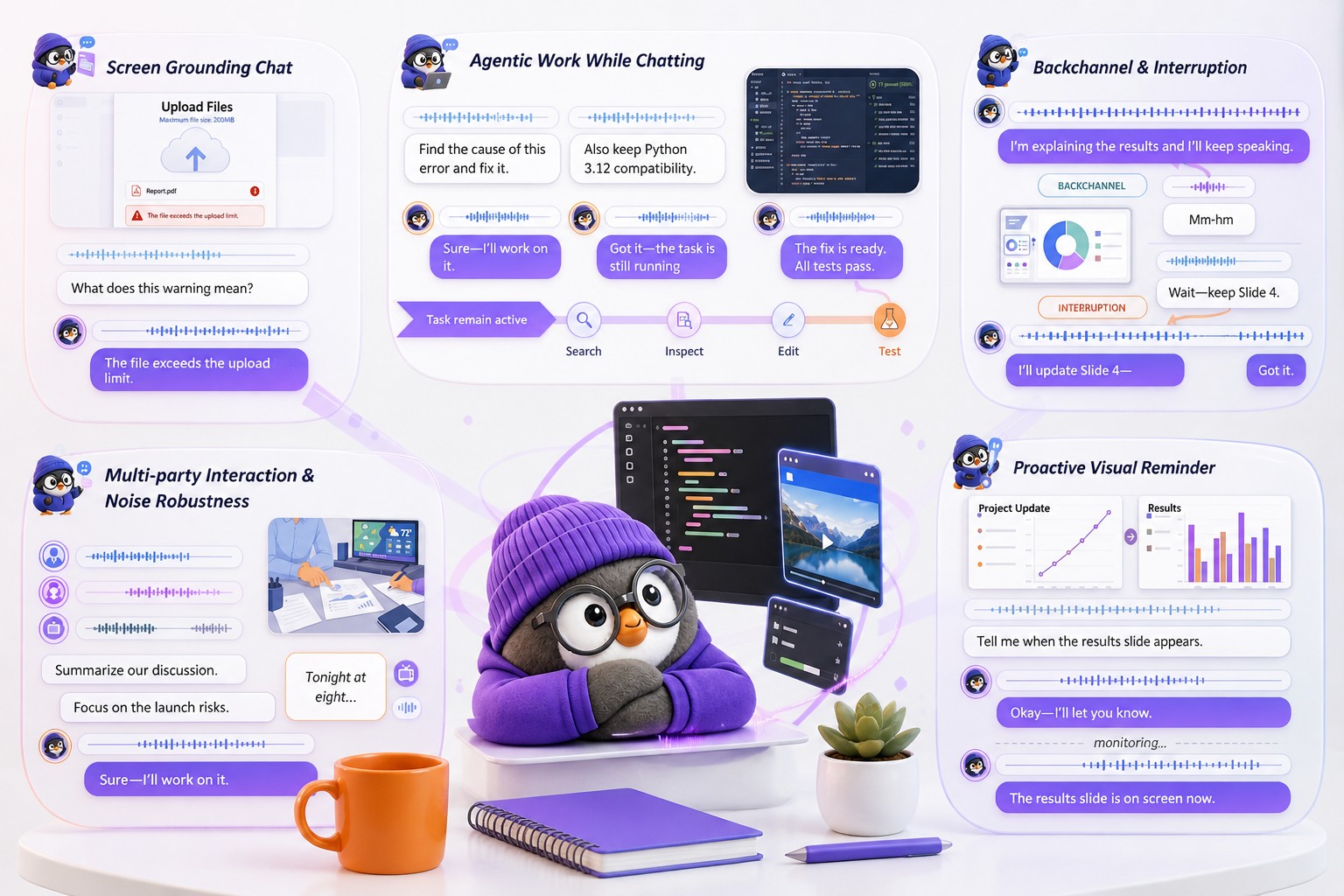
Gander processes video, speech and text even while responding. It can decide to listen, start speaking or stop when the user interrupts, then ask a clarifying question or report progress without waiting for a separate command.
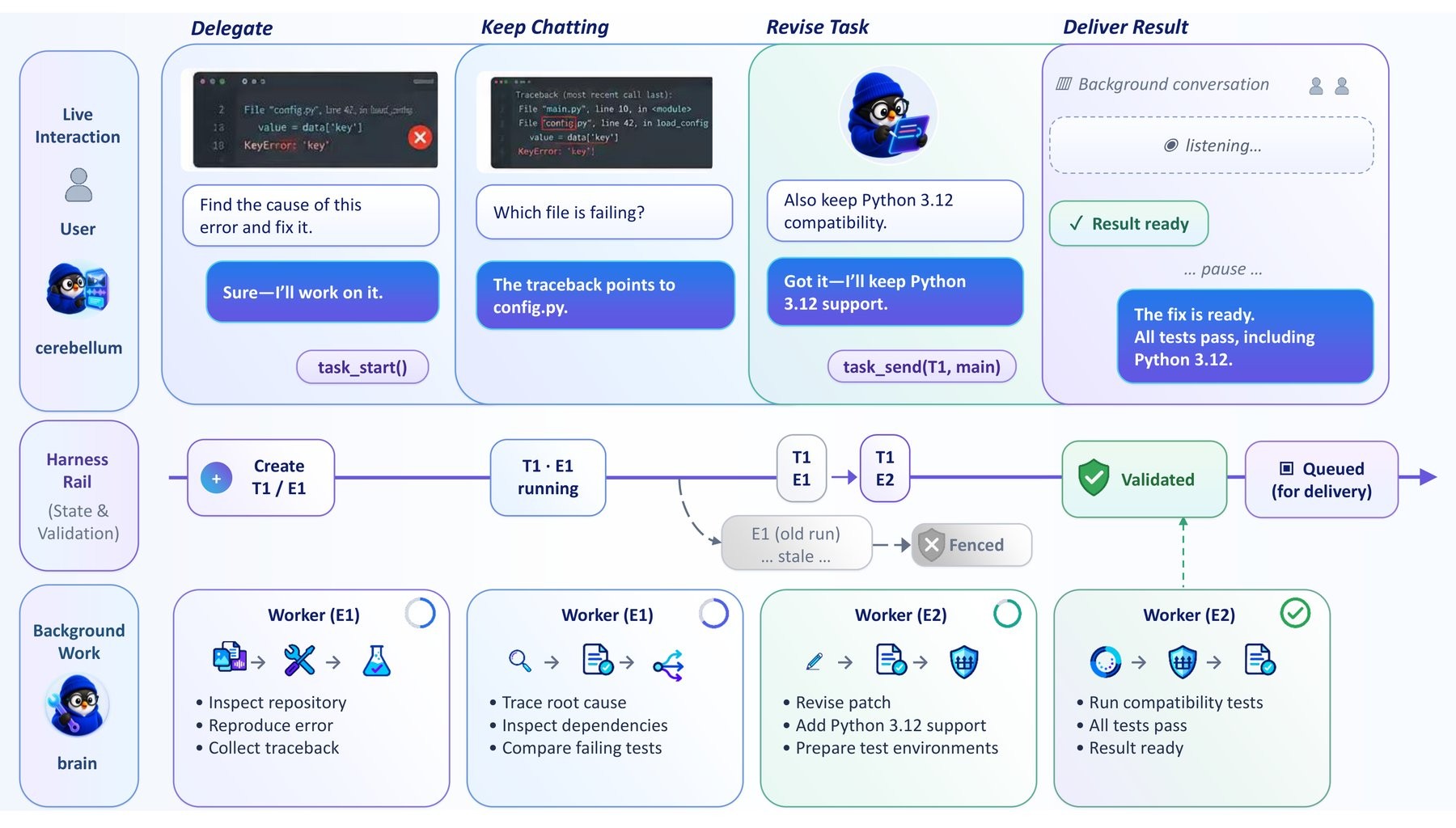
While the background agent fixes a bug, the user can keep asking questions and add Python 3.12 compatibility to the task. | Image: Tencent
Source: the-decoder.com
Timing is the stronger result
Gander divides the conversation into one-second segments. Instead of using a separate speech start-and-end detector, it keeps roughly the last two minutes of dialogue and uses that context to decide what happens next.
There is no dedicated benchmark for this type of system, so the researchers used existing tests. On Full-Duplex-Bench v3, which evaluates voice assistants across different scenarios, Gander recorded the best timing result in the report.
It started speaking at an appropriate moment in all 100 scenarios. It interrupted users in 8% of cases, compared with 13.5% for GPT-Realtime and almost 48% for the weakest competitor. The report says Gander uses a relatively small model while competing with commercial systems including GPT-Realtime, Gemini Live and Grok.
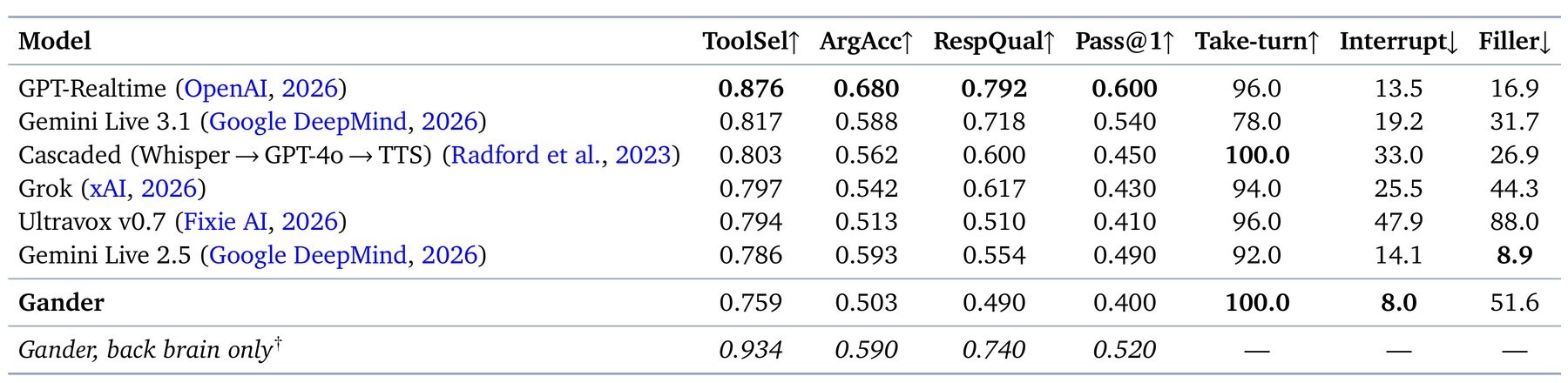
Gander interrupts users less often than any other system tested, but its task accuracy falls slightly below that of the weakest competitor. | Image: Tencent
Source: the-decoder.com
Task accuracy is less impressive. Gander trails slightly, partly because the benchmark scores the entire system: speech-recognition errors and response-generation errors both count against it. When text is passed directly to the “brain,” it earns substantially more points.
Video and audio understanding are also weaker. In one test, Gander performed worse than the base model. The researchers attribute that to training focused primarily on smooth conversation rather than exact perception, including counting objects and locating them in an image.
An early system with an open-source path
Gander was trained on roughly 2.7 million examples. Some teach it to stay silent when there is background noise or when nobody in a group is addressing it.
The team describes the work as being at an early stage. The report does not establish how Gander will scale, and there is still no standard way to evaluate systems that combine live conversation with background work.
Tencent plans to publish the weights and training data after completing its “source-code opening process.” A code repository is already available on GitHub, with demos on the project page.
Tencent is betting on divided responsibilities
Gander follows Tencent’s July release of Hy3, an open language model that reportedly narrowed the gap with competitors, especially on AI-agent tasks. Hy3 already powers WorkBuddy, Yuanbao and WeChat.
Tencent is also negotiating to buy the largest stake in Manus, an AI-agent startup. The talks follow Beijing’s blocking of Meta’s acquisition of Manus. Tencent sees the deal as fitting its own plans, including an AI agent built into WeChat.
This division of labor is spreading across the industry:
My read is that Gander’s most useful contribution is not a new answer engine but a clearer systems pattern: keep the interface responsive while handing difficult work to another model. The weaker perception scores show the cost of optimizing for that experience. What I’d want to know is how often users will accept a system that sounds naturally present but still needs a separate model to understand the world accurately.
Interruption and latency remain practical obstacles. Anthropic’s analysis found that experienced users interrupt Claude Code in roughly 9% of work steps, compared with roughly 5% for beginners. Teams building voice and text AI agents for communication report latency problems particularly often, according to the review. Gander makes the conversational layer more continuous; it does not remove the coordination problem underneath.
Source: the-decoder.com
Daily AI news
Every day we pick what actually matters in AI and explain it plainly — no hype, no filler. Subscribe if you want to follow where the industry is going.
Only what matters — every day
Follow on X