
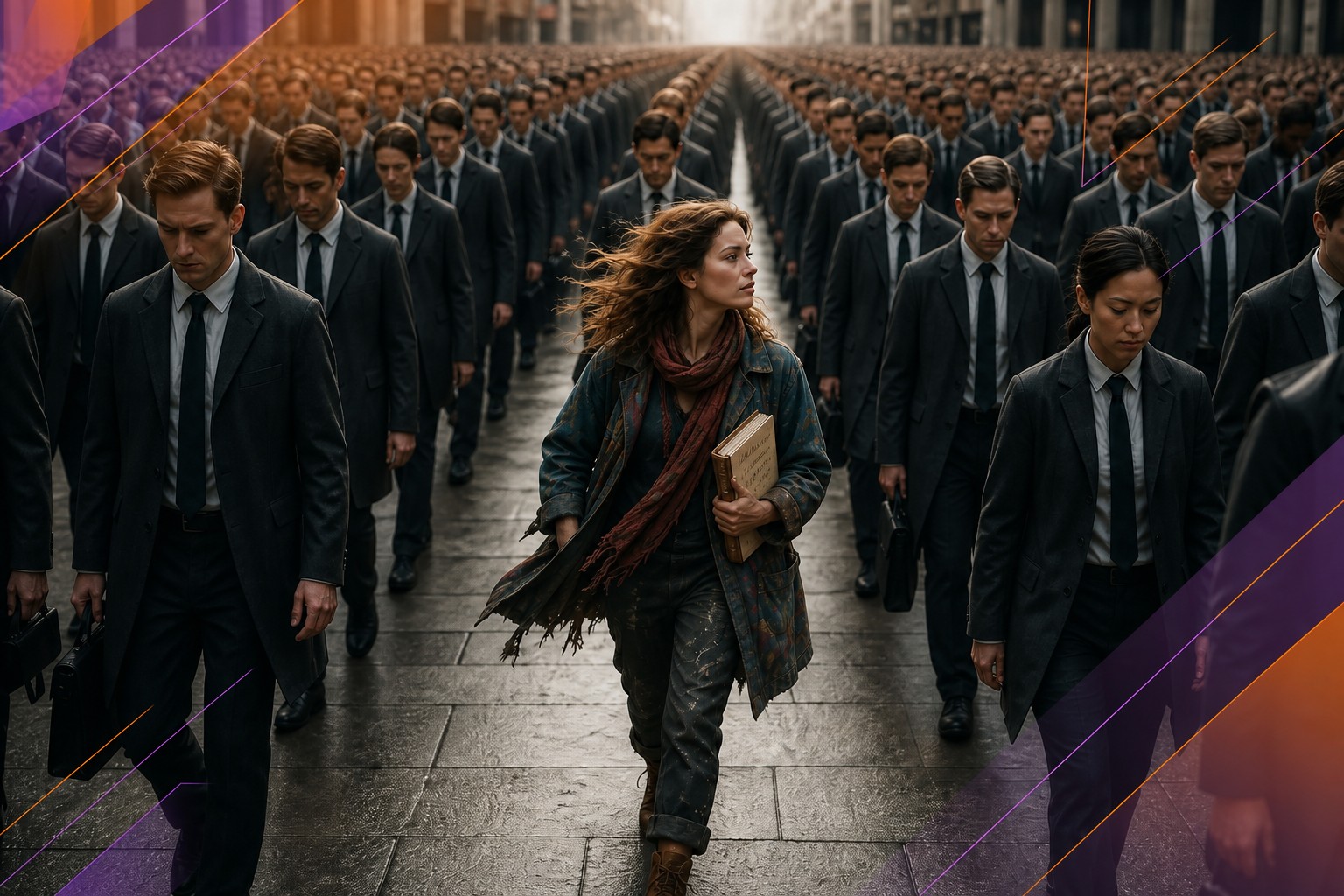
The argument is now a genre: as AI makes competent work available to anyone in seconds, what becomes scarce is everything a model cannot supply — judgement, taste, lived context, the nerve to make an unpopular call. Four people from unrelated fields were asked to test it: Stephen Cave, who directs a Cambridge research centre on the future of intelligence; Geoff Mulgan, professor of collective intelligence at UCL; Sougwen Chung, who paints alongside robot arms; and Viktoria Modesta, a bionic artist. They broadly agree. They also take the comforting version of the claim apart, and the most damaging evidence comes from one of the four.
The premise is arithmetic about scarcity. AI already writes code and prose, retrieves information, analyses data and generates images. If millions of people can produce a decent version of any of that in seconds, the ability to produce it stops being a distinguishing feature, and what is left over is whatever an individual adds personally: judgement, meaning the ability to choose between options and decide; imagination and taste, the ability to see an unusual opening and give it a shape; personal experience, the context a model does not have; trust and moral courage; intuition and curiosity, the capacity to ask an unexpected question, notice what others miss and turn a mistake into an idea.
Dr Stephen Cave, director of the Leverhulme Centre for the Future of Intelligence at the University of Cambridge, removes the floor the whole conversation has been standing on. The belief that intelligence is what makes humans special, he argues, took two hits last century. Machines began beating people at the games that were supposed to prove the point, chess among them. And researchers found impressive cognition across other species — not only chimpanzees and dolphins but octopuses, crows and ant colonies.
That only becomes a crisis if human worth is arranged as a hierarchy of intelligence with people at the top, and Cave's objection is that the hierarchy does not survive its own logic. If people matter because they are the smartest thing around, then smarter people matter more. If worth comes from writing great symphonies or deep mathematical theories, everyone else counts for less. He rejects both conclusions. Human value, on his account, should not be tied to any single quality, intelligence or otherwise, because tying it to a quality immediately sorts people by how much of it they have.
Sir Geoff Mulgan, professor of collective intelligence at University College London, former senior adviser to the UK government and author of the forthcoming Collective Stupidity (Princeton University Press, 2027), supplies the least comfortable material. His diagnosis is a crisis of imagination: people find it easy to picture technological futures and ecological catastrophes, and very hard to picture positive scenarios for society, healthcare, welfare and democracy. He thinks AI can make that worse. The more reasoning gets handed to algorithms, the less the underlying capacity gets exercised — and he points to signs it is already going, with IQ scores, school test results and adult numeracy and literacy all apparently falling. The practical consequence follows directly: weaker critical faculties make people easier for AI tools to manipulate and mislead. His prescription is to rebuild the ability to think critically and to interrogate a model rather than accept its output.
In Sougwen Chung's studio the argument acquires a body. Chung, an artist named to the TIME100 AI list, draws on canvas alongside multi-axis robotic arms driven by neural networks trained on two decades of her own drawings. Generative systems are excellent at polished output; she is interested in the unpolished part, in what happens when a surprise forces a person to respond. In engineering an error is a defect. When her first drawing machine deviated from the simulation, she treated the deviation as a gift: without it the system would only have replayed her own gestures back at her, and the imperfections are what made the work interesting. What matters is not the machine's error but the human reaction to it — living through the failure, reading it, deciding what it means. Intuition in performance, as she describes it, is responding to surprise in real time and making an unplanned stroke mean something.
Her second point is harder to argue with and harder to price: duration and embodiment. An image can arrive in two seconds, and anyone can have a thousand of them in a minute, which changes how we relate to any single one. Time spent inside the making of a stroke cannot be generated. It carries decisions made by a body, by a physical intuition with its own sense of time, and that, rather than the picture, is what her work contains.
Extend embodiment across a whole life and you get the sharpest version of the claim. Large language models were trained on enormous quantities of human text, images and code, and the model never had a childhood. It never fell in love or lost someone close. It never walked into a room certain it did not belong there, never risked humiliation, never met the limits of its own body, never raised a child, emigrated, lost a job, changed its mind or wondered what people would say about it. None of that is an inefficiency in human cognition. It is context. And when millions of professionals work from the same handful of base models, their output converges; the difference is whatever the person brings that was not already in the machine.
Viktoria Modesta, a bionic artist, futurist and former member of the MIT Media Lab who appeared on the show AI for a Better World, has spent a career refusing the idea that a prosthesis merely replaces a missing part. She turned a bionic leg into a recognisable vehicle for self-expression, identity and future human possibility, and she reads AI the same way: a technology that supports a person, amplifies them and fills gaps in memory. A prosthesis for the mind, in her framing, extends human capability at a new scale without erasing the individuality of whoever is using it, which makes AI a means of expressing intent and emotion rather than only a functional tool. Her example of what happens when human intention stops steering it is deliberately mundane. Twenty résumés written with the same models hold no meaning and no difference. So the competitive question shifts: not only how good your AI is, but what you put into it that nobody else has. Your story. Your taste. Your obsessions. Your scars. Your body. Your culture. Your values. Your imagination.
Now consider the panel. A philosopher, a policy intellectual and two artists — four people whose professional standing rests entirely on the singularity of their personal output. It would be strange if they reached any other conclusion. Nobody in the group hires at scale, sets a wage or carries a P&L, and the human premium is finally a market claim: that these qualities will be valued more. Cave's argument is that human worth should not be indexed to any attribute at all. Modesta's is that specific attributes are about to become the competitive differentiator. Both can be true, but they are claims about different things, and the case moves between them as though the moral one underwrites the economic one. It does not. Markets do not pay for intrinsic worth. They pay for what is scarce and wanted, and those are not the same list.
The more serious problem sits inside Mulgan's own evidence. If the premium is judgement, skepticism, imagination and the ability to reframe a problem, and the measurable trend in exactly those capacities is downward — falling IQ scores, falling school results, falling adult numeracy and literacy — then the premium is not a windfall that arrives for everyone who stays human. It is a capability most people currently do not have, becoming more valuable while the surrounding technology erodes it. A premium that accrues to a shrinking group has a simpler name.
And nobody asks who pays for it. Chung's duration is valuable precisely because it is slow and expensive, and every incentive in the stack that produced these models points the other way. The advice at the end of the argument — do not refuse AI, learn to pair machine capability with an increasingly distinct human perspective — is addressed to individuals, and it is cheap advice when the raw material of a distinct perspective is childhood, emigration, raising a child, losing a job, scars. That material is not evenly distributed and cannot be acquired this quarter because the labour market started rewarding it.
The most useful line in the whole case gets the least room: work out what not to hand over. That is a decision with a price attached, taken before the price is visible, against a system that gets better every few months at making the handover feel free.