
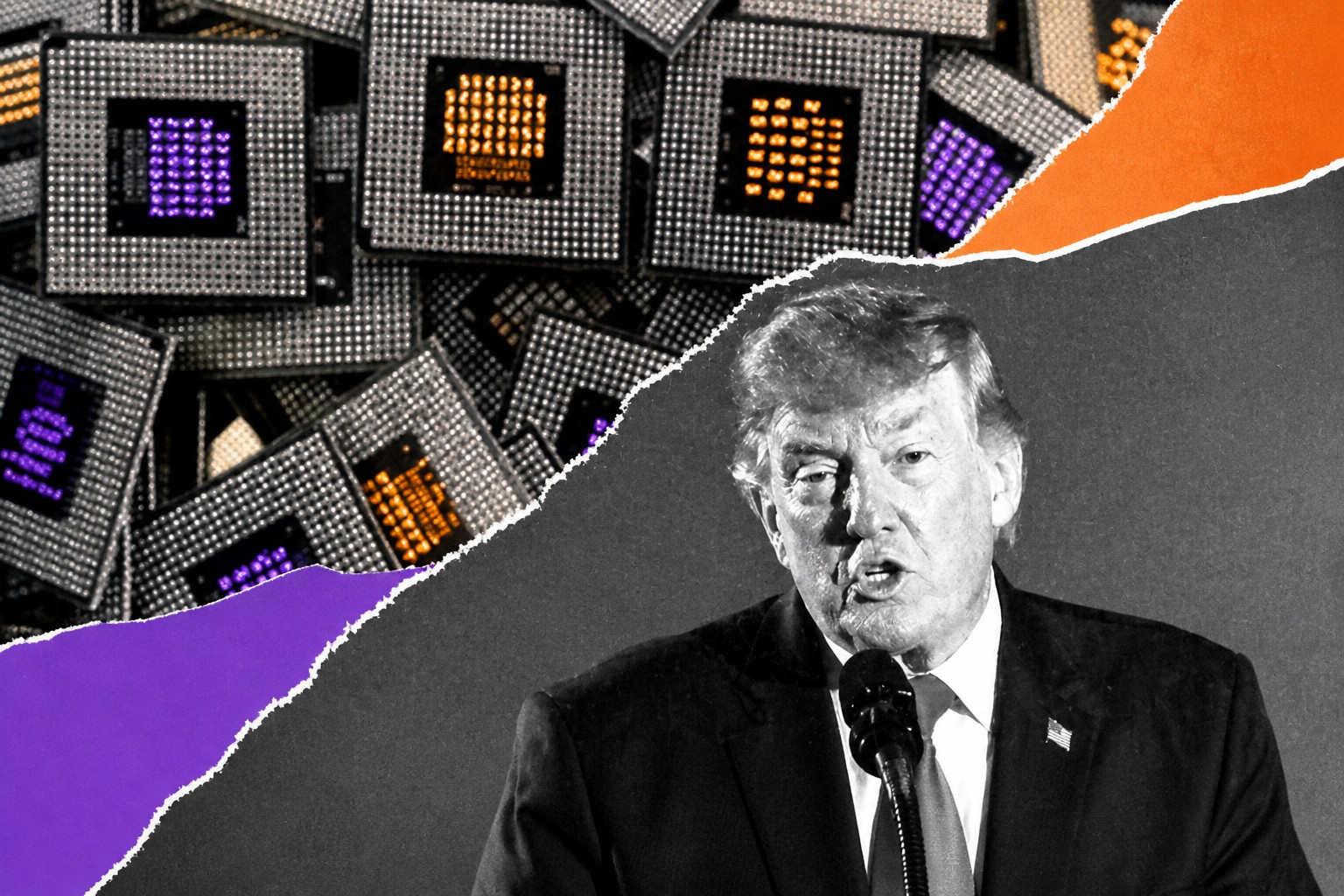
The Donald Trump administration has tightened rules on Chinese companies’ access to Nvidia’s advanced AI chips. Overseas data centers that provide China with large amounts of computing power will now need special licenses; the restrictions also affect chip shipments to five countries, including Singapore and Malaysia. The new measures cover remote rentals of computing power too—a way to use chips outside China without bringing them into the country. The announcement came amid a scandal involving Nvidia co-founder Jensen Huang and his relationship with Alice Huang, who is suspected of having ties to Chinese intelligence.
US restricts China’s access to AI chips and overseas computing rentals
From blocking shipments to controlling use
In 2022, the Joe Biden administration imposed restrictions aimed at denying China advanced chips for training powerful AI models, as well as the equipment used to make them. The US had previously used export controls to keep sensitive technologies away from certain military programs, governments, and companies on blacklists. The new strategy was broader: Washington hoped to use US influence over the global semiconductor industry to hold back China, the world’s second-largest economy, in the race for advanced technology.
The calculation was that training the most powerful AI models requires enormous computing resources, and US company Nvidia holds a leading position in the market for the relevant chips. By restricting China’s access to them, the US hoped to preserve its technological advantage.
But enforcement was assigned to the Bureau of Industry and Security (BIS) at the Department of Commerce, a small agency with inadequate funding. In 2026, its budget was just $235 million, far less than Nvidia’s revenue in a week. The task grew harder as the Biden administration introduced new, increasingly complex restrictions and manufacturers and intermediaries looked for ways around them. One problem was the growing smuggling of AI chips into China.
Smuggling and computing rentals
At BIS, Megaspeed became a prominent example of the problem, though a person familiar with the situation said it was far from the only company—and may not even be the largest one—suspected of involvement in smuggling. According to Bloomberg, Megaspeed imported about 136,000 AI chips into Malaysia and Indonesia in 2024 and 2025. About 50,000 of them could not be located during Nvidia’s initial accounting check. It is not known where those chips ended up; Nvidia later said it had found at least some of them.
Even if all the unaccounted-for chips reached China, they would make up only part of the semiconductors believed to have been smuggled into the country over the past few years. Researchers at the Institute for Progress estimate that by the end of 2026, China could have accumulated smuggled computing capacity equivalent to about 1 million high-performance Nvidia H100 chips.
Chinese companies did not have to bring US chips into the country to use them. They could rent computing capacity at overseas data centers. This practice did not violate export restrictions, and officials and researchers involved in developing the measures knew about it.
Renting can be more expensive and complicated than owning chips, especially when a company needs to train large AI models over an extended period. Some analysts thought that access to US technology abroad would keep Chinese companies dependent on it and discourage China from developing its own solutions. Banning such rentals would be difficult, and restrictions could harm US technology companies.
Washington is now trying to control this route to access as well. In 2022, the goal was to prevent Chinese companies from acquiring certain US chips. Now the US wants to regulate the use of those same chips even when they remain outside China.
The impact and cost of restrictions
There is evidence that export controls have made it substantially harder for Chinese AI companies to obtain computing power comparable to that available to their US competitors. But it is difficult to measure the restrictions’ impact precisely.
The measures also come at a cost to US companies. Researchers at the Federal Reserve Bank of New York studied earlier restrictions and found that affected US suppliers struggled to replace lost sales in China with new customers. In their estimate, the restrictions cut the companies’ combined market value by $130 billion and also hurt their profitability and employment.
At the same time, the restrictions gave China a strong incentive to develop AI without US technology. Huawei, for example, developed a way to combine powerful chips into larger, more capable systems. The Chinese lab DeepSeek showed that more efficient training can help produce competitive models with fewer resources.
The trigger for the new rules was the situation surrounding Jensen Huang, Nvidia’s co-founder, who stepped down as CEO last week after admitting to an affair with Alice Huang. Alice Huang is a Chinese businesswoman suspected of having ties to Chinese intelligence. She previously worked at Singapore-based Megaspeed, which provided remote access to computing capacity and is suspected of smuggling chips. The new rules were not an unexpected idea: similar proposals had been discussed in Washington for a long time. But the timing of the announcement raised questions—the scandal may have prompted the White House to show that the situation was under control.
A White House representative previously told WIRED that the new rule is intended to stop the smuggling of advanced US chips and ensure they go first to American AI developers rather than Chinese shell companies. Newsletter writer Will Knight believes the Trump administration risks moving from controlling chip sales to trying to regulate the use of US technology around the world. Dataist’s take: the main shift in the new measures is the expansion of control over remote access, but the consequences for US suppliers and the difficulty of enforcing the rules remain significant constraints.
Daily AI news
Every day we pick what actually matters in AI and explain it plainly — no hype, no filler. Subscribe if you want to follow where the industry is going.
Only what matters — every day
Follow on X