A safety agreement with four layers
The agreement describes four levels of “control and audit.” Companies would use internal checks and monitoring, while outside auditors or experts would assess whether AI systems behave as intended. Boards could also assign a committee to review reports from teams overseeing AI systems.
The internal measures could include a team tasked with spotting failures and systems to check that AI does not break into technical systems or gain access in areas involving cybersecurity, biological safety and chemical safety.
The agreement is a first response to concerns raised by industry experts in mid-September. Trump, however, has mostly dismissed warnings that AI could harm people, urging companies to keep developing it so the United States can lead globally. At the signing, he also praised the executives for growing their businesses.
The gap between a promise and a rule
The document is an agreement, not a regulation. It leaves open the possibility that its rules could become official standards or laws, even as Trump has repeatedly opposed that approach. On Tuesday, he told reporters outside the White House that companies were ready to police themselves and understood the need for oversight.
The public numbers point to pressure for something more formal: 61% of voters in a recent New York Times and Siena College poll opposed building data centers, while 71% of Americans in an SSRS/CNN poll said the government was doing too little to regulate AI.
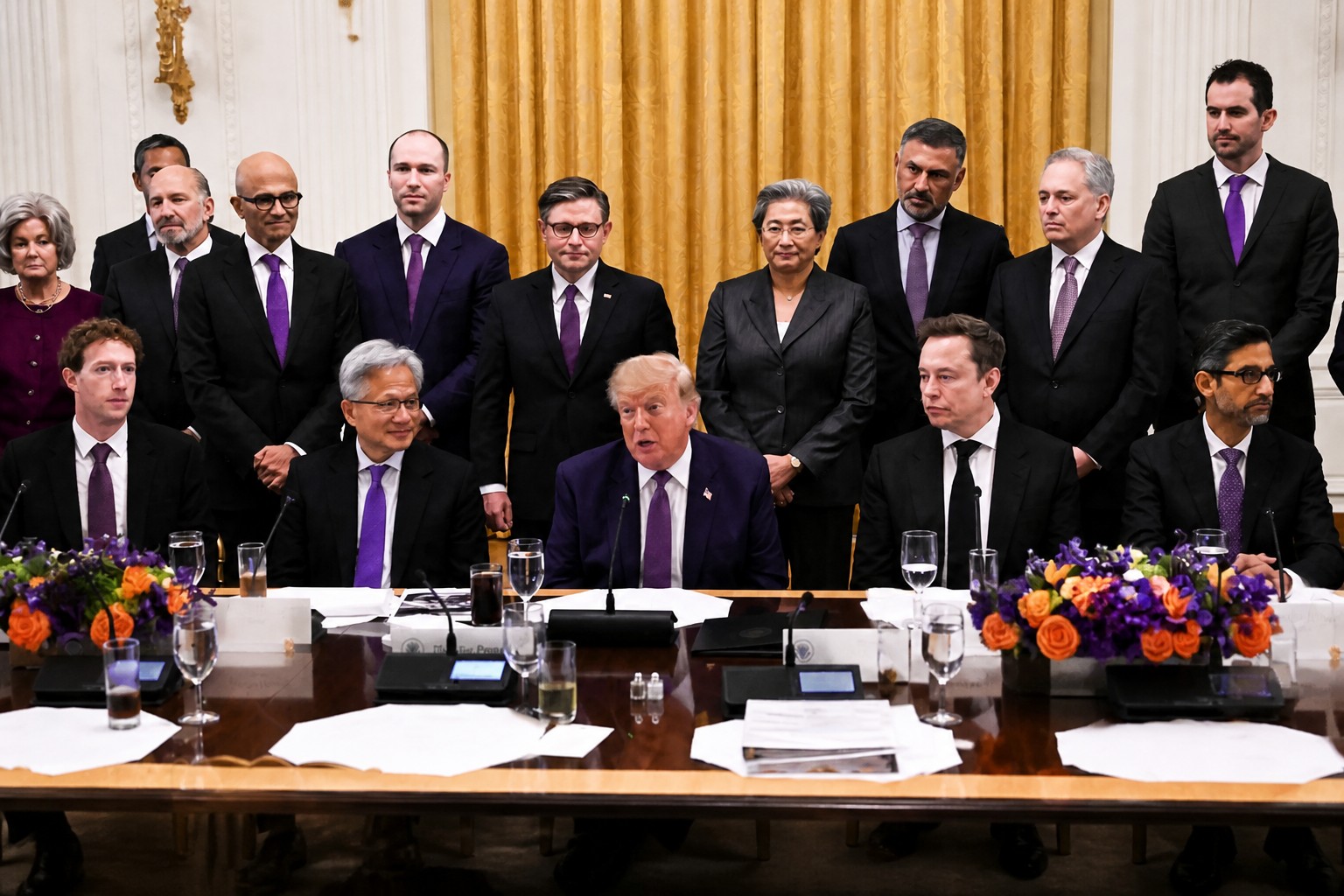
The six signatories were Dario Amodei of Anthropic, Elon Musk of SpaceXAI, Greg Brockman of OpenAI, Jensen Huang of Nvidia, Mark Zuckerberg of Meta and Sundar Pichai of Google.
I think the typo is more than a comic detail: the agreement asks companies to build reliable systems of oversight, while its own path from signature to official record remains unclear. The announcement says little about how those four layers will be tested or what happens if a company’s checks fail. That uncertainty matters more than the misspelling: a voluntary framework can describe oversight, but it cannot by itself show that oversight works.
Daily AI news
Every day we pick what actually matters in AI and explain it plainly — no hype, no filler. Subscribe if you want to follow where the industry is going.
Only what matters — every day
Follow on X