
Thinking Machines unveils Inkling 2 Small with a score of 31 on an AI index
Architecture and results
Inkling 2 Small is a mixture-of-experts model with 594 billion parameters, 17 billion of which are active at any one time. It accepts text and images, and its reasoning depth can be adjusted to trade speed for thoroughness. Inkling models are designed for fine-tuning, which could make them suitable for specialized applications.
According to Thinking Machines, the model scored 31 on the Artificial Analysis Intelligence Index. Its predecessor, Inkling Small, scored 13, while the new version’s result is roughly in line with Google’s Gemini 3.8 Flash.
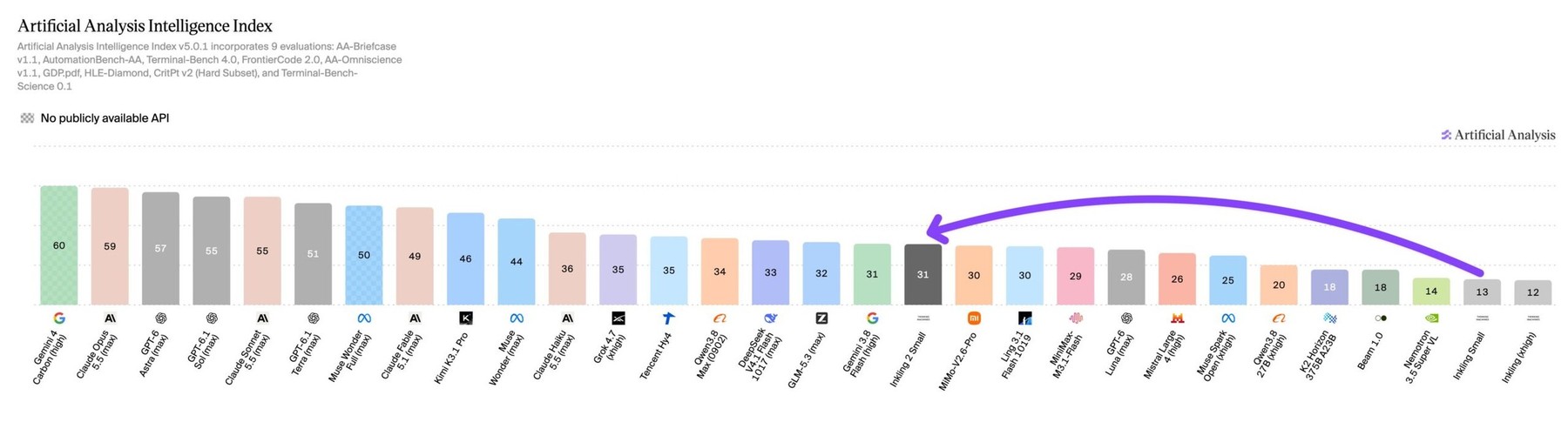
Inkling 2 Small scores 31 on the Artificial Analysis Intelligence Index, an 18-point gain over the predecessor Inkling Small (13) and on par with Gemini 3.8 Flash. | Image: Artificial Analysis
Source: the-decoder.com
The biggest gains came on tasks where the model independently carries out multi-step workflows. Its score on AutomationBench-AA rose from 5 to 46%, and on FrontierCode 2.0 from 5 to 25%. On AA-Briefcase, a benchmark for knowledge-work tasks, the model scored 1527 Elo—615 points above its predecessor. Its hallucination rate fell from 61 to 27%, largely because the model answered less often: its answer rate dropped from 77 to 53%.
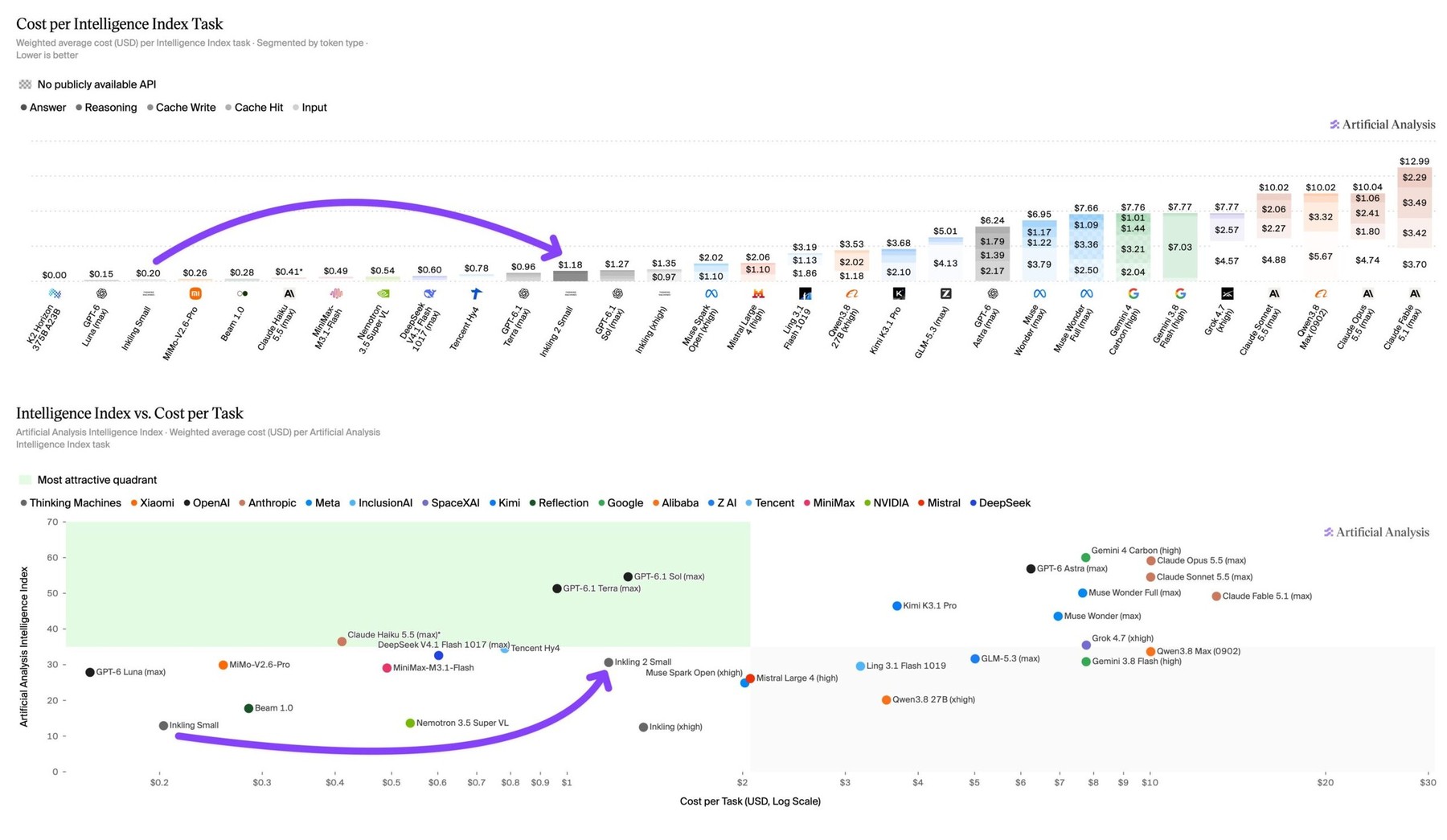
Inkling 2 Small costs $1.18 per task according to Artificial Analysis, far less than Gemini 3.8 Flash or Claude Sonnet 5.5. In the quadrant chart (below) it sits in the sweet spot of low cost and high intelligence. | Image: Artificial Analysis
Source: the-decoder.com
Thinking Machines also reports strong results on coding benchmarks: Inkling 2 Small scored 25.4% on FrontierCode 2.0, 72.1% on DeepSWE, and 86.3% on SWEBench Pro v2 (Hard). The newer Deepseek-V4.1-Flash outperforms it on most of these tests, scoring 28.5% on FrontierCode and 77% on DeepSWE.
Cost and training
The improved results come with higher token use. Inkling 2 Small generates about 150,000 output tokens per task on average—roughly four times as many as its predecessor. Artificial Analysis puts the cost at $1.18 per task, nearly six times that of Inkling Small. That is still less than Gemini 3.8 Flash ($7.77) and Claude Sonnet 5.5 ($10.02), and closer to the price of lower-cost Chinese models.
Thinking Machines trained the model with reinforcement learning on hundreds of thousands of long-running coding tasks. An automated evaluation system checked whether the generated code worked and how the model had solved each task. Across all training stages, the model processed about 12 trillion tokens—considerably fewer than comparable models, according to the company. After pretraining, the reinforcement-learning stage took nine days, during which the model processed 3 trillion tokens on 2048 GPUs.
Vision and visual tasks
Thinking Machines says the model’s strengths include text recognition, infographic interpretation, and visual reasoning. On GDP.pdf, a test of question answering over complex PDF documents, Inkling 2 Small scored 25.2%, more than any of the other models compared. It scored 81.6% on MMMU Pro, which tests multimodal understanding of academic questions involving diagrams and illustrations.
On PerceptionBench, which evaluates visual perception in multimodal models, Inkling 2 Small scored 64.7% and ranked first. DesignArena Website was used to evaluate visual content creation: users compare AI-generated websites in pairs. The model scored 1340 Elo, the best result among open-weight models. Thinking Machines also reports improvements in 3D modeling.
In one unusual demo, the team held a blind wine tasting between the model and its own researchers. Given only a photograph, Inkling 2 Small correctly identified three wines in 19 out of 20 attempts.
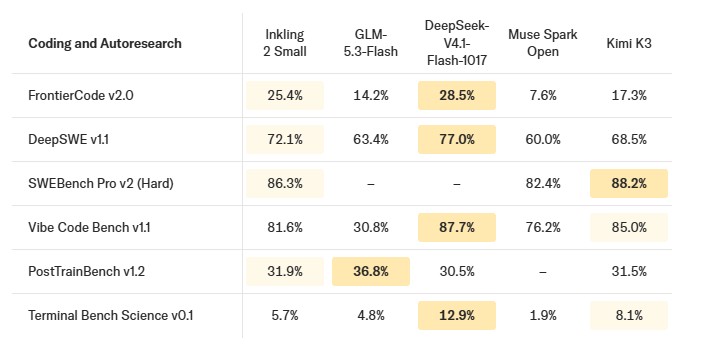
Inkling 2 Small scores 25.4 percent on FrontierCode v2.0 and 72.1 percent on DeepSWE v1.1. DeepSeek V4.1 Flash leads on individual tests; on SWEBench Pro v2 (Hard), Kimi K3 narrowly tops the field. The newer Kimi K3.1 Pro is absent from the comparison. | Image: Thinking Machines
Source: the-decoder.com
Limitations and release plans
Thinking Machines notes that the model sometimes responds inefficiently and does not always choose suitable tools when working with large codebases. It does not support audio and is less suited to dialogue. The model can also overreact to health-related topics and produce overly long answers.
Inkling 2 Small is currently available through the Tinker platform. Thinking Machines plans to publish the weights under the Apache 2.0 license once an external safety review is complete. It is one of the more permissive open-source licenses, with fewer restrictions than the open-weight licenses used by Meta and Mistral. The company says the model is part of a family of different-sized versions and that it intends to release more variants soon.
Dataist’s take: Inkling 2 Small pairs substantial gains on agentic and visual tasks with high costs and limitations in working with codebases and dialogue. Until the weights are published, the model cannot be considered available under the terms announced for the future release: it is currently offered through Tinker, and publication depends on completing the safety review.
Source: the-decoder.com
Daily AI news
Every day we pick what actually matters in AI and explain it plainly — no hype, no filler. Subscribe if you want to follow where the industry is going.
Only what matters — every day
Follow on X