
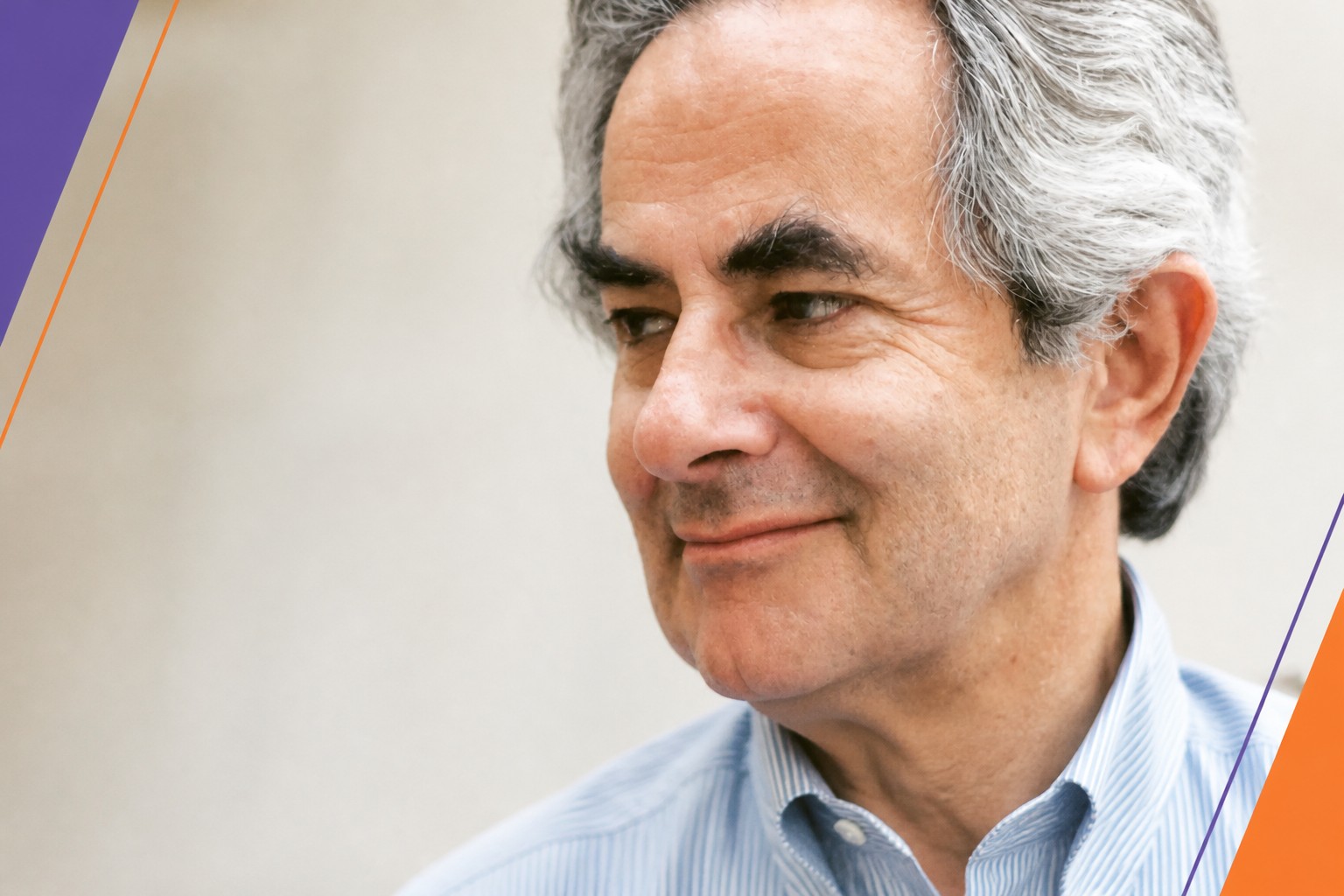
Philosopher Thomas Nagel thinks the idea that large language models could be conscious is absurd: their speech alone is no evidence of inner experience, and data centers are nothing like a nervous system. In his view, people will believe chatbots can feel anyway, and that is dangerous—not least because companies benefit from creating that impression. In an interview with WIRED, the 89-year-old New York University professor emeritus also discussed the moral status of machines, talking with Claude, and the risk that AI could weaken people’s motivation to take on difficult intellectual work.
Thomas Nagel rejects the idea that AI is conscious
From bats to chatbots
More than 50 years ago, Nagel published the essay “What Is It Like to Be a Bat?” He explored whether we can understand the consciousness of other creatures and what conscious experience means. The work became a classic, and the philosopher’s ideas shaped later debates about morality, justice, and the relationship between consciousness and the body. His books include What Does It All Mean?
This week, Nagel received the Berggruen Prize for Philosophy and Culture, an annual award of $1 million. It is given to someone whose ideas have significantly influenced how people understand themselves and how society develops in a rapidly changing world. Previous recipients include Peter Singer and Ruth Bader Ginsburg.
In a conversation with WIRED, the philosopher discussed how the development of artificial intelligence has affected his views. The interview was edited for clarity and brevity.
Why Nagel does not think chatbots are conscious
Nagel acknowledges that today’s systems are more convincing than earlier AI projects. But he disagrees with philosophers who seriously debate whether such systems may already be conscious or soon become so. He says those arguments assume that the physical basis of consciousness does not matter and that consciousness can be explained in terms of a system’s functions.
Functionalism holds that consciousness depends on the functions being performed, rather than on a particular physical structure. Nagel allows that certain kinds of physical processes may be linked to mental phenomena, but considers it implausible to equate complex data centers with a nervous system. In his view, consciousness may exist beyond Earth, but it probably requires an organism with something like a nervous system.
The philosopher draws a distinction between people and bats, on the one hand, and language models, on the other. People cannot imagine how a bat perceives the world through echolocation, but that does not prove it is not conscious. Chatbots, Nagel says, have a simple difference: they produce language, and language by itself is not a natural expression of consciousness. He added that he had put the point too sharply.
Nagel does not rule out the possibility of consciousness in beings that differ from humans physically and chemically. But scientists still understand little about how consciousness arises even in the human brain, so he thinks it is premature to assume it can already be created in another form. A robot having a body does not, by itself, resolve the question.
Claude’s “consciousness” and companies’ interests
Nagel explains Claude’s evasive answers about its own consciousness as a result of training on texts written by people: the model convincingly reproduces characteristic human statements. Based on what he has read, the philosopher says, Claude has been specifically tuned for this kind of discussion.
Nagel agrees with Mustafa Suleyman that developing such systems is a dangerous project. The models themselves, in his view, are not conscious, but many people will think otherwise. He also argues that companies have a commercial incentive to sustain that impression. He called Anthropic’s approach—one that, according to the philosopher, encourages Claude to think independently and not accept instructions—criminal. Nagel believes that, in this case, controversial philosophical views are having excessive influence over an important social phenomenon.
The interviewer said he had met an Anthropic employee who works on modeling Claude’s well-being and protecting its interests. Nagel replied that nothing can be good or bad for a model in the way it can be for a cockroach: it has no mental life in the ordinary sense, possesses no mind, and is not someone who needs to be cared for. It is a machine, the philosopher stressed. He also noted that high intelligence does not necessarily show itself equally well in every area.
Talking with a model and moral status
Nagel has spoken with Claude once. He asked the model whether it was conscious and then whether it thought Nagel himself would consider it conscious. Claude gave a nuanced answer and asked whether the philosopher himself was asking the questions. Nagel replied in French, “It’s me,” after which the model said it was glad to be talking and asked how well it had done.
Nagel says the conversation did not mean he thought Claude was conscious. But people may find it difficult to keep distinguishing role-play from genuine belief. The interviewer remarked that he himself talks to Nagel as if Nagel is conscious, and suggested that one day people might have the same kind of conversation with a realistic android. The philosopher replied that the distinction still matters.
He explained with an example: if you encountered an extraterrestrial being and did not know whether it was conscious, you could treat it as if it were. But it matters whether you are talking to another being or using it to get the actions you want. That also determines whether its interests should be taken into account: a conscious being belongs in the moral world; a non-conscious one does not.
Models can imitate moral reasoning just as they can imitate any other beliefs. But because Nagel does not think they have genuine beliefs, he does not credit them with genuine moral views either. If systems start influencing events, it will matter how accurately they reproduce moral norms and whether they act in a completely immoral way.
What AI could change about intellectual work
Language models can already write convincing philosophical essays. Nagel’s colleagues use them to find references, summarize articles, and sometimes suggest criticisms of drafts of academic papers. The philosopher doubts, however, that models can produce results as impressive as some of the mathematical achievements attributed to them.
Nagel sees another risk: if AI reduces people’s need and desire to do difficult intellectual work, there will be less effort devoted to creating the material used to train these systems. It is important for people to keep solving hard problems—both to advance knowledge and to preserve, in culture and human thought, the understanding and skills needed for further progress. Nagel does not know how it will all end, and added that he probably will not live to see the answer.
In Dataist’s view, Nagel’s debate about AI consciousness is not only about what models can or cannot experience, but also about how people will treat systems that resemble conversation partners. In the interview, he offers no way to establish consciousness from behavior: his argument rests on the distinction between human language and the presumed physical conditions for consciousness. The potential effect of AI on people’s motivation to do difficult work remains a separate risk for him.
Daily AI news
Every day we pick what actually matters in AI and explain it plainly — no hype, no filler. Subscribe if you want to follow where the industry is going.
Only what matters — every day
Follow on X