
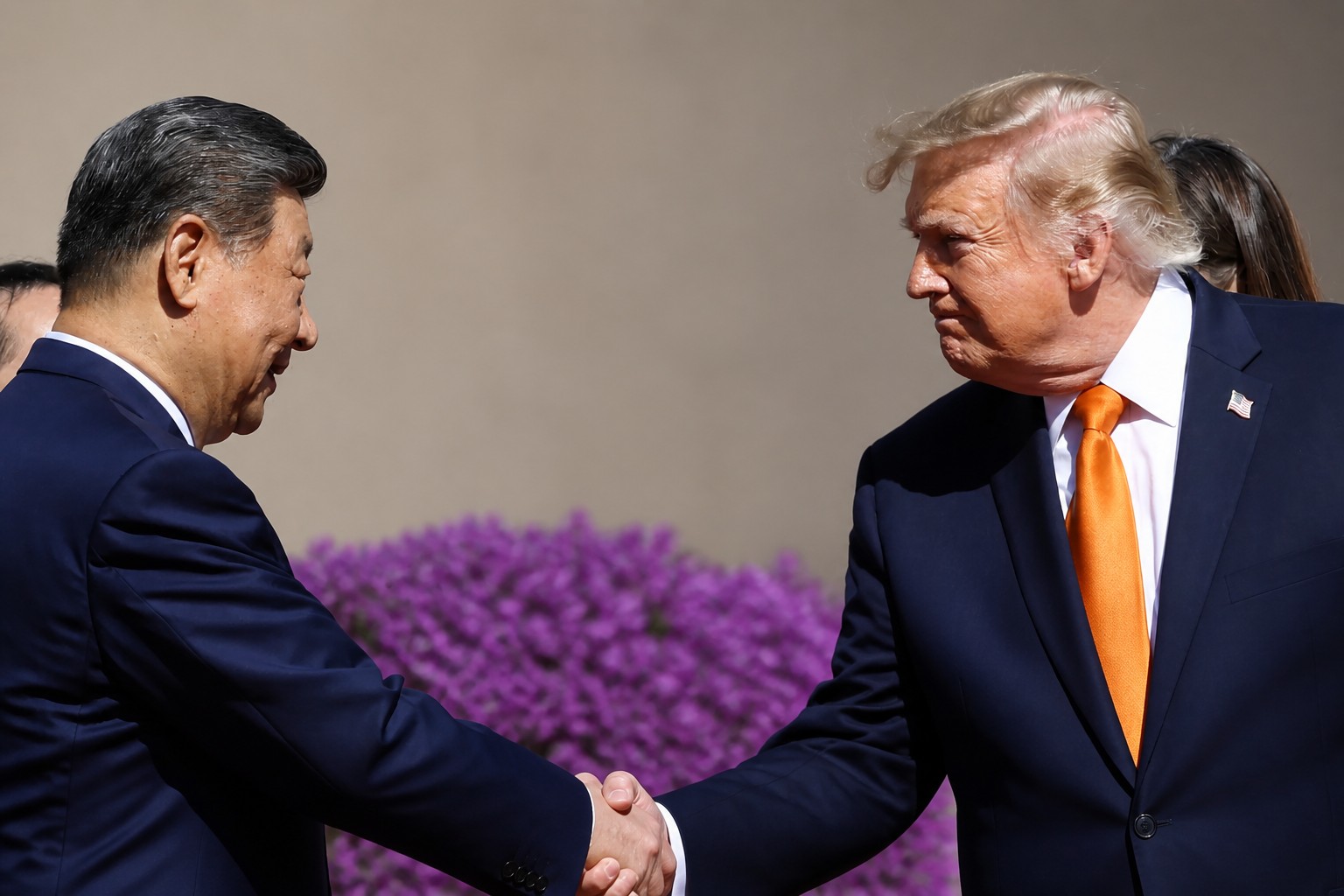
Trump and Chinese President Xi Jinping ended a three-day state visit without announcing meaningful steps to manage artificial intelligence, even as Xi said the two countries share responsibility for developing and governing the technology. The contrast is the point: leaders acknowledged AI’s stakes but left the summit with no announced working group, pause or inspection plan. For a technology race that both governments say must remain under human control, the meeting produced ceremony rather than a mechanism.
A pause that never made the agenda
Ro Khanna, the leading Democrat on the House Select Committee on China, argued that Trump missed a straightforward chance to show leadership. He said the president could have proposed technical working groups and a meeting between DeepSeek, Moonshot and Alibaba on one side, and Anthropic, OpenAI and Gemini on the other, alongside technical experts. Their aim could have been at least a temporary halt to developing AI that can improve itself.
Khanna said he believed Xi would have agreed to form working groups, but Trump showed no interest.
On Thursday, Xi said the United States and China were responsible for developing AI for human benefit, governing it and ensuring that its development remained under human control. China aims to bring next-generation smart devices and AI agents to more than 90% adoption by 2030.
Trump, who has repeatedly said the United States must stay ahead of China, instead focused on renaming artificial intelligence “superintelligence.” He later wrote on social media that Xi seemed to like the term, without explaining what the two leaders had discussed.
The summit’s public moments offered a different kind of comparison. After three days of ceremony, Trump and Xi had tea on Friday. Trump said the meeting had made great progress and that American farmers would be pleased, but gave no details about any agreements. The two then visited the National Archives to view the Declaration of Independence, the Constitution and the Bill of Rights. Trump told reporters they had compared Chinese documents with America’s founding texts, adding that the United States was 250 years old and China 6,000.
A dinner without China’s tech leaders
Trump later hosted a state dinner with a formal evening dress code and invited technology executives. Independent Vermont senator Bernie Sanders posted a photo of Trump and Xi’s table, pairing the guests’ names with estimates of their wealth:
Sanders called it a government of billionaires acting in their own interests. No Chinese technology-company representatives attended. Neither country appeared to take even a symbolic step toward slowing the race.
Khanna said a sweeping treaty like the nuclear arms agreements between Ronald Reagan and Mikhail Gorbachev was not necessary. A working group of Chinese and American technologists could have prepared recommendations and proposed ways to monitor and inspect laboratories.
Jonathan Jin, a research fellow at the Brookings Institution’s China Center in Washington, also said an opportunity had been lost. Technology and relations between the two countries were at a potentially pivotal moment, he said, but instead of a meeting suited to that moment, the result was an absurd spectacle.
Jin pointed to the age and distance from the technology of the two leaders making decisions about its future: one in his 70s, the other in his 80s, and possibly neither having used AI themselves. In his view, the only apparent agreement was that neither wanted to slow its development, regardless of how well they understood it.
My read is that the dinner made the gap harder to miss: the people closest to the technology were in the room, but no process for governing it came out of the summit.
The visit beyond AI
The state visit also drew attention to Trump’s contrasting treatment of democratic allies such as Canada and authoritarian rivals such as China. When Xi arrived at Joint Base Andrews in Maryland, Trump broke protocol to greet him on the red carpet.
Trump also showed Xi around the White House, including the presidential gallery, where Joe Biden is depicted with a mocking allusion to an autopen; the construction site for a ballroom; and a new helipad. Trump said Xi knew about stone and liked quality granite.
The summit was partly overshadowed by Trump’s decision the previous week to bar CNN, MS Now and Politico from the White House, triggering a court dispute. On Thursday, Chinese state journalists were allowed onto the White House grounds while representatives of the free American press were initially kept out, though they were later admitted. As during Trump’s trip to Beijing in May, the leaders held no joint press conference.
Jin said he had expected little from the meeting, but even those low expectations were not met. The summit, he said, seemed to have descended from the attic to the basement, and it was unclear what the United States had gained.
Senate Democrats also criticized the meeting, saying Trump had secured no substantial concessions from Beijing on trade, security, human rights or AI. Minority Leader Chuck Schumer said Trump acts according to who flatters him, where the nearest photo opportunity is and what headline he wants to see. Schumer added that Trump would not only invite a foreign authoritarian leader to the United States, but personally greet him at the plane.
Two more meetings ahead
Trump and Xi are expected to meet twice more before the end of the year. Xi will host the Asia-Pacific Economic Cooperation summit in Shenzhen, China, in November. In December, the G20 summit will take place at Trump National Doral Miami in Florida.
Those meetings leave room for a technical process the leaders did not create here. But with no working group or inspection proposal announced, the immediate tension is plain: both governments have described AI as something they must keep under human control, while neither has signaled a willingness to slow its development.
Daily AI news
Every day we pick what actually matters in AI and explain it plainly — no hype, no filler. Subscribe if you want to follow where the industry is going.
Only what matters — every day
Follow on X