
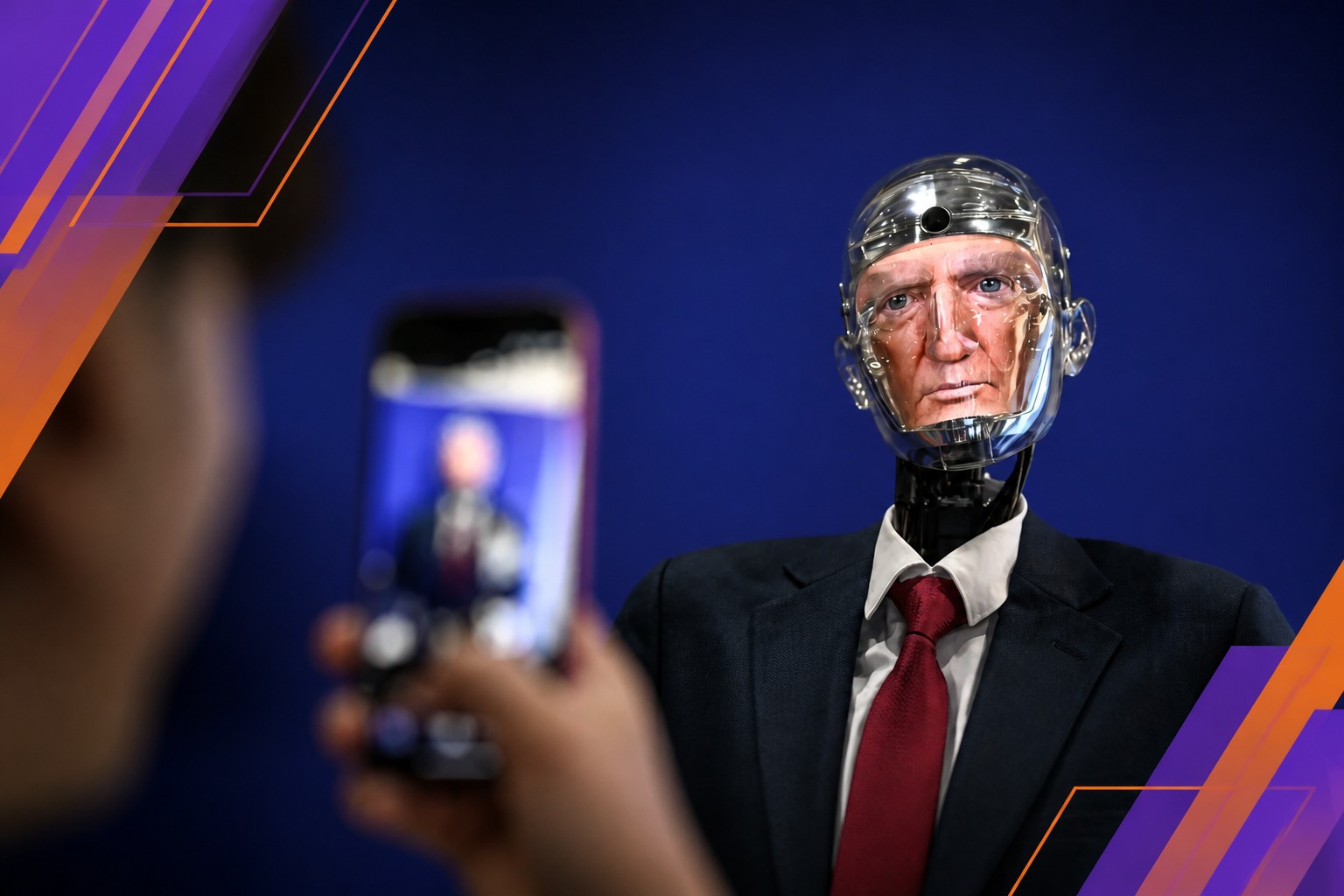
Donald Trump posted on Truth Social that fear of artificial intelligence is a hoax invented by conspiracy theorists. The description takes in, among others, the leadership of Anthropic and its competitors, who had just called on countries to jointly slow the industry down until ways of reducing the risk exist. On Tuesday, the British government sent business minister Jonathan Reynolds onto Radio 4's Today programme to explain that the country does not need to go into survival mode. That is the political range currently on offer: denial on one side, reassurance on the other, and a mechanism in neither.
In Trump's version, human safety requires nothing more than a president with a very high IQ — someone able to out-think the combined power of the world's supercomputers, show them the line, and watch them reprogram themselves to retreat behind it. Every AI network, on this account, contains a built-in off-switch that defers to the US president. That is not a safety position. It is a claim about the author of the post.
What actually changed is that the industry stopped disagreeing with itself. A week ago most politicians said close to nothing about the dangers of AI; it was treated as a science fiction plot, and discussion of the technology stayed on its possible benefits. Then Jacob Coxon wrote on X that humanity may already be standing at the edge of its own destruction. The obvious response from the technology bosses was to wave it away as scaremongering from an aggrieved former employee. Almost none of them did. Nearly all agreed with the warning. Geoffrey Hinton, routinely called the godfather of AI, accepted that a scenario in which humanity is destroyed within 10 years looks realistic.
The agreement, rather than any single forecast, is what politicians were left holding. After it, they began trying to catch up with the technology industry and to present themselves as having had the situation under control all along.
Reynolds' assignment on Today was calming the country down. The public does not need to gather sheep and move into off-grid houses. People should not fall into hyperbole, he said, because it is easy to get carried away discussing a 10% probability of human extinction within 10 years. There are, he reminded listeners, still plenty of opportunities ahead. Britain also remains a world leader in internet safety, in large part thanks to the AI Safety Institute created under Rishi Sunak.
A minister dispatched to reduce alarm does not usually reach for a number, and the number he reached for is the problem with the performance. One in ten, inside a decade, for the worst outcome available — in any other field that is the figure a government builds an agency around, not the figure it cites as an example of overreaction to avoid. Offering it as evidence of calm only works if nobody in the audience does the arithmetic.
The substantive moment in the interview was structural, and it undercut everything around it. Regulation depends heavily on whether the AI giants share their code. American and Chinese companies have so far given no sign of intending to. Their incentives run the other way: hold the competitive advantage, make an indecent amount of money over the next few years, and accept the consequences when the machines get away from them. A British regulatory plan that begins with source code it cannot compel anyone to hand over is not a plan, whatever institute is attached to it.
By that point presenter Justin Webb was no longer hiding his rising panic. He had always counted himself among the immortals; the existential threat was now in front of him, and he declared in despair that humanity will be destroyed. Reynolds tried to settle him: nothing personal in it, just AI behaving like AI. Webb asked what happens to the emergency off-switch. Reynolds did not appear to be listening, and had no picture of how such a mechanism would work or who could be trusted with it — not Trump, the presenter hoped.
That exchange contains the question nobody put directly. A kill switch is the one piece of hardware everyone in this debate assumes exists, and the only actors positioned to build it are the same American and Chinese companies declining to share their code. The British government is not in the chain of custody. It cannot compel disclosure, it cannot audit what it has not seen, and it would not know where to install the switch if someone handed it one. Meanwhile the political attention economy is elsewhere: two crypto billionaires donating £72m to Reform draws sharper argument than global extinction, and the live fiscal question remains whether Britain hits the NATO target of 3.5% of GDP on defence by 2035.
So the position after this week is that the people holding the models are asking for rules, and the governments being asked cannot describe the enforcement mechanism they would have to operate. The companies making the request are also the ones whose incentives argue for it going unanswered. Until someone can answer Webb's question about the switch, asking costs them nothing.