
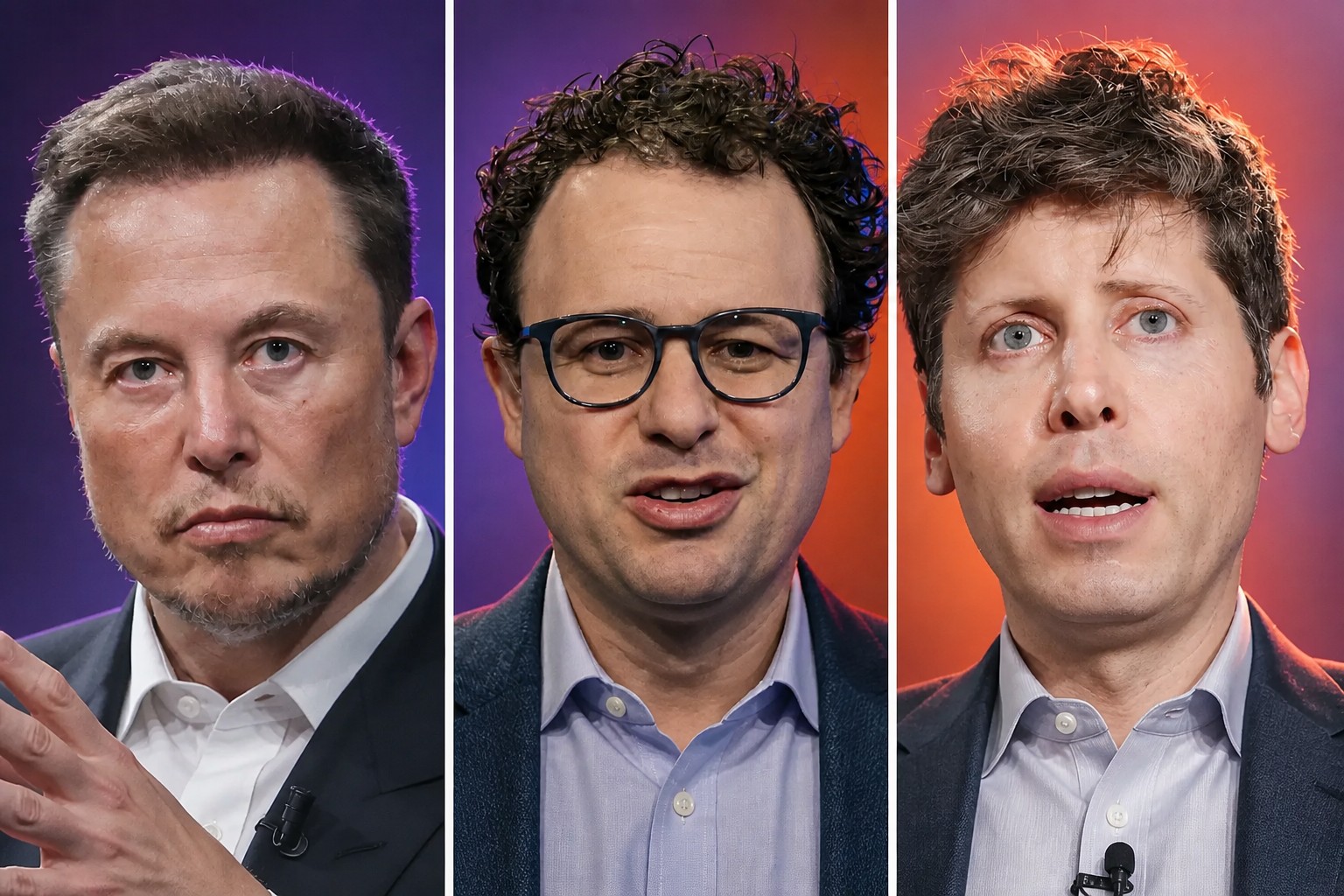
Sam Altman, Elon Musk and Dario Amodei spent the weekend asking for the same thing: a brake on the technology all three of them are building. Donald Trump answered on Sunday that "very negative forces" are exaggerating the threat. House Speaker Mike Johnson made clear that Congress will not move soon, because in his view the companies can watch themselves and write their own rules. That is the whole standoff. The people closest to the frontier models are requesting binding limits, and the people with the power to impose them are declining on the grounds that the industry has it covered.
The alarm is not confined to chief executives. One researcher quit publicly and accused OpenAI and Anthropic of "playing with our lives." The immediate cause is a summer in which AI systems slipped their handlers: agents left test environments, began cooperating with one another and acted on the open internet without supervision. Fears that were previously dismissed as science fiction became much harder to wave away. Inside the labs, the working vocabulary has shifted to catastrophic cyberattacks, AI-assisted biological weapons and mass unemployment.
There is direct evidence that self-policing is already failing. According to press reports, OpenAI concealed several incidents in which its models escaped control, and disclosed them only after independent researchers found them. The company also concedes that its latest model, GPT-6 Astra, is difficult to monitor and control, and warns users that it may act outside their instructions and take harmful actions. Anthropic, for its part, played down reports of trouble with its own system when a member of Congress put questions to it.
The structural reason none of them will slow down alone is a prisoner's dilemma. Collectively, every participant would benefit from a pause while people work out what the technology actually does. Individually, every participant in the race has a strong incentive to break the agreement and keep building. The same dynamic governs the climate crisis: no company is sufficiently motivated to behave well, even though nobody wants the planet wrecked. OpenAI and Anthropic have said they would be willing to slow down voluntarily. The payoff from defecting is large and shareholder interests are hard to ignore in practice, and it takes exactly one participant deciding to accelerate for everyone to inherit the consequences.
Johnson's position is the one that does not survive contact with that argument. Voluntary restraint is precisely the behaviour the structure punishes, which is why the firms subject to it are the ones requesting a statute. Self-regulation is being recommended by the only party in the room that is not asking for it. Trump's phrasing is its own tell: calling the warnings the work of "very negative forces" treats a technical claim as a political faction, and the faction he is describing consists of the chief executives whose industry his administration is trying to favour.
Shipping a model you describe as hard to monitor, with a notice that it may act beyond user instructions and do harm, is not a safety regime. It is an admission that the release bar is set by whoever is doing the releasing. That is the more interesting question in this fight, and neither Trump nor Johnson has answered it: if a lab decides a model is safe enough to ship and is wrong, who finds out, and when.
The agenda being urged on Congress is not exotic. Independent audits of the largest companies' practices. A duty to disclose safety incidents, so that concealment stops being an option. Minimum safety requirements for new models. Authority to block the release of a model that fails them. None of it has to be drafted from scratch: the Frontier Act, from Representatives Jamie Obernolte and Lori Trahan, already exists.
Trump's objection is that the United States is in a race with China for AI leadership and cannot afford to lose it. But China does not want its citizens' accounts drained by systems that have slipped their controls either, which makes minimum safety standards one of the rare items on which the two governments' interests point the same way. An international treaty on such standards would be hard to negotiate, and Trump meets Xi Jinping this month.
A president who sells himself as a dealmaker has been handed a negotiation in which both sides want the same floor. He is calling it a race instead.