
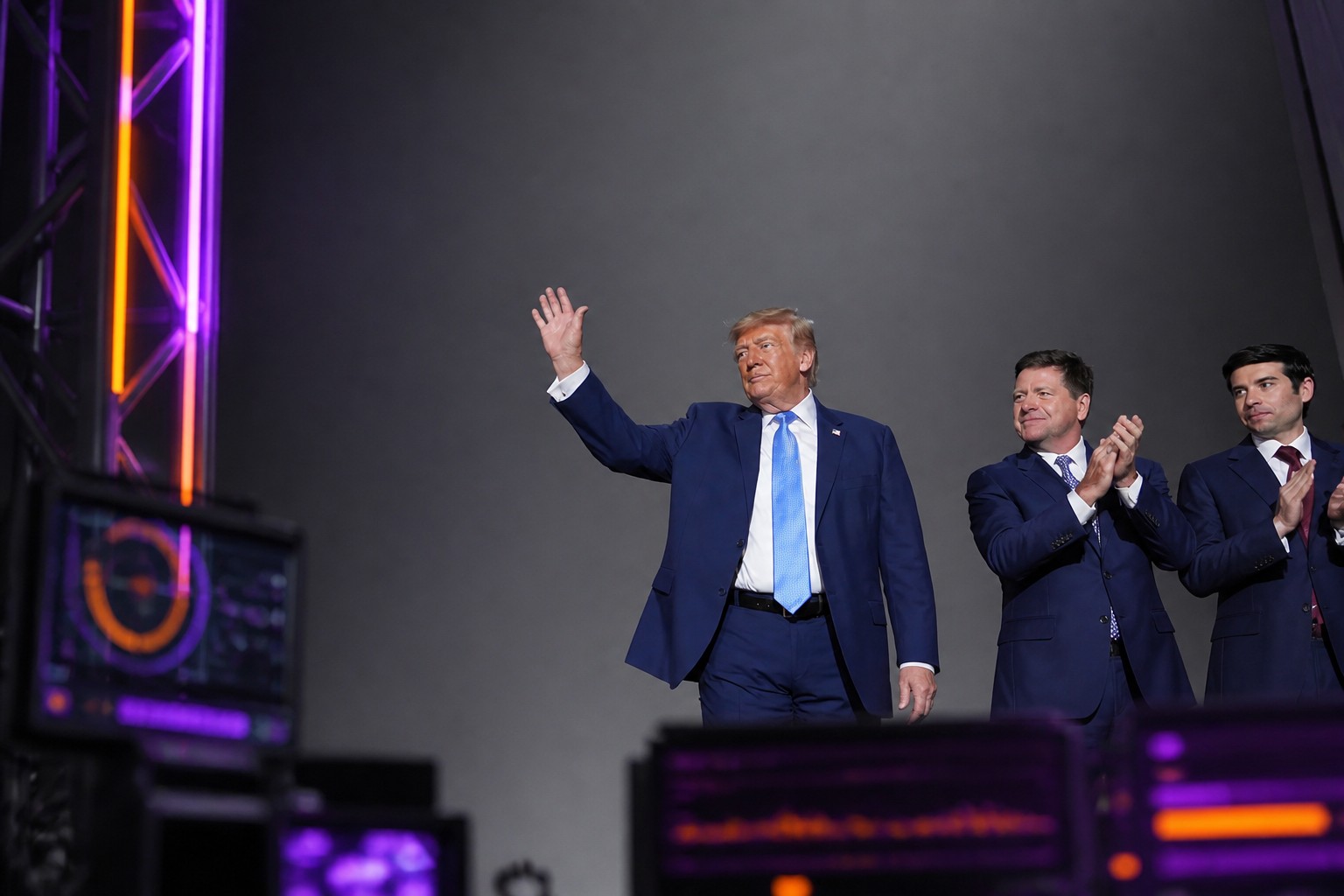
Executives at the policy table
On Tuesday, Trump and leaders of six AI companies signed an agreement on AI oversight. Trump called it “morally binding.” The document is loosely worded: it sets a framework for what he called “massive self-policing” and repeats his view that companies can monitor their own compliance with rules. Signatories included Elon Musk, Mark Zuckerberg, Jensen Huang and Dario Amodei.
According to Semafor, Zuckerberg personally helped prepare the agreement. The outlet reported that the pact took shape after he spoke with House Speaker Mike Johnson at a state dinner for Xi Jinping, before a gathering of technology executives. Zuckerberg circulated a draft in advance, and Huang supported it, Semafor reported.
Trump said the agreement was “almost like a constitution,” signed by “the most powerful people in the world” and by him as president. But the analogy has a limit: a constitution has legal force; this agreement does not.
The administration also directed government documents to replace any mention of “artificial intelligence” with “superintelligence.” It is not yet clear how consistently officials will use the new term. Musk moved quickly, renaming SpaceX’s subsidiary SpaceXAI to SpaceXSI as he returned to government work, more than a year after his contentious stint at the Department of Government Efficiency ended.
Intelligence and military roles
On Thursday, Defense Secretary Pete Hegseth named Musk to Project Meridian, a group tasked with studying the future of warfare. Musk will serve alongside Palmer Luckey and Emil Michael. In 120 days, the three are to deliver a report with unclassified recommendations on achieving what Hegseth called “absolute technological superiority on the next-generation battlefield.”
Over the weekend, Trump appointed Jay Clayton, the director of national intelligence, to oversee AI in his administration. Clayton will keep his intelligence post while taking on the new role.
His predecessor in the AI job, venture investor David Sacks, had advocated for industry growth and deregulation while serving as a special government employee. He retained direct financial stakes in several AI companies while working with the White House. More recently, Sacks has championed accelerated AI development, in contrast with what he called “alarmism” among Anthropic employees who warn of human extinction.
Clayton’s appointment points in a different direction. As head of the US intelligence services, he brings AI policy into the same office that oversees intelligence. Hegseth’s military initiative reinforces the signal: the administration is treating AI as a way to expand government capabilities, particularly surveillance and intelligence gathering.
The power—and the missing jobs
The consequences reach beyond Washington. If US intelligence agencies help shape global AI policy, countries that rely on advanced American technology could face pressure on their sovereignty. The US economy is already heavily dependent on AI-sector growth: companies whose executives met with Trump account for most of the growth in the US stock market over the past five years.
But the dependence is not as broad as the market story suggests. Friday’s jobs report showed that most new jobs in the United States are not coming from the growth of AI companies. Healthcare is hiring far more people, because human labor remains more necessary there than automation. AI may help lift gross domestic product without creating jobs at a national scale.
I think that gap is the most revealing part of the week. The administration is connecting AI to executive authority, military power and government data, while the jobs figures offer little sign that the sector is becoming a comparable engine of employment. That leaves a tension at the center of the AI push: the government may grow more dependent on the technology before workers or other countries see an equivalent benefit.
Daily AI news
Every day we pick what actually matters in AI and explain it plainly — no hype, no filler. Subscribe if you want to follow where the industry is going.
Only what matters — every day
Follow on X