
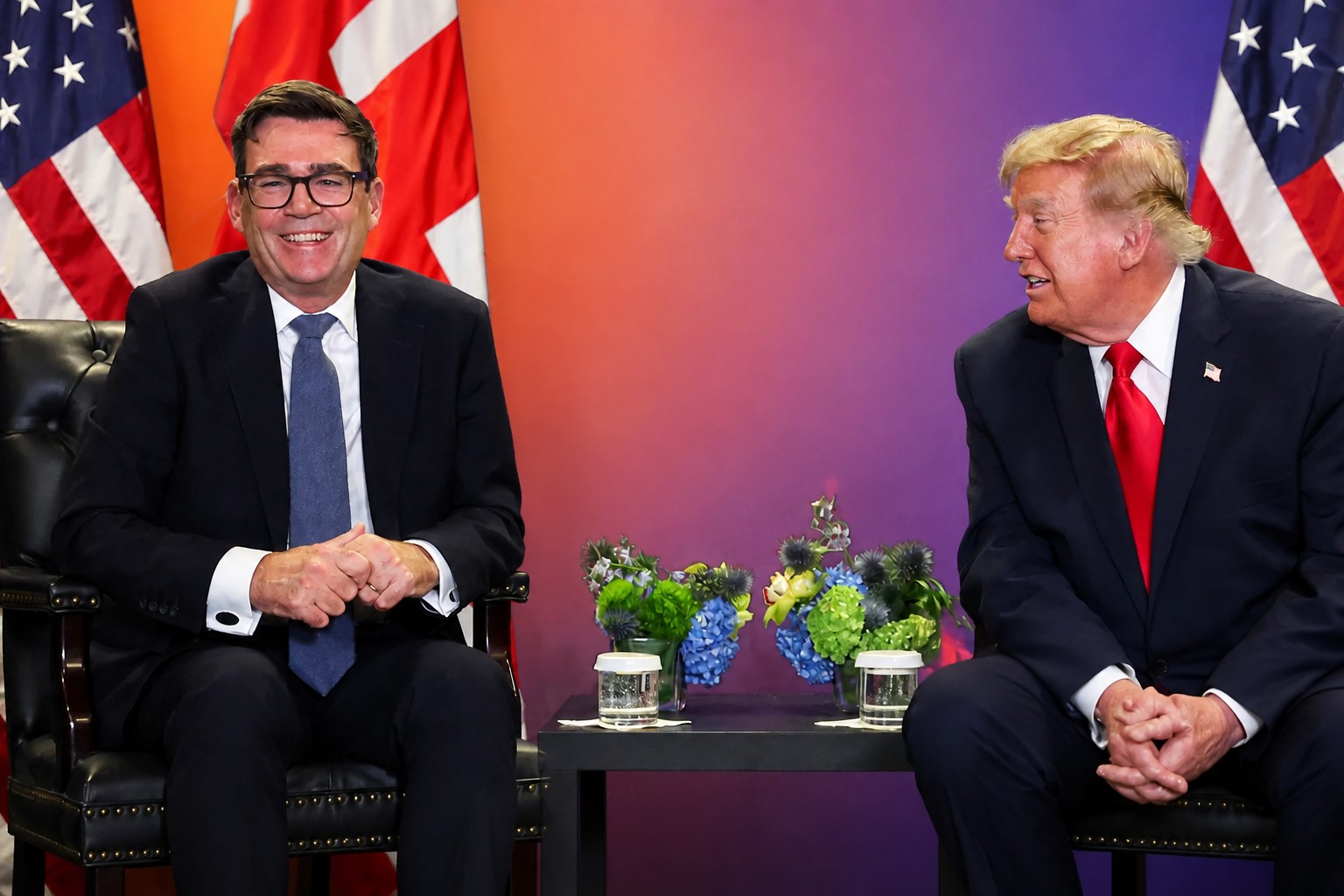
A friendly meeting with difficult business
Burnham arrived in the United States under pressure to ask Trump to reduce tensions with Iran. The conflict in the Middle East has pushed up global energy prices and added to pressure on the UK economy.
Foreign Secretary Ed Miliband and National Security Adviser Jonathan Powell joined Burnham at the talks. Burnham said he and Trump had developed a good connection from the beginning of their relationship. British officials were visibly nervous beforehand: Trump had previously called Burnham extremely liberal and described him as the former mayor of Greater Manchester.
The meeting appears to have gone well enough for both sides. Trump said the US-UK relationship was better than it had been under the previous British prime minister, linking that improvement to his relationship with Burnham. He also said the two countries worked well together.
That warmth did not remove the disputes waiting behind it.
Iran sets the limit
Iran dominated the broader summit. Trump repeated his threat to “destroy” Iran and said he would send the country to hell if its leadership did not retreat and sign a peace agreement with the United States.
Asked whether he sympathised with allies facing a higher cost of living because of his actions, Trump said prices would fall sharply as soon as the war ended. He had previously suggested that Iran might reach an agreement after the US midterm elections in November. This time, he said people understood the need to prevent Tehran from obtaining nuclear weapons, even if that meant more expensive petrol and goods in shops.
For Burnham, the immediate problem is political as well as economic: he was asking Trump to lower the temperature while Trump was publicly defending escalation as the route to a deal.
AI is the sharper disagreement
Burnham was expected to use his address to the UN General Assembly to call for stronger international oversight of AI. At a meeting with business representatives, he said he wanted a single set of global principles and standards to protect against dangerous uses of the technology. The issue is expected to be one of the main priorities of the UK’s G20 presidency next year.
The British initiative faces opposition from Washington and pressure from another direction:
Trump said Americans had never backed away from new frontiers or difficult challenges. He said he would not restrain the growth of a technology that could surpass the Industrial Revolution.
The disagreement is not about the value of AI. It is about who gets to decide what counts as acceptable risk before a model reaches the public. Burnham’s proposed global principles and the Finland-Norway initiative both assume that safety checks should come before release. Trump’s position puts development first and rejects a shared control system.
My guess is that this tension will be harder to manage than the personal chemistry between the two leaders. The announcement is quiet about the practical bridge between a global standard and an American refusal to join one: who would write the rules, who would enforce them, and what happens when a company ignores them.
The disputes that cordiality could not hide
The Chagos Islands created another direct clash. Britain has agreed to transfer sovereignty over the islands to Mauritius while London pays rent for the military base on Diego Garcia.
Trump called the agreement terrible and said he did not support it. He argued that Mauritius had suddenly declared itself the owner of a territory over which it had not claimed rights for decades and centuries. Still, he suggested Burnham might reconsider the deal, pointing to the islands’ strategic importance. Burnham nodded and agreed that he would examine the issue.
Trump declined to comment on Britain’s decision to ban trade with settlements in the West Bank, leaving that question to Burnham. He did agree, at the British prime minister’s request, to raise the case of detained Hong Kong activist Jimmy Lai with Chinese President Xi Jinping on Thursday. British officials at the meeting suggested that Lai could live in Britain.
The pair also differed over Ukraine and Russia. Trump said peace would come faster than many people thought. After meeting Ukrainian President Volodymyr Zelenskyy, he warned that Starmer’s rhetoric toward Moscow had been too tough and that London should be more cautious.
That makes Trump’s comparison with the previous British prime minister politically pointed. He praised Burnham personally while pressing him to soften positions on issues where Britain’s policy is already under scrutiny.
Two competing readings of the world
Many of Trump’s arguments contradicted the address by UN Secretary-General António Guterres. Guterres described the consequences of international conflicts, the climate crisis and the rapid development of AI over the past decade.
He said geopolitical divisions had deepened, inequality had grown and trust had been damaged. The climate crisis, he said, had moved from a distant warning to an everyday reality. AI was advancing so quickly that even its creators had been caught off guard by its pace.
Without naming Israel directly, Guterres said the October 2023 Hamas attack was followed by an offensive against Palestinians in the Gaza Strip. The scale of killing and destruction, he said, had no precedent during his time in office.
The meeting therefore produced a useful contrast: a personal relationship that looked stronger than expected, alongside disagreements over the rules of technology, the use of force and the boundaries of national sovereignty. The cordiality may help Burnham keep talking to Trump, but it cannot make those positions look compatible.
Daily AI news
Every day we pick what actually matters in AI and explain it plainly — no hype, no filler. Subscribe if you want to follow where the industry is going.
Only what matters — every day
Follow on X