
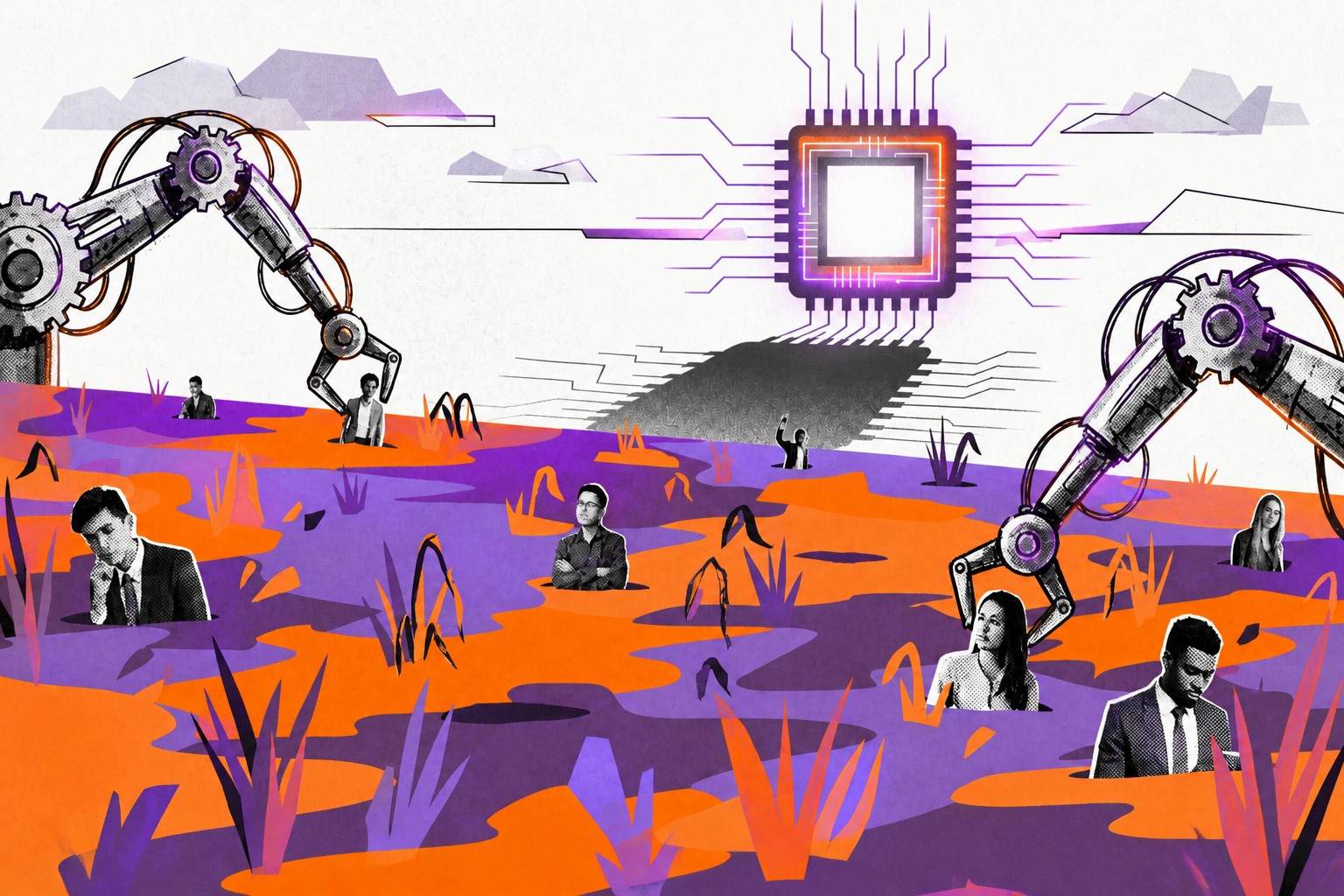
UBS has made AI skills a mandatory condition of being hired, putting it among the first large banks to write the requirement into the door. The bank says those skills complement academic and social ability rather than replace it. The timing is what makes the move worth reading closely: the work banks are automating fastest is financial analysis, research and the preparation of client presentations — which is, almost item for item, the work junior hires used to be handed so they would learn the job.
Santander is moving in the same direction. Internal documents show the Spanish bank looking for advanced AI users for some of its intern training programs. Neither bank is unusual in what it is automating. What is new is the position of the requirement in the funnel: AI fluency has stopped being something a graduate scheme teaches and started being something it screens for.
The number behind all of this comes from Morgan Stanley analysts, who expect more than 200,000 banking jobs to disappear in Europe over the next five years. Spread across a continent and five years, that is not a cliff edge. But it will not be spread evenly. The roles being automated first are the entry-level ones, which means the contraction falls hardest on people who have not been hired yet and therefore have no one inside the bank arguing for them.
The tension inside this was named from within the industry in December, when Conor Hillery, head of JPMorgan's European business, warned that entry-level staff must not lose basic professional skills. He was describing the mechanism, not just the risk. Analysts acquired judgement by building the model themselves, badly, several hundred times. Take the building away and the judgement has to come from somewhere else, and nobody has said where.
My reading is that UBS has answered a training problem with a recruitment policy, which is cheaper and faster but addresses a different question. Requiring AI skills at hire tells you a candidate can operate the tools that are eating the apprenticeship. It tells you nothing about whether they will ever develop the instinct to notice that a model's output is wrong — the instinct the apprenticeship existed to produce. UBS's own qualifier, that AI skills complement rather than replace academic and social ability, reads as an acknowledgement of exactly this gap, phrased so as not to have to solve it.
Notably absent from the announcement is any definition of what an AI skill is or how the bank intends to test for it. Prompting is not a durable credential; it is a set of habits that changes with each model release. A hiring bar built on it will either be a formality within two years or will have to be rewritten annually.
Running underneath, UBS is testing analyst avatars for client presentations. That detail sits oddly next to the hiring policy: the bank is raising the AI bar for the people it recruits to do analyst work while piloting a synthetic version of the analyst in front of the client. Both cannot be the long-run plan. The hiring requirement assumes a junior workforce worth screening carefully; the avatar assumes a junior workforce that does not need to be in the room.