

Britain's planned data centres will directly support around 10,400 jobs, roughly a quarter of the more than 40,000 promised by the industry lobby TechUK, according to an analysis by the environmental think tank Verdant. The figure for sites already built is starker: fewer than 4,400 direct jobs, or about 8.6 jobs per megawatt of power, against the 43.7 per megawatt implied by TechUK's forecasts. The gap matters because the Labour government has repeated TechUK's employment numbers while classifying AI data centres as critical national infrastructure to accelerate their approval, against rising public scepticism about their water and electricity demands.
Verdant examined 20 projects for which staffing information exists, drawing on planning applications, corporate filings and press releases, plus international comparisons. It counted only the permanent staff needed to maintain and run the facilities. Temporary construction jobs, which are far more numerous while a site is going up, were excluded.
The projection for future sites is the sharper number. Data centres now in planning are considerably larger than those already operating, and larger sites are not proportionally more labour-intensive — so on Verdant's estimate they may support as little as 1.6 permanent jobs per megawatt. Scale, in this industry, works against employment rather than for it.
To show how much power these facilities consume per worker, Verdant compared them with other large sites. Against roughly 8.6 jobs per megawatt at current data centres, it puts a car factory at about 400 and a hospital or similar medical facility at more than 3,600.
James Meadway, the think tank's co-director, said the country is being pushed into supporting a rapid build-out on weak economic grounds. AI and related technologies do have substantial potential, he argued, but large data centres impose visible costs on local communities and climate plans, and the case for them should be made by government and industry rather than assembled after the concrete has set.
The government rejected the comparison and disputed the method. A spokesperson said jobs per megawatt is a misleading metric and that setting data centres against hospitals and schools is not a valid comparison, and suggested the think tank may have confused electrical capacity with actual consumption. The same spokesperson said the calculations undervalue the broader economic worth of computing capacity, along with the national security and technological sovereignty arguments for building critical digital infrastructure in Britain.
Verdant replied that it had used the electrical capacity the technology companies themselves declare, and that even if a finished data centre never draws all of it, the allocated capacity can still crowd out alternative projects.
TechUK, for its part, said its estimate that the UK data centre industry already supports 43,500 jobs, and its forecast of 40,000 more by 2035, rest on a published methodology, industry data and standard economic impact techniques. Its spokesperson said the numbers were built transparently on the best industry data available when the estimate was prepared, and that they remain a reasonable assessment of the sector's contribution to employment.
Read those two positions carefully and the argument partly dissolves. Verdant counted permanent staff who work inside the buildings. TechUK's 43,500 is jobs "supported", which in standard economic impact work includes supply chain and induced employment several steps removed from the site. Those are different quantities, and a factor of ten between a direct headcount and a supported-jobs total is not by itself evidence that anyone is lying. What is telling is that neither side says so. TechUK has no incentive to explain that most of its number is indirect, and Verdant has no incentive to concede that direct headcount was never the whole claim. The genuinely damaging figure in the report is the one that is like-for-like against TechUK's own model: 8.6 jobs per megawatt actually observed versus 43.7 assumed.
The government's rebuttal is more revealing than the numbers. It spends one clause on methodology and then moves to compute's broader economic value, national security and sovereignty. That is the argument ministers actually trust. The jobs case was always the retail version, the thing you say at a constituency meeting, and it is the first thing to be dropped when someone counts.
The sovereignty case is at least being made openly. Labour declared AI data centres critical national infrastructure to speed up planning consent, and Andy Burnham confirmed his own backing for the sector by appointing AI minister Kanishka Narayan to his cabinet. Narayan advocates rapid expansion of the data centre estate, national sovereignty included. Last month he told the Times that the British public wants strong defence and independent capability rather than dependence on foreign billionaires who own infrastructure vital to people's lives, and that this is unachievable without large-scale domestic computing capacity built in the country.
The Green Party in England has demanded a moratorium on data centre construction, and protests are under way in Scotland, where campaigners say large projects are being rushed through. Green leader Zack Polanski said the government wants to suppress local resistance so private companies can build, without explaining what the benefit will be. He also noted that England and Wales are still facing drought after the hottest summer on record while data centres are set to be given priority access to water, and that the new research points to far fewer jobs from building and running the facilities than the government promises.
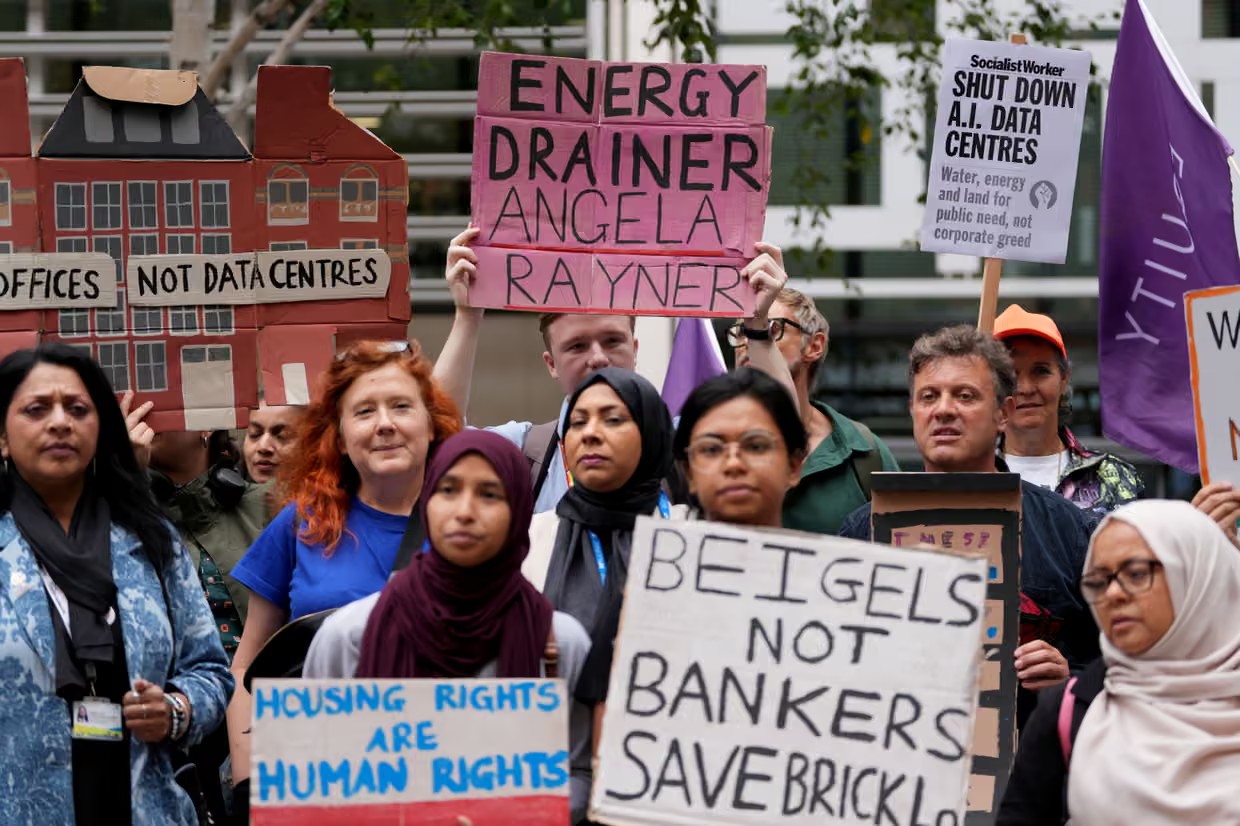
Protesters oppose plans to redevelop the 10-acre Truman Brewery site on Brick Lane, which include building a data centre
Source: theguardian.com
A government spokesperson answered the call for a pause by saying it would simply send investment and good jobs overseas, leaving Britain dependent on foreign computing capacity to process sensitive medical and defence data.
That answer contains the trade the government has not yet put to voters plainly. If the reason to build is sovereignty, then a site drawing hundreds of megawatts and priority water in a drought year is worth it whether it employs 40 people or 4,000 — and the employment figure should never have been the headline. If the reason is jobs, Verdant's 1.6 per megawatt for the largest planned sites makes these the least labour-intensive pieces of industrial infrastructure Britain has consented to in a generation. Ministers have been arguing both, and the two arguments require different things from the people living next to the substations.