
British mobile networks rank 57th in the world for network performance, behind every one of the 27 EU member states and every other G7 country, according to a report from the consumer group Which? built on Opensignal data. The country's largest mobile operator says that gap is a problem now, before AI traffic arrives, and that closing it does not require government money. What it requires is planning permission, which is the part of the argument worth examining.
The rest of the ranking is no better. The UK places 70th globally for download speed and 55th for connection reliability — the measure that governs video calls, streaming and gaming, which is to say most of what people actually do on a phone.
57th for network performance 70th for download speed 55th for connection reliability
This sits oddly beside the fixed-line picture. Britain has shed its old reputation as one of Europe's laggards on slow broadband: BT Openreach and other operators are laying full-fibre across the country. Mobile 5G is moving noticeably slower, and the divergence between the two is the actual story here.
Andrea Dona, network director at VodafoneThree, the UK's largest mobile operator, put the warning plainly: if the networks already perform sub-optimally with today's technologies and services, mass adoption of AI will load them further. He said the quality of connectivity today embarrasses him, and that the country needs reform to get the level of service EE, O2 and VodafoneThree are capable of offering.
His illustration of what a capacity shortfall feels like is the one every British phone owner has lived through — losing signal in a crowd at a Wembley stadium concert, the British Grand Prix at Silverstone, an international at Twickenham. Today those failures are caused by a one-off concentration of people. In a world of AI, he argues, the same condition could become permanent, with users needing additional network capacity for new services and devices.
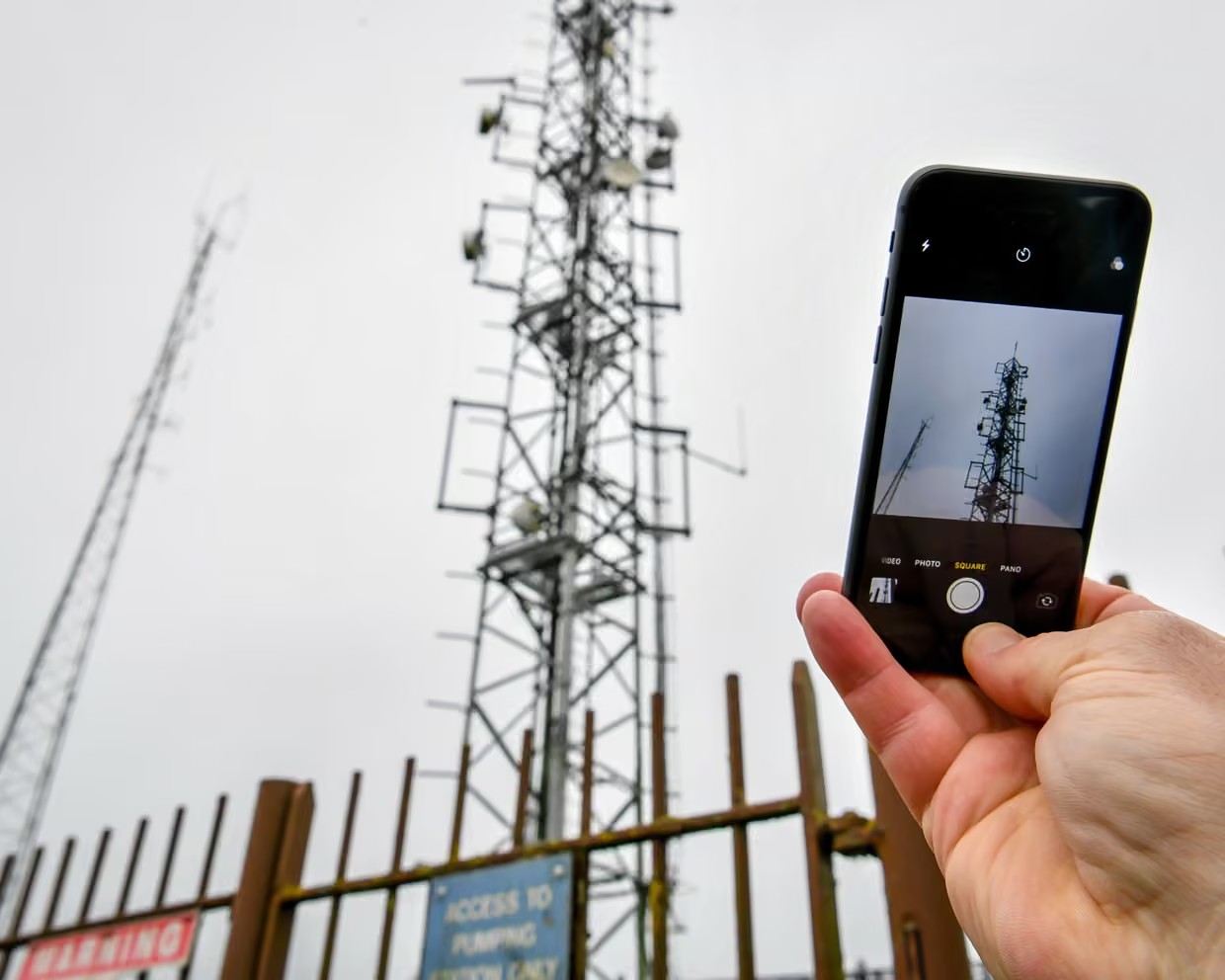
The UK's major mobile operators are investing heavily in standalone 5G technology, including upgrading masts. They say planning rules delay even simple upgrades
Source: theguardian.com
The operators' ask is specific. VodafoneThree is putting £11 billion into mast upgrades, but says the work is held up, in part by planning rules. Dona was explicit that the company does not need to build more sites — it intends to shrink its national mast network by 30%. The obstacle is restrictive rules that complicate even a simple upgrade to a site that already exists. About 96% of the upgrades VodafoneThree needs fall on existing sites, and more than half of those require some form of planning permission, a process operators describe as slow and bureaucratic.
Dona tied that to the growth agenda Andy Burnham is pushing, arguing that telecoms infrastructure can help the government and the British economy, that changing the rules would be the cheapest available way to support growth because it requires no public spending, and that it would make a plausible first-100-days achievement for a new prime minister.
There is a second complaint underneath the first. Mobile networks have been designated critical national infrastructure, alongside data centres and energy and water systems. They have not been given the reliefs the government extended to those sectors — on business rates and energy costs among others.
Here is what I think is going on. The engineering case for upgrading existing masts rather than building new ones is sound, and a 30% reduction in sites while carrying more traffic is a real efficiency, not a rhetorical one. But it is also a cost reduction, and it is being sold with a growth-agenda label attached. The company asking for permitted-development relief is the company that stands to spend less because of it. That does not make the argument wrong; it does mean the AI framing should be read as the lever, not the reason.
And the AI part of the case is thin on its own terms. Another telecoms executive described the link between AI and networks as a topic still in its infancy, though one he expects to become a question of national competitiveness in the way slow full-fibre rollout did. He put the inflection point two or three years out, after the next generation of devices arrives with AI built into everything, and noted that AI companies and governments rarely think about networks yet — they will start, he said, when infrastructure limits get in the way. That is an honest account of a forecast rather than a measurement.
Which is the question nobody in this conversation is asking: how much traffic does AI actually add? Not one figure has been offered for it. The case rests on a device generation that does not yet exist, delivering services nobody has specified, at volumes nobody has estimated. Everything concrete in the operators' pitch — the ranking, the £11 billion, the 96%, the planning delays, the missing rate reliefs — is about the networks Britain has today, under the load it already carries.
That is the tension the government will have to resolve. The operators have been handed the critical-infrastructure label without the reliefs that came with it for data centres, energy and water, and they have found in AI the argument most likely to pry the two apart.