
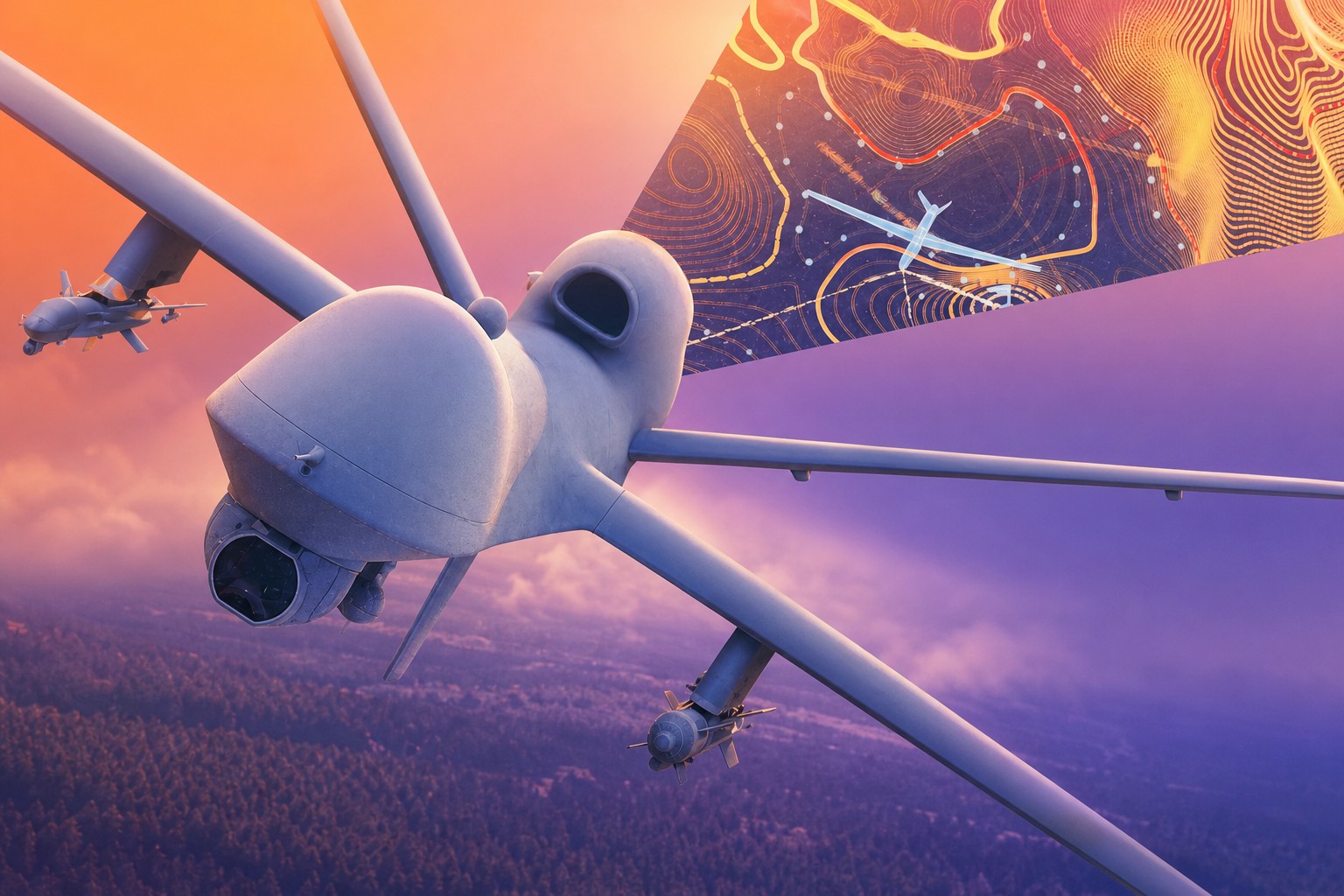
In January, Ukraine's defence ministry said it would hand military contractors and commercial firms millions of data points gathered across tens of thousands of drone flights. More than 100 companies and the British government have since been given access. The American company Enabled Intelligence, which prepares data for AI training, says it has opened more than half a million hours of Ukrainian drone video for the next generation of models, and points to both military and commercial uses. A country fighting for its survival is now setting the terms of a new market in machine combat experience, and no regulator anywhere has jurisdiction over what happens to that data once a model absorbs it.
Every flight produces thousands of data points: stills, video, operator commands and other records. Taken together they show how a machine and a human responded to circumstances that kept changing. Match the sensor record against what the operator did and operational data becomes a training set. That is the whole conversion, and it is not technically hard.
What makes combat footage expensive is the part of it that nobody can stage. The most useful training data comes from the abnormal cases: visibility gone, signal jammed, the operator improvising. Companies spend years and enormous sums assembling enough of those episodes to make a model robust. War generates them at a rate controlled testing cannot approach.
That is also why this material is worth more than its battlefield application suggests. A delivery or inspection drone will never meet artillery fire, but it will have to act on incomplete information around people behaving unpredictably. The war compresses the same problem into a far shorter span. The transfer is already happening: drones trained to operate under jamming over Ukraine are being used in agriculture, helping farmers map and survey fields in areas with no cellular coverage that earlier generations of equipment depended on.
None of this is the first time a battlefield has fed a model. American drones over Syria and Yemen produced the records that helped build the first generation of semi-autonomous military hardware in the late 2010s, and sensor-heavy platforms like the Predator and Reaper have been feeding military intelligence programmes for close to a decade, Project Maven among them. What was never open was the distribution. Those records moved through closed classified channels and produced weapons that went back into the same military system that generated the data. The loop was sealed.
Ukraine has cut it open. The same commercial technology that was adapted for war is now producing data that flows back into the industries it came from, and into the data infrastructure that public and private organisations build on. For a state at war this is a fast route to funding and partners, and the front line becomes a live training environment that AI companies could not reproduce on their own.
The risks are not hypothetical. Unwanted buyers are the obvious one, partly mitigated by purchase restrictions, with intelligence officers vetting a prospective customer's infrastructure to judge whether the records could reach adversaries or other dangerous parties. Harder is provenance. A commercial dataset can be traced when it carries seeded contact details that surface two steps past the original buyer. Training data loses its origin entirely, because the origin ends up embedded in the technology itself.
Then there is consent, which is the part of this that no market mechanism touches. Soldiers and civilians who appear in the footage did not agree to become instructional material for products that may sell years later. Sensor data, camera records and the coordinates of civilians running from a drone strike are now being used to teach future machines how to decide. The people in those records, whether targets, operators or bystanders, become training material, and the assumptions and errors baked into the data travel with the model into delivery vehicles and farm equipment.
Corey Alpert, a University of Melbourne researcher who studies AI's effect on democracy and previously worked in Joe Biden's White House, argues that the result is an extraction economy: wealthy countries far from danger profiting from the lethal risk borne by states on the front line, with a built-in incentive for the market to treat wars as endless sources of digital gold. Existing law governs how militaries may fight. It says almost nothing about records stripped of operational context, converted into data and licensed to companies whose products then spread far beyond where the data was made. The liability of the firms building those systems is undefined.
Alpert's prescription is to treat defence data as a controlled arms transfer until a regulator with jurisdiction exists: record provenance, license users, restrict onward transfer, and require disclosure when a model trained on military material is later folded into a civilian product. Ukraine has started on the first part. Its Avengers Labs programme lets companies train on battlefield data without direct access to the sensitive databases, and access controls appear in the recently signed UK-Ukraine agreement on AI. No government is actively regulating what happens after the model reaches the civilian market.
The extraction argument is the strongest moral claim in the case and the weakest empirical one. Nobody has shown a buyer lobbying to prolong a war, and the incentive story does not need to be true for the market to be a problem. The nearer risk is more mundane and better evidenced: the rules of a global market in battlefield data are being written by a ministry at war, at the moment of its least leverage, and every state that follows will cite those terms as precedent.
The more interesting question is what the announcement is quiet about. Only two recipients have been named in public: Enabled Intelligence and the British government. The other hundred-odd companies are a number, not a list. Neither is there a price. A programme described as a way to attract funding has never disclosed what the data sells for, which makes it impossible to say whether Ukraine is being paid the value of an asset that AI companies could not build for any amount of money, or the value of a distressed seller's inventory.
And the data outlives the reason it exists. The controls Ukraine is building are wartime instruments, run by a wartime ministry, over material whose commercial worth does not fall when the shooting stops. Half a million hours of video will still be training models in a decade, in products sold to buyers who have never heard of the flights that produced it. The question is no longer only what technology companies can sell into a war. It is what they can take out of one.