
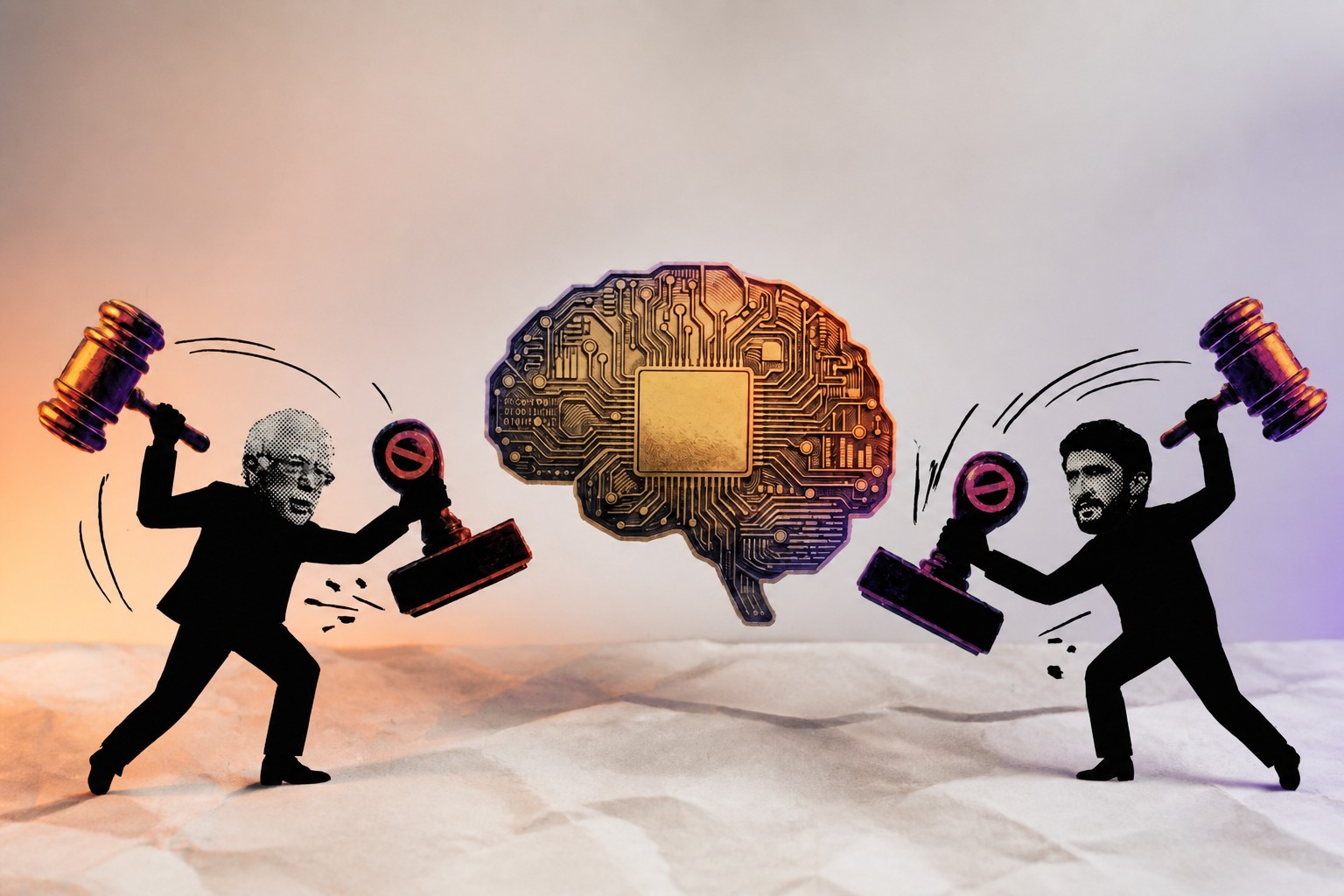
What the bill would do
The proposal combines a domestic ban with an attempt to stop superintelligence development internationally. It calls for agreements that would prevent the technology from being developed anywhere in the world, following similar regulatory approaches recently proposed by specialists in the US and China.
The penalties would be unusually severe:
The bill would also establish a federal AI agency with cabinet-level status. That would give the government a permanent institutional base for enforcing the ban, rather than leaving oversight to existing departments.
The argument behind it
Sanders says companies are investing hundreds of billions of dollars in AI despite risks that are already known. In his view, AI represents an existential threat to humanity, and a small group of technology billionaires should not be allowed to set the rules for the industry themselves.
Casar’s warning is even more direct: artificial superintelligence could lead to the deaths of an enormous number of people. The political contrast is sharp. The bill’s supporters want a permanent prohibition, while Trump, according to Casar, wants development accelerated.
I think the proposal’s defining feature is not the agency but the choice to treat superintelligence as a prohibited capability, closer to illegal weapons development than to a regulated product category. That makes the measure more sweeping than a debate over model safety standards or corporate accountability.
The enforcement gap
The document is quiet about the threshold that would trigger the ban. The source describes systems capable of hacking, creating viruses and developing other AI systems, but it does not specify how authorities would decide that a model has become “superintelligent.” Without that boundary, the agency would have to enforce a prohibition against a capability whose legal definition remains unclear.
My guess is that this ambiguity is not a minor drafting problem. It is the central tension in the proposal: the more serious the perceived risk, the more aggressively the law would need to act, but the broader the definition, the more AI development could fall under a ban designed for a hypothetical endpoint.
Daily AI news
Every day we pick what actually matters in AI and explain it plainly — no hype, no filler. Subscribe if you want to follow where the industry is going.
Only what matters — every day
Follow on X