
The first working project of the Genesis Mission, the national AI-for-science initiative the White House launched at the end of 2025 and handed to the Department of Energy, runs on two open models released by Meta. The project, SYNAPS-I, is led by Lawrence Berkeley National Laboratory and joins five national labs — Berkeley, Argonne, Brookhaven, Oak Ridge and SLAC — around a single unglamorous problem: X-ray and neutron experiments now generate data faster than anyone can label it. Its pipeline is built on Segment Anything Model 3 and DINOv3, fine-tuned on beamline images and deployed inside government infrastructure. A labeling job that took a specialist a month per time step now takes about 15 minutes.
The bottleneck is a detector problem that became an analysis problem. Berkeley's Advanced Light Source, a facility the size of a football field, produces extremely bright X-ray beams used to study materials and plants at atomic and molecular scale. After a detector upgrade raised both resolution and speed, the image stream stopped being something humans could work through. Ten years ago a detector captured one frame every six seconds. Current hardware can take 100,000 images per second. Across the Department of Energy's light and neutron sources, output now runs to tens of petabytes a year — millions of gigabytes, roughly equivalent to 2 million hours of high-definition video.
Volume is only half of it. There are few specialists in any given scientific domain and they are already overloaded. Modern in-situ experiments require watching dynamic processes — a chemical reaction, a material failing — and interpreting them while they happen. No human team processes that by hand.
Most of the work reduces to segmentation: finding individual structures in an image and drawing their boundaries precisely. Computer vision uses the same operation to separate a tumour from healthy tissue in a medical scan, or pedestrians from road for a self-driving car. In research it turns a raw grayscale X-ray frame into a map of named objects — cell walls, mineral grains, semiconductor layers — that can then be measured and compared across experiments. Doing it manually can take a specialist weeks for a single dataset.
Source: ai.meta.com
The two Meta models split the job. DINOv3 is a self-supervised vision model: it finds visual patterns in raw images without human annotation and works out which structures are present and where. SAM then draws the exact boundaries around individual objects — the same work as a scientist tracing structures by hand, done in seconds. SAM handles pixel-level edges, DINOv3 supplies the context of what the structure is and where it sits inside the sample.
The SYNAPS-I team fine-tuned both on scientific images collected at Department of Energy beamlines, then ran them on 300 A100 accelerators at national computing centres including NERSC. A scientist standing at the instrument gets back a fully reconstructed three-dimensional volume with semantic labels in roughly 15 minutes — before the experiment has finished. That is the stated goal of the project: collapse the delay from months to something fast enough to steer the experiment while it is still running.
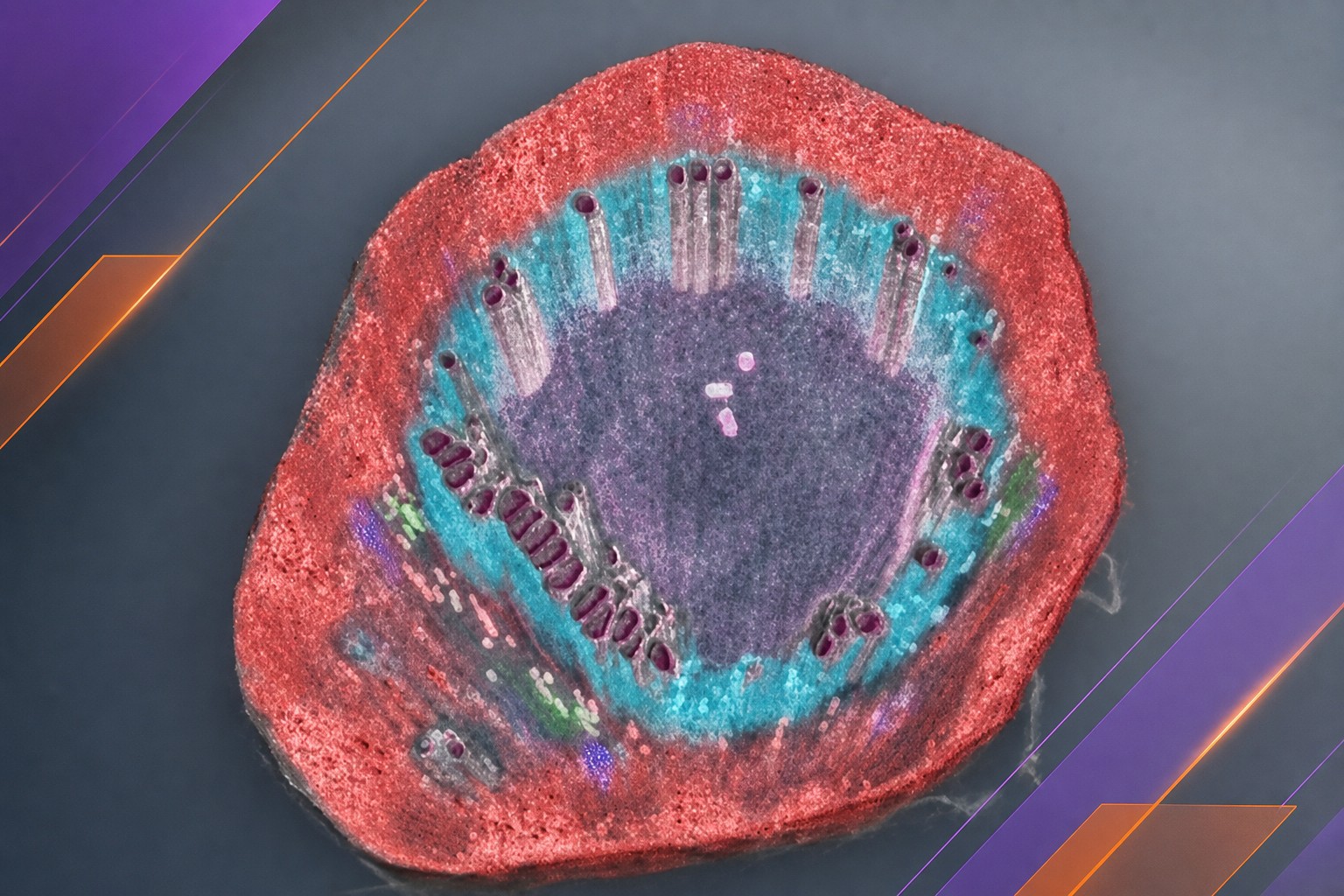
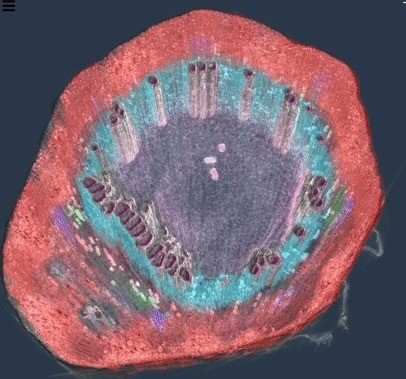
The team tested the pipeline on an agricultural question, studying how grapevines respond to drought at the cellular level. Micro-computed tomography at the Advanced Light Source reconstructs three-dimensional volumes of the stems, and the models automatically locate the xylem vessels — the microscopic tubes that move water through the plant. Tracking how those vessels change as drought deepens produces the data behind drought-resistant crops and sustainable agriculture work. The annotation that previously consumed a month of specialist time per time step now takes about 15 minutes, which means a dynamic biological process can be studied at the speed the data arrives.
The choice of open models is not ideological, and this is the part of the story worth reading closely. National laboratories keep pre-publication research data and AI models on government infrastructure rather than external cloud services; while the work is unfinished it has to run on secured platforms. Meta's license lets the SYNAPS-I team download, fine-tune and deploy SAM and DINO inside that environment themselves, and adapt models originally trained on ordinary photographs to scientific domains they were never built for.
That is the strongest argument for open weights anyone has made this year, and it did not come from a vendor. It came from a customer who could not use the alternative at any price. No amount of frontier-model capability solves a problem defined by custody: if the data cannot leave the building, neither can the inference. Meta shipped weights that a national lab could take behind its own firewall, and for this class of work that beat every API on the market by default.
The other number worth staring at is 300 A100s. Those are two generations old, and 300 of them is a rounding error next to the clusters that get announced with press events. This was never a compute problem. It was a plumbing problem — thousands of hours of expert tracing standing between a beamline and a result — and it got solved with retired hardware and models somebody published for free. The Genesis Mission's first visible win cost almost nothing in the terms the AI industry usually measures itself by.
What the account is quiet about is durability. Meta receives no money from this and gains no leverage over it; the arrangement exists entirely because one company's licensing choice happened to align with one agency's security requirements. SYNAPS-I now involves 60 researchers across five labs and is meant to extend, as the Genesis Mission grows from individual projects into full programs, across more priority areas of national science. The team is already describing intelligent research facilities in which AI not only processes data but proposes hypotheses, recommends the next experiment, and carries findings from one beamline to another. At the recent Trillion Parameter Consortium meeting, Deputy Secretary of Energy Dario Gil said SYNAPS-I unites AI, high-performance computing and experimental systems, analysing data as it arrives and helping steer experiments in real time, replacing slow manual operations with adaptive automated ones. In his assessment the approach compresses the time to scientific discovery from days to moments and creates a continuously improving model of how research is done.
All of that is built on a license the United States government does not control and cannot renew. The Department of Energy has made an open-weight release from a private company load-bearing for national scientific infrastructure, and nothing in the arrangement obliges the next version to arrive on the same terms.