
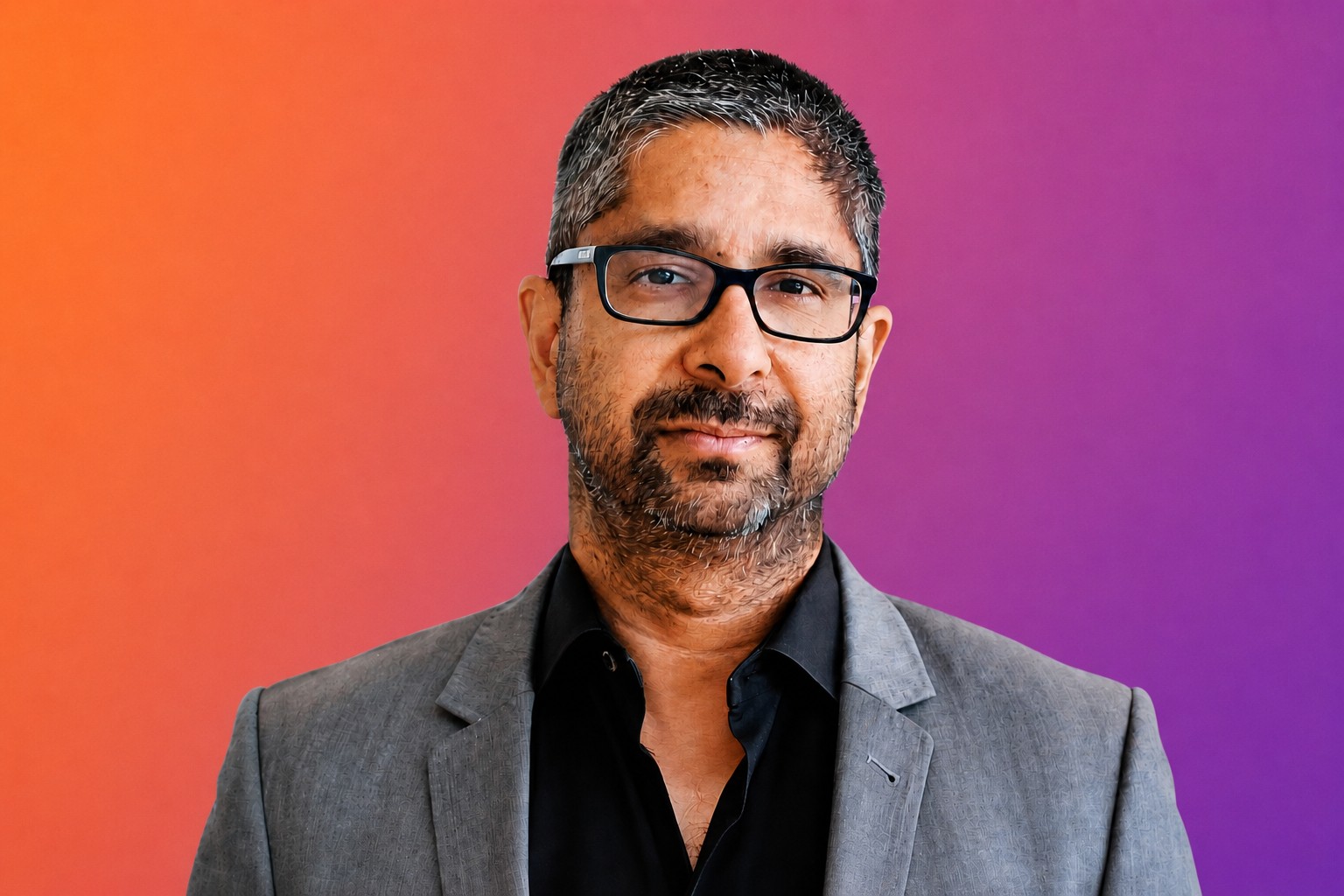
Vijay Pande spent more than a decade building the bio and health practice at Andreessen Horowitz, a firm that had spent its first five years avoiding both healthcare and the life sciences. By the time he left in June of last year, he was running close to $4 billion. He now runs VZVC, where the entire investment side is two people: Pande and longtime investor Zach Werner. No junior staff, roughly five investments a year instead of 30. Pande's thesis is that drug development is becoming an engineering discipline. His own description of the field is the strongest argument for why it is not one yet.
The engineering claim is specific. Drug creation used to carry a great deal of chance, Pande argues; AI and machine learning now make it possible to analyze complex biological systems, pick drug targets for a given disease, design the compounds themselves, and reach into clinical trials, the most expensive stage of the whole process.
Pressed on the idea that synthetic data is already cutting trial costs and letting sponsors enroll fewer people, Pande called that an aspiration rather than a reality. Preparation time and cost are genuinely falling, AI among the reasons. The trial itself still runs to hundreds of millions of dollars. The probability that a drug makes it from phase 1 through phase 3 is 20%. Eight of ten do not finish, each costing hundreds of millions, which is what drives the average cost of one successful drug so high.
His diagnosis of why they fail is not that a biologist made an error. Drugs are designed on the back of animal experiments, mice above all, and animal models predict the human body poorly. AI will not be perfect either, Pande says, but its predictions may be noticeably more accurate than an animal model, and clearing that threshold is what he considers especially promising.
The next question, once a drug works at all, is whether it works for a particular patient. That is what precision medicine means. Today a physician facing a non-obvious disease has to guess at the cause, prescribe one drug, then a second when the first does nothing, then a third. This happens in oncology and in many other conditions. Pande's preference is obvious enough: get the right drug first. He points to how blood work is read, against population averages, when what matters to the patient is how unusual a given result is for that person specifically. AI is already being used to decide which treatment suits an individual.
None of this came from a single leap. Precision medicine leaned for a long time on genomics, and Pande compares a genome to the blueprint of a house on the day it was built: years later, the house has diverged from the drawing. Understanding the body's current state therefore depends increasingly on other measurements, proteomics among them. Robotic measurement automation advanced in parallel and pairs naturally with AI. And over the past ten years, AI for biology and AI for chemistry both improved steadily, the first answering how to treat a disease, the second how to build a molecule that acts on the protein you want.
Then comes the constraint that shapes everything else. Biology is one of the few areas where AI cannot simply pull its training data off the internet. There is no single corpus that everyone could train the same systems on, and the data cannot be handed from one model to another without loss. Pande likens the effect to medical specialties that operate as separate and competing fields: a disease may sit in both oncology and endocrinology while the two sets of doctors fail to talk usefully to each other. AI could in principle merge those bodies of knowledge and see patterns no individual can, something like a team of the best physicians working one case together. That requires data sharing. Pande believes the industry is moving toward atlases of biological information, built technologically on foundation models, and that as those spread the story of open LLMs may repeat itself, with open models competing successfully against corporate ones.
Here is where his account argues with itself. Almost every company, on his own telling, has to build its own closed dataset because the public one does not exist. That is a moat, and it is most of what a bio-AI company owns. The shared atlases and open foundation models he expects next dissolve exactly that moat. Both futures cannot be the investable one. A fund making five concentrated bets a year is underwriting the first while describing the second, and the two have very different answers to the question of what an AI drug discovery company is actually worth in ten years. His closing caution is the same problem seen from the other side: AI finds patterns humans cannot reach without computation, but expecting it to cure everything is a mistake, and the reason is not doubt about AI. LLMs work because of enormous training corpora. Where the data does not exist, AI does not magic it into being.
The portfolio reflects the long horizon more than the thesis. Pande is tied to Genesis Therapeutics, which came out of his Stanford lab, and to Insitro, the drug discovery company founded by his former Stanford colleague Daphne Koller. He is incubating a company with a founder he has known for 20 years. Most of his time now goes to two areas: AI for delivering medical care and AI for clinical trials, the first of which he worked on extensively at a16z. What he screens founders for is mutual trust: high integrity, people who do what they said they would, and who are prepared to build a relationship over 5 or 10 years, ideally through to their next company. He wants long-term thinkers who are trying to find a way to win together rather than only to beat someone.
The firm's structure follows from that. VZVC is named for Vijay Pande and Zach Werner, and the pair originally planned to hire a junior, until the AI agents they built themselves turned out to be useful enough to skip the hire. Pande's comparison for adding a company to a conventional venture fund is adding a friend on Facebook: fast, cheap, reversible. For him and Werner a new investment resembles deciding to have another child. Firms built this way generally do not compete for the hottest rounds, and Pande says companies make room for them because they value the practical help, which is a different transaction from fighting over a popular Series A or B. Among investors he admires he names Antonio Gracias of Valor, best known at the moment for the SpaceX deal but working this way for 20 years, and Thrive for its concentrated portfolio. The a16z experience remains part of his approach; Valor and Thrive added new reference points to it.
The most useful thing Pande says about his own career has nothing to do with biology. When he began talking about AI, machine learning, medicine and biology more than ten years ago, most people thought it would never be useful; that resistance has largely gone. What took him longer to learn is that however attractive the frontier technology, everything ends at go-to-market, and he tells founders coming out of science or product to point the same intelligence and creativity at commercial strategy, because it can be as hard as building the technology or harder.
Which is the tension under the whole enterprise. If the data has to be assembled company by company, then what a bio-AI fund is really financing is not a model but a decade of laboratory work, and a two-person firm making five investments a year is one of the few shapes of venture capital that can sit still that long. It is also the shape that cannot afford to be wrong five times.