
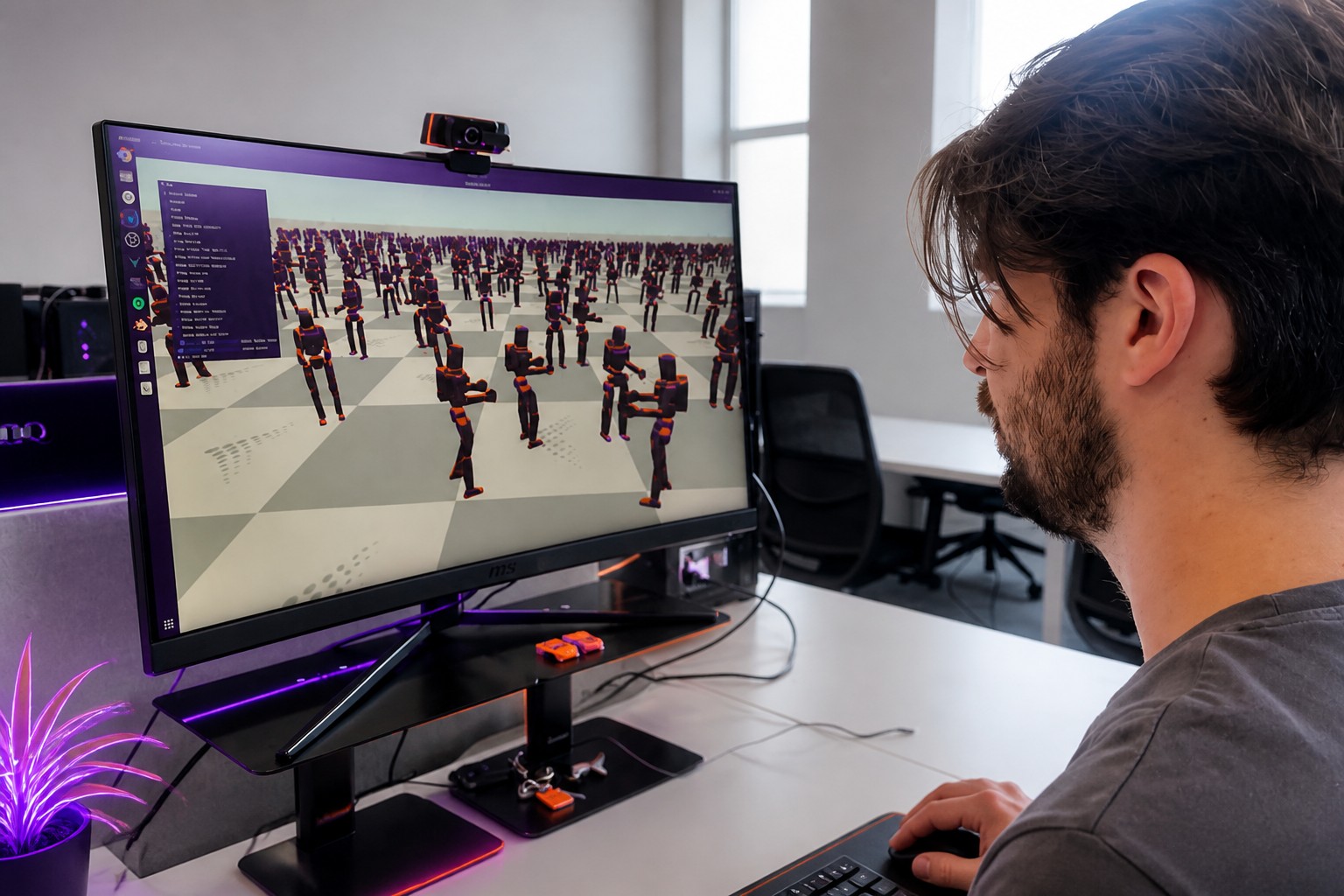
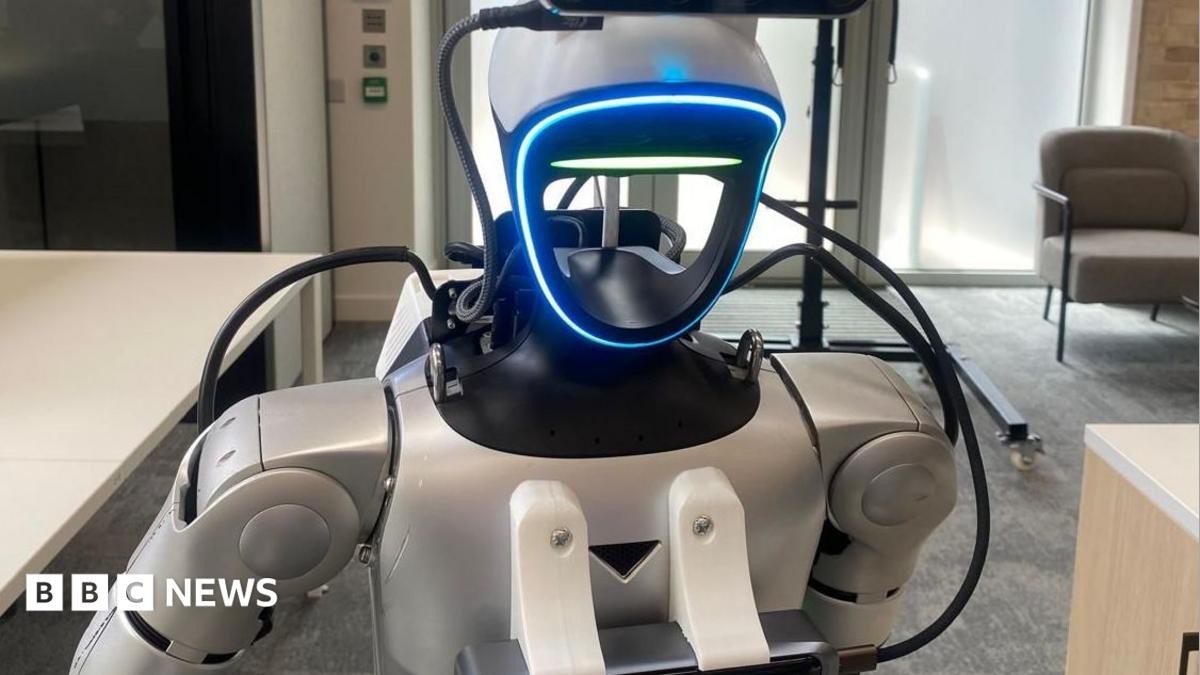
A robot named Freddo walks across an office and takes a plastic bottle from an employee's outstretched hand. The act is not remarkable. The clock is: developing those skills — walking, recognising the bottle, closing a hand around it — and loading them into the machine took a few minutes. Freddo runs software from Vsim, a ten-engineer startup that rebuilt robot simulation from scratch so it would run on GPUs, and the result is fast enough to ride onboard. About a second ahead of itself, Freddo evaluates 20,000 versions of what might happen next.
Source: bbc.co.uk
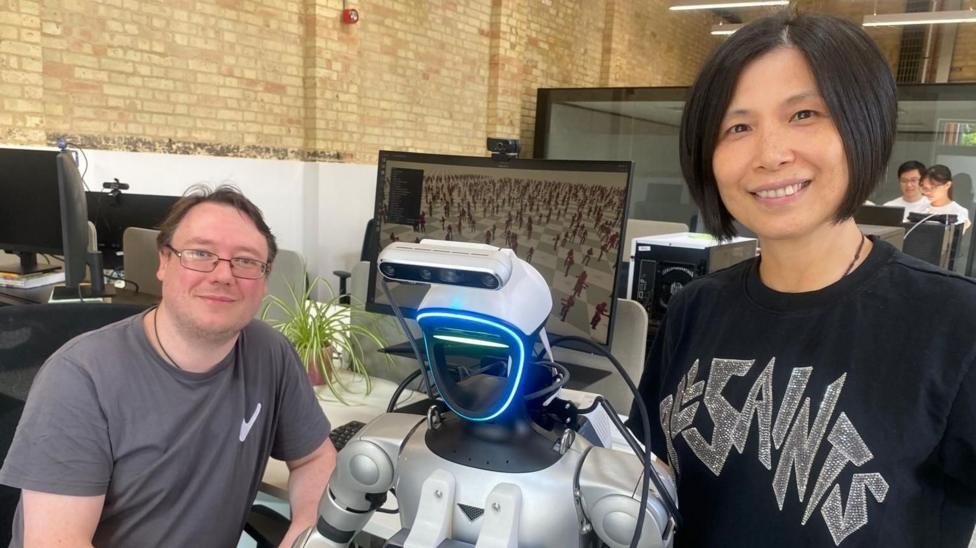
Vsim's founders, Michelle Lu and Kier Storey, expect their software to eventually drive robots that move on their own and do useful work in homes and workplaces. A robot recently broke Usain Bolt's 100-metre world record, which tells you how far raw locomotion has come and how little that settles.
Storey describes the paradox that governs the field: the movements people find hardest, gymnastic routines among them, robots can already do reasonably well, while the things humans barely think about — precise work with the fingers — remain difficult for machines.
Freddo's skills were trained in a virtual environment, where the robot performs a task in simulation millions of times. When an optimal way of acting is found, it is called a policy, and the policy is loaded into the physical machine.
Source: bbc.co.uk
None of that is new. Nvidia's Isaac Sim works on the same principle, and Lu and Storey helped build an early version of it. What they concluded, and what led them to found Vsim in 2022 to build their own training environment and toolchain, was that the foundations were wrong. The core algorithms behind most robotics simulators date from the 1970s and 1980s, Storey says, and map badly onto GPUs. Within months of starting from a blank sheet the team found its system running far faster than anything it knew of. Eighteen months in, Lu says, Vsim had a fully working high-performance simulator.
Speed changed the category of the thing. The software is efficient enough to run on the hardware Freddo carries, which means the robot can execute tens of thousands of simulations while it is in motion rather than only before it. In an unstructured space like an ordinary house, that matters: people, animals and other robots do unpredictable things that require a change of plan, and they do them fast. The robot has to adapt quickly, stay safe, and keep working on the task it was given.
Nvidia sits at the other end of the industry. It dominates the market for AI chips and runs a robotics software division with hundreds of engineers. It does not build robots; it sells the software to train and control them, including simulation-based training systems and a world model called Cosmos, meant to give a robot a working sense of real-world physics and of how its surroundings may shift while it moves.
Even with Nvidia's compute, that sense of reality remains approximate. Spencer Huang, Nvidia's director of robotics products, puts the boundary simply: picking up a bottle is not hard. The trouble starts with long sequences — pick up the bottle, fill it, carry it somewhere and pour it out. He does think the technology is improving quickly. This year Nvidia began using AI agents to build the virtual training environments and to check whether the solutions found in training actually hold. Constructing and scanning a virtual world has been largely manual labour; handing most of it to agents gives Nvidia what amounts to a large virtual workforce.
Simulation is not the only route. Robots can also be trained by watching people, or by watching video.
Rika Antonova has worked in robotics since 2015 and is now an assistant professor in the Department of Computer Science and Technology at Cambridge, researching the software and hardware that help robots acquire complex behaviour. She works with MuJoCo, the training system Google DeepMind has owned since 2021 and released as open source, free for researchers to use and modify.

Antonova calls MuJoCo unusually easy to work with, which matters most to research groups and small startups. She considers Vsim's very fast simulation approach promising: if the simulator is quick enough, then in the few seconds a robot spends deciding how to alter its movement, hundreds of millions of examples can be generated, and the trajectory changes almost in real time.
Her caveat is the one that has always bounded this field. Virtual environments are still a crude approximation of the real world, and that limits which skills can be learned in them. Some objects and actions resist accurate simulation — highly deformable materials, and cutting.
My read is that the demonstration and the achievement are not the same thing. Grasping a bottle is exactly the task Nvidia's own robotics product lead names as easy, so the video proves little about manipulation. What is genuinely different is the position of the simulator: it has moved from an offline training step into a runtime loop on the robot's own hardware. Twenty thousand futures a second ahead is a reflex system, and a good one. It is also, by construction, a one-second horizon — which is the opposite end of the problem from the pick-fill-carry-pour sequence Huang describes as the real obstacle. The industry is getting rapidly better at the next second and not obviously better at the next minute.
The sim-to-real claim deserves the same caution. Lu says the team has narrowed the gap, using more accurate simulations to train models that behave in the real world as they did in the virtual one. That is the founder's account of her own system, and narrowing a gap is not closing one; Antonova's deformable objects and cutting are still sitting there.
A second robot, Nacho, is joining the work, meant to speed development and confirm the software runs on different machines. Freddo gets company, and Vsim gets the first real test of whether it built a simulator or a robot-specific policy generator — which is the distinction that decides whether ten engineers can compete with several hundred.