
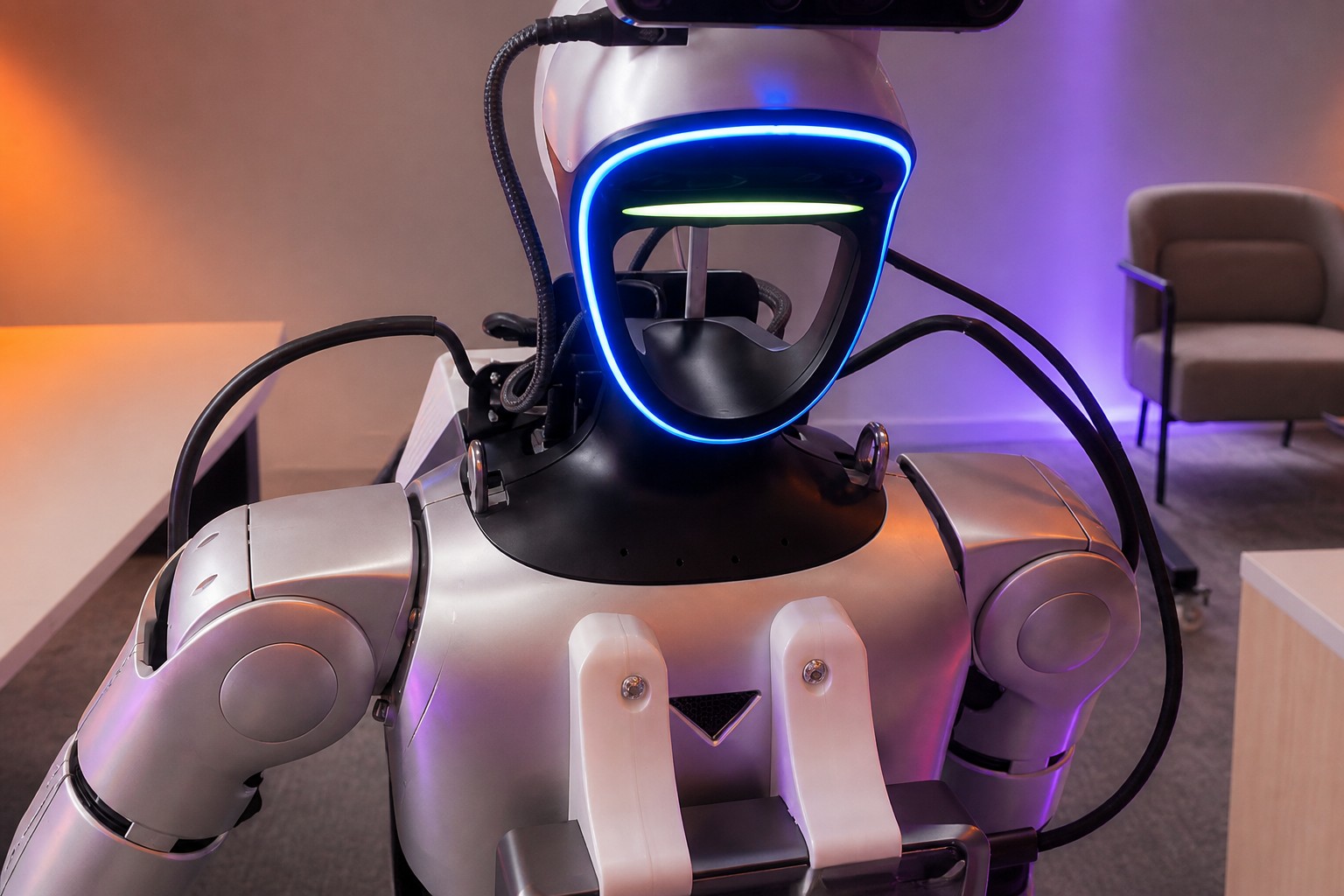
A robot called Freddo walks, recognises a bottle and picks it up. Set beside the machine that recently broke Usain Bolt's 100m record, that is a modest demonstration. The interesting part is not what Freddo does but where the thinking happens: the simulator that trained it also runs on the hardware the robot carries, and it keeps running while the robot moves. Freddo belongs to Vsim, a British startup in Cambridge founded in 2022 by Michelle Lu and Kier Storey, who helped build the early version of Nvidia's Isaac Sim before setting out to write their own. Vsim has ten engineers working on the technology. Nvidia's robotics software division has hundreds.
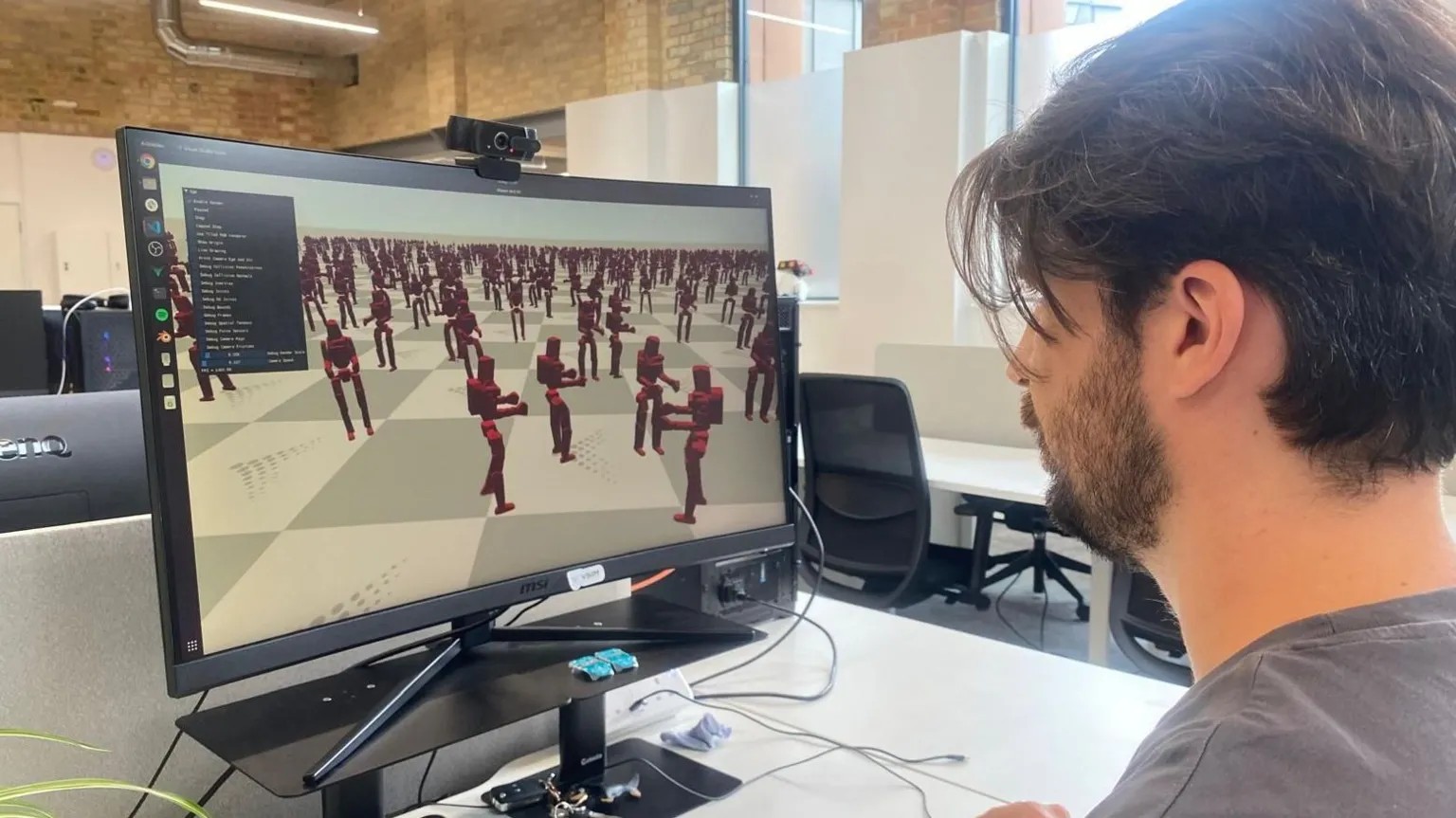
The standard method here is old enough to be uncontroversial. A robot's skills are rehearsed in a virtual environment, where the same task can be run millions of times in a computer simulation. The best solution that emerges — the policy — is then loaded onto the physical system, in this case Freddo. Nvidia's Isaac Sim works on that principle, and simulation training is now the default across the field.
Storey points to an odd inversion in robotics: things that are hard for a human, like gymnastics, robots do reasonably well, while the fine motor control people take for granted gives them trouble. His diagnosis of why the software is slow is more specific than most complaints in this industry. The core algorithms behind most robotics simulation, he says, go back to the 1970s and 1980s and map badly onto GPUs — the chips that everything else in AI now runs on. Starting from nothing let Lu and Storey optimise for that hardware from the first line.
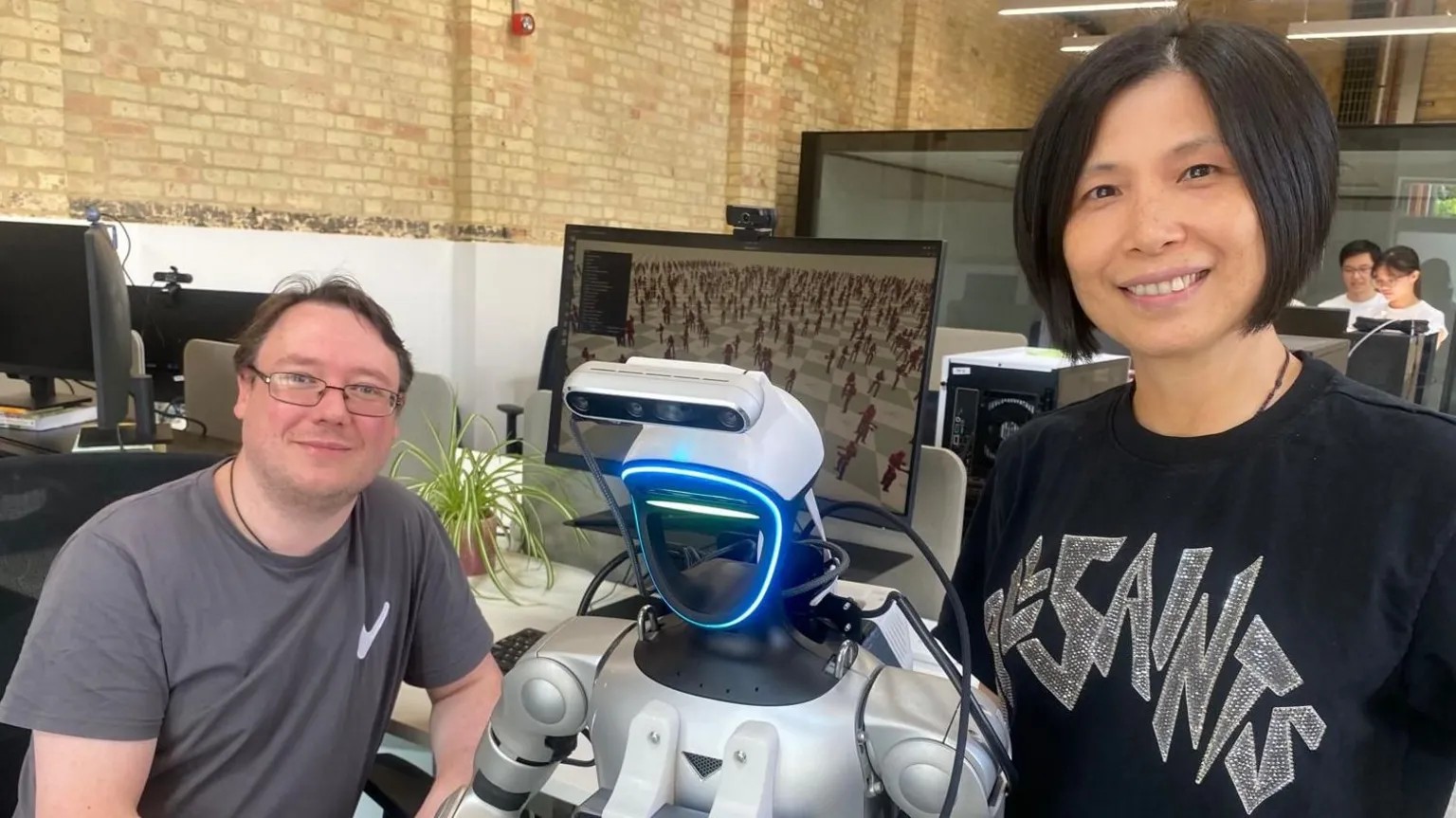
Within a few months, the two say, they could see their system running noticeably faster than anything they knew of. Eighteen months after starting, according to Lu, Vsim had a fully functional high-performance simulator.
Speed is what turns the simulator from a training tool into a runtime component. The software is efficient enough to run on the hardware Freddo carries, which means the robot can execute tens of thousands of simulations while it is moving. Storey describes the system as looking roughly one second into the future and examining 20,000 different ways events could unfold, all at once.
That matters most in an ordinary house, which is an unstructured environment by definition. People, animals and other robots do unexpected things that have nothing to do with what the robot intended, Lu says, and in those moments the strategy has to change quickly enough to stay safe and still complete the task.
Nvidia sits at the other end of the industry. It dominates the market for AI chips and does not build robots at all; it sells the software for training and controlling them. That package includes simulation-based virtual training systems and Cosmos, a world model meant to give a robot a grasp of real-world physics and of how its surroundings may change while it moves. Even with the compute Nvidia has available, that software still yields only a basic picture of reality.
Spencer Huang, product director for Nvidia's robotics line, draws the line where most people in the field draw it. Picking up a bottle is not especially hard. The trouble starts with long tasks — pick up the bottle, fill it, then pour out what is inside.
Huang thinks the picture is improving. This year Nvidia began using AI agents both to build the virtual training environments and to check whether the policies that come out of training actually work. Constructing a virtual world and scanning it, he says, is still largely manual labour, and pointing agents at it gives the company what amounts to a large virtual workforce.
That is the most revealing sentence in Nvidia's account, and it is not about compute. The company that sells everyone else their compute is describing its own constraint as labour: someone has to build the worlds.
Simulation is not the only route. Robots can also be trained by watching people or video demonstrations. Rika Antonova, who has worked in robotics since 2015 and is now an assistant professor in the Department of Computer Science and Technology at the University of Cambridge, builds software and hardware that help robots acquire complex behaviour. She works with MuJoCo, the training system Google DeepMind has owned since 2021 and which remains open source, free for researchers to use and modify. MuJoCo is simply convenient, she says, which is why it suits research groups and small startups.
Antonova considers Vsim's very fast simulation approach promising. If a simulator is quick enough, she says, then in the few seconds a robot spends deciding how to alter its motion you can generate hundreds of millions of samples and correct the trajectory almost in real time.
Her caveat is the one that constrains the whole field. Virtual environments remain approximations of the real world, and that limits which skills can be learned in them. Highly deformable objects and cutting, Antonova notes, are hard to model accurately in simulation. Both Nvidia and Vsim are working on it. Lu says her team has narrowed the gap between simulation and reality, and that accurate simulations let them train models that behave in the real world the way they did in the virtual one.
Here is what I take from the two accounts placed side by side. Vsim's numbers are specific where they concern speed — 20,000 branches, eighteen months, ten engineers — and vague where they concern fidelity. The sim-to-real gap is described as narrowed, not measured; there is no benchmark against Isaac Sim, no customer and no price. Meanwhile both camps name the same unsolved problems, and neither is a speed problem. Deformable objects and cutting are a physics-modelling problem. Long-horizon tasks are a planning problem. A simulator that produces hundreds of millions of samples in seconds is still producing them inside an approximation, and running the wrong physics faster mostly yields wrong answers sooner. The claim worth testing is not that Vsim is fast. It is Lu's quieter one, that the simulations are accurate enough for the speed to be worth anything.
A second robot, Nacho, is joining the work shortly. Lu says it should speed up building the system and help confirm that the software runs on different machines.
That second sentence is the commercially important one. Vsim, like Nvidia, is a software company that happens to own robots, and a policy that only works on Freddo is a demo. Nacho exists to prove the software is not about Freddo — which is also the moment Vsim stops competing on a simulator's frame rate and starts competing with a company that has hundreds of engineers and owns the chips.