
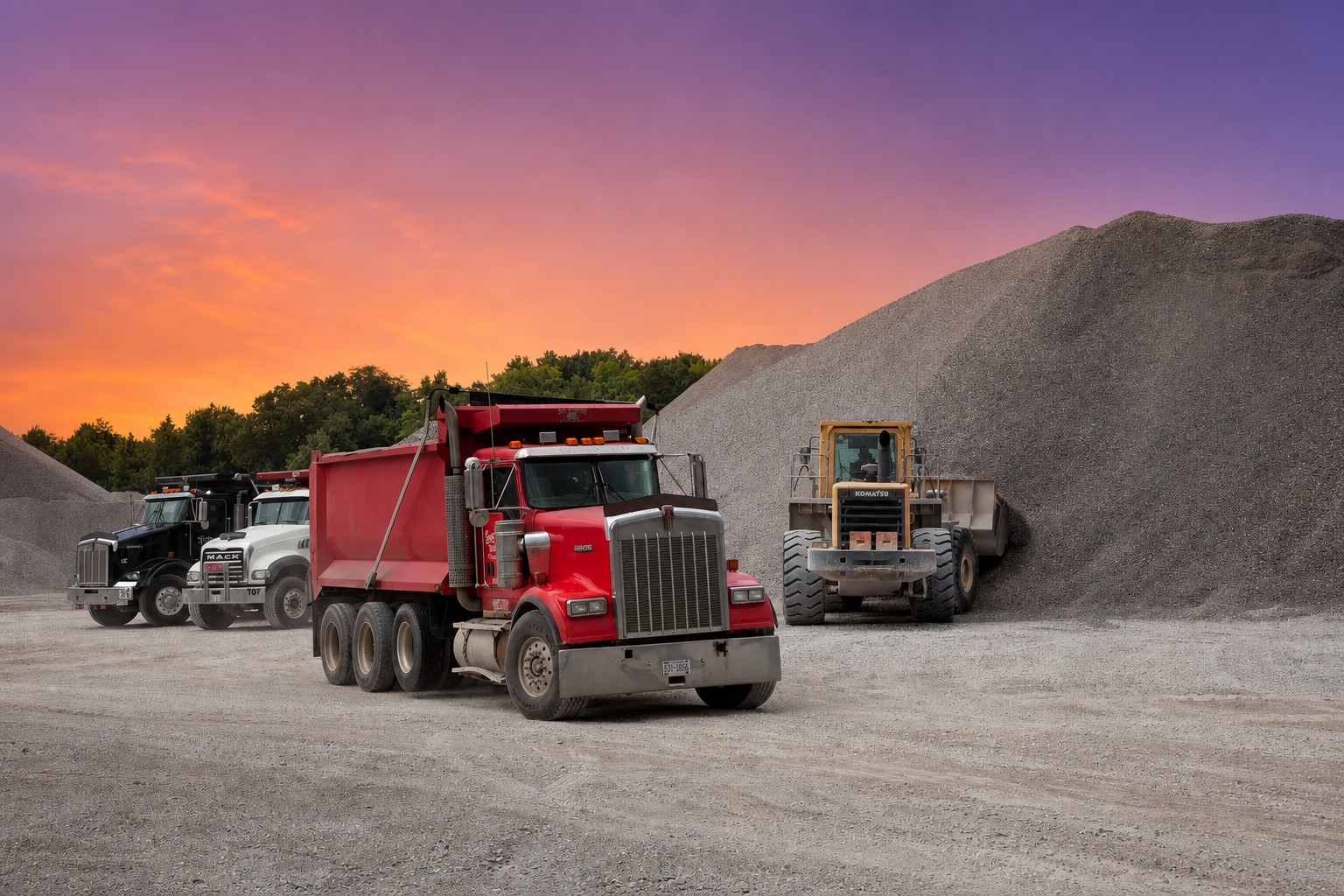
Vulcan Materials booked $7.8 billion in revenue in 2025, runs more than 400 sites across 24 states, and shipped over 220 million tons of aggregates last year. Its AI program is built on the least exciting premise available: that the work worth doing first is cutting the number of systems the company runs and fixing the data inside them. Krzysztof Soltan, chief information officer since 2021, describes the product as something that is probably in almost every building, road and bridge, and in structures made of concrete and asphalt. He describes his own job in similar terms — plumbing that everything else rests on.
Soltan's remit covers sales, finance, human resources, supply chain, cybersecurity and data. Cloud platforms, AI and automation sit inside that program, but he frames the role primarily as a partnership with the business units and as helping the company change through technology. He also casts himself as the person who explains to employees what new tools actually make possible.
The transformation began in the commercial and marketing functions, timed to coincide with the Vulcan Way of Selling initiative, when the company had both the readiness and the momentum for change. The stated goal was to let salespeople spend more time with customers and less on administrative work. The second goal was quieter and more durable: building a data foundation for more advanced analytics and for AI applications that did not yet exist.
That template is now being applied to the back office — finance, HR, supply chain. The point, Soltan says, is not to move old processes into the cloud. Vulcan is rethinking them, stripping out unnecessary complexity and giving employees better tools. Replacing an old system without revisiting the work attached to it preserves the inefficiency, in a more modern technical environment. Consolidation is therefore a central strand of the strategy: fewer systems means less to maintain, less to integrate, less for employees to learn, and more value for the company.
Consolidation also feeds directly into the data problem. Fewer systems improves consistency and produces a more reliable picture of the state of the business. But improving data during a migration is not enough — quality has to be maintained continuously. Soltan's position is that AI depends fundamentally on good data, that most companies already hold large volumes of it, and that Vulcan expects to make its own better over time.
To that end the company introduced a master data governance program. It identifies data owners within the business, assigns people accountable for the condition of that data, and gives IT the job of managing, controlling and tracking the underlying records. What started as part of the transformation program has gradually become part of everyday culture. The hard part is not the tooling: leaders have to allocate accountability, settle disagreements, and explain to staff why consistent data matters to the whole organisation.
The staffing side is treated as part of the same foundation. Vulcan hired a new head of data, built expertise that sits across functions, and continues both to recruit externally and to develop existing employees, with continuous upskilling aimed at making data a strategic asset.
On AI itself, Vulcan was using machine learning, analytics and other forms of AI before generative AI became a board-level priority. In operations it standardised systems that help produce finished materials, and the commercial transformation created a better information base for new applications. Soltan is now examining generative and agent-based AI, including through an internal marathon to find solutions for employees around real business problems. He is explicit that he does not want a mass of small experiments to stand in for practical impact across the organisation. The intent is to pick a handful of tasks capable of moving the business and point AI at those first, with opportunities in operations, commerce and the back office ranked by value rather than pursued in parallel.
The buy-versus-build calculus is handled with the same bluntness:
A ready-made capability already built into an enterprise platform Vulcan uses — that is normally the starting point.
Standard processes — not worth building something custom.
Competitive advantage — more likely to build in-house.
Valuable intellectual property, or a need specific to the industry — another reason to build.
A middle path — a ready-made platform combined with custom components.
What stands out in all of this is the absence of a headline. There is no claimed return on AI investment, no named deployment, no productivity figure, no count of hours saved. For a company of this size that has been transforming since 2021, the restraint reads as deliberate rather than evasive — the specific numbers Soltan does offer are about physical scale and system count, not about AI. The logic he describes is a chain of dependencies where each link has to hold: modern platforms simplify processes, simplification improves data, reliable data makes AI more useful. Chains of that shape are honest, and they are also slow. A CIO who says out loud that hackathons are not impact is setting an expectation that most of the value is still several links away.
The horizon he names is five to ten years for automation to take a larger role in operations, gated as much by cybersecurity, risk management and organisational readiness as by technical maturity. Technology that performs in a pilot may not yet be fit to scale and support in a complex production environment. He is also watching human interaction with AI agents, AI-assisted software development, and AI at the edge, where processing data near the equipment can cut latency, reduce dependence on centralised data centres and speed up operational decisions.
The example that makes the point is autonomous movement of equipment. Quarry conditions are not public roads: no lanes, no traffic lights, none of the predictable markers that driving systems are built around. Physical AI has to operate safely alongside heavy machinery in a far less structured setting. That is the harder half of Vulcan's AI story, and it is the half that data governance cannot reach — a clean master data record tells you nothing about whether a haul truck can read a pit face. The company has more than 400 sites of exactly that environment, and the plumbing being laid now was never designed to solve it.