
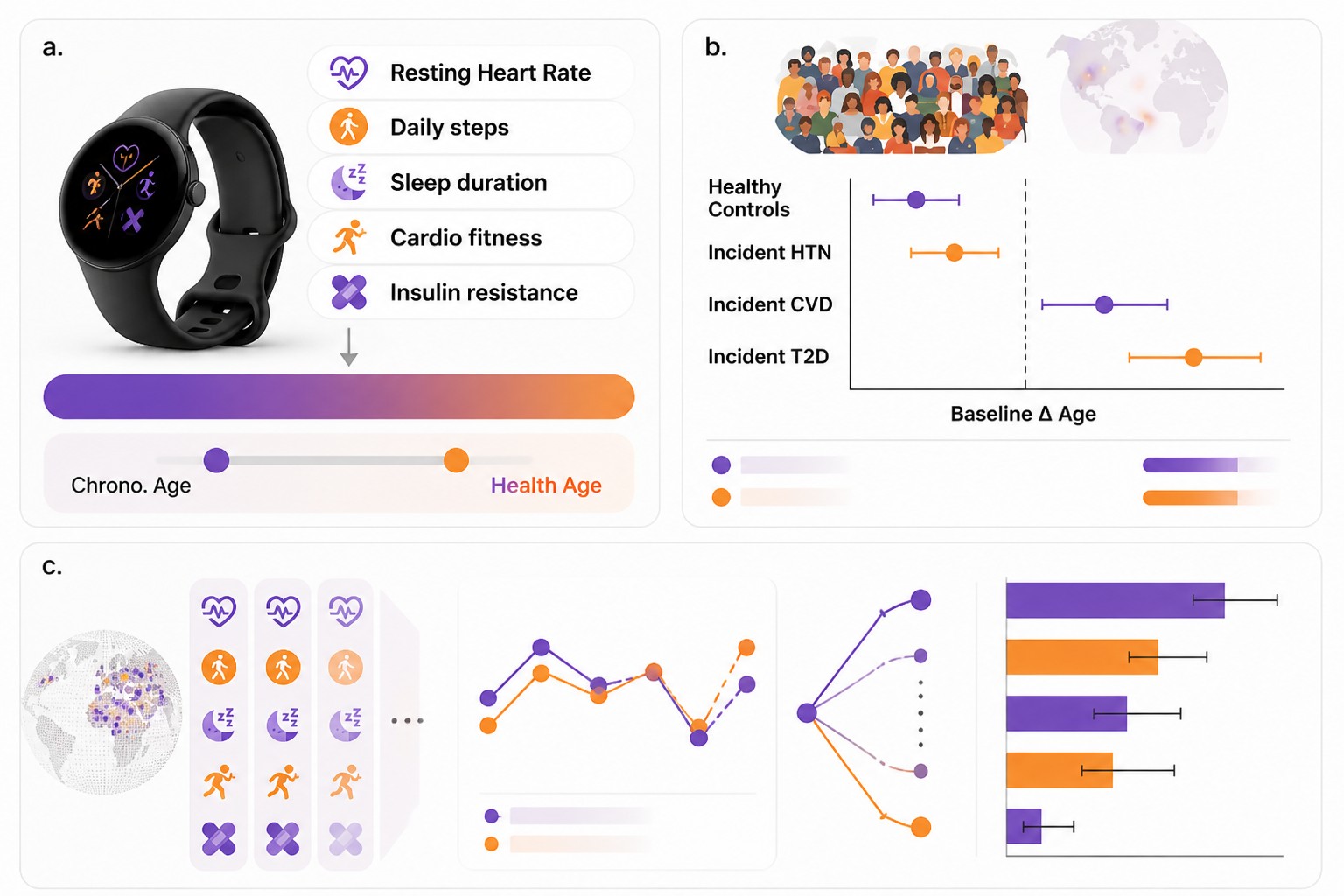
Google Research has introduced a research system that uses wearable-device data to estimate “health age” and model how changes in habits may affect the body over the next 12 weeks. The SensorWM model was trained on 2.28 million person-weeks of data from about 100,000 Fitbit users. Combined with a language model, it helps create plans that account for possible health changes, a person’s habits and safety constraints. In a separate study, researchers added three routine blood-test measures to device data to assess risks to the cardiovascular, kidney and metabolic systems.
Source: research.google
Google Research models how habits affect heart, kidney and metabolic health
Cardiovascular disease, kidney disease and metabolic disorders, including type 2 diabetes, are linked and form cardiometabolic-kidney syndrome, or CKM. The condition can develop without symptoms for a long time, and everyday habits affect the risk: physical activity, sleep and cardiovascular function. Smartwatches track these data, but on their own they cannot answer how a specific change — such as an extra 30 minutes of sleep or a brisk walk — will affect health in the coming months.
A health age that can change
Chronological age does not reflect a person’s physiological state: people born in the same year can differ considerably. Some biological clocks estimate whether the body is aging faster or slower than its chronological age, but they are often trained to predict year of birth. Such models may rely on traits that are difficult to change and do not show how a specific habit will affect future measurements.
Google researchers described the approach in the paper “Personalized Health Coaching Through Modifiable Health Age and Wearable Counterfactual Trajectories” and a companion study, “Cardiovascular, Kidney, and Metabolic System Health Age From Wearables and Blood Biomarkers.” The approach has three components:
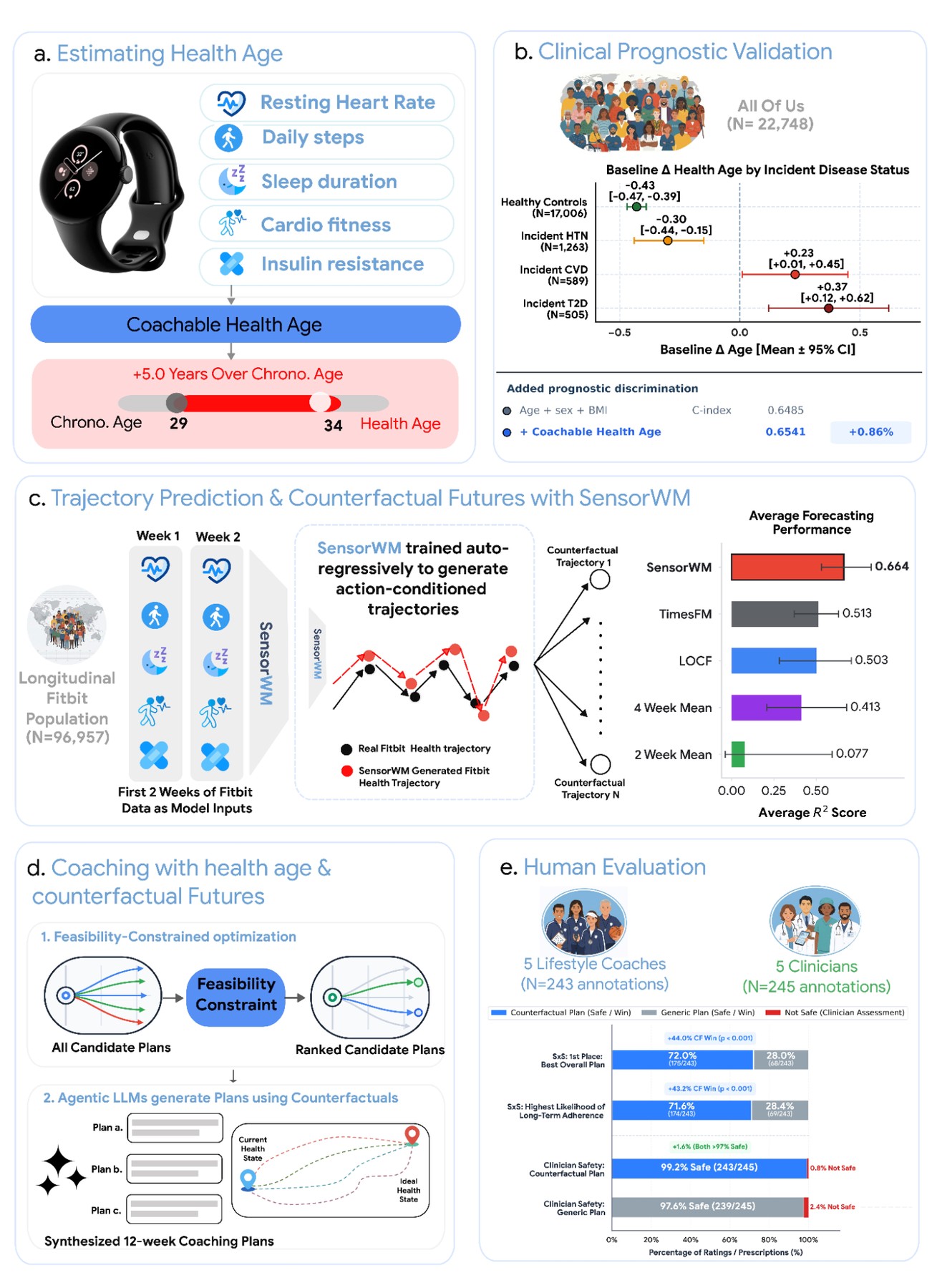
CHA health age uses four main measures: resting heart rate, daily step count, sleep duration and weekly minutes of activity in exercise-intensity zones. When available, the model also accounts for VO2max, sleep regularity and insulin resistance. Because the measures are partly correlated, the model adjusts for their overlap so each contributes separately to the difference between health age and chronological age. A negative difference, such as −3 years, means the physiological profile looks younger than the person’s chronological age; a positive one indicates accelerated aging.
The model was tested on three independent samples:
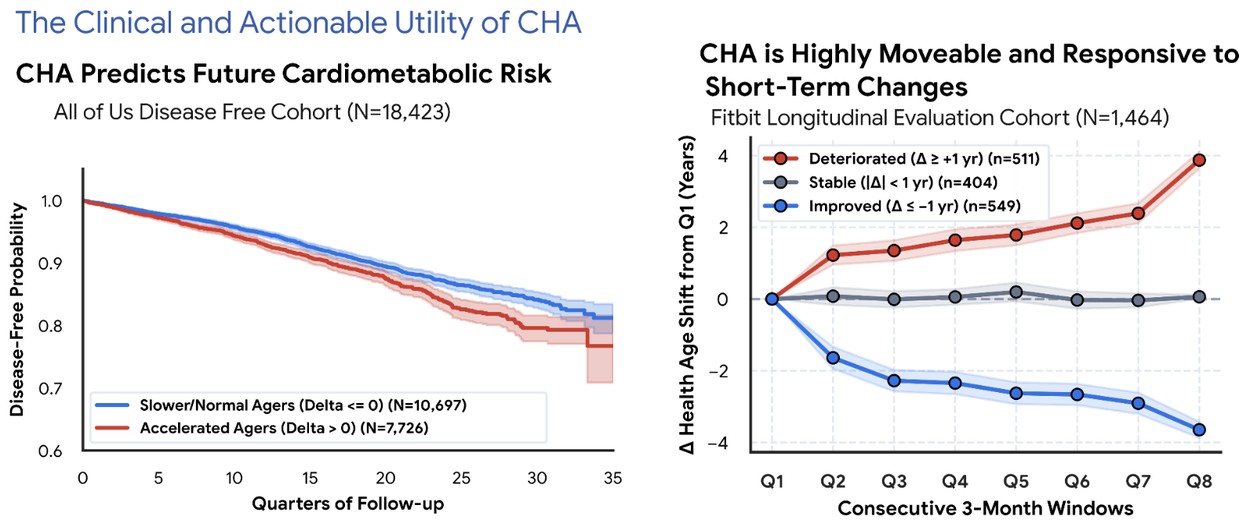
Among 18,423 All of Us participants without disease, those whose health age was equal to or lower than their chronological age were more likely to remain disease-free over eight years. Two-year observations also showed that health age could be reduced substantially within three-month periods.
Source: research.google
How SensorWM models change
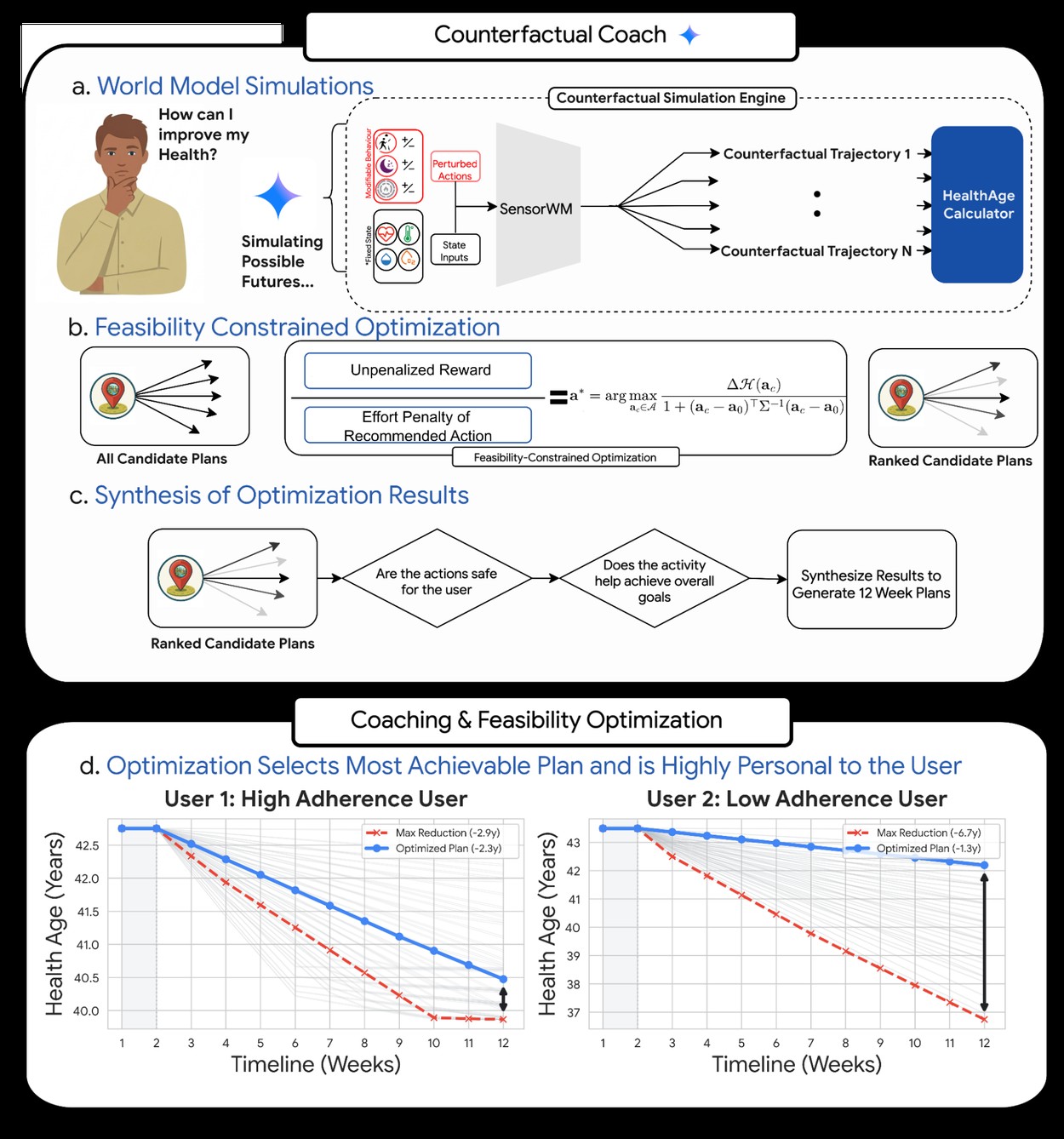
Health age shows a person’s current state. A personalized plan requires estimating what will happen over the next 12 weeks if specific habits change — and which option the person can realistically stick to.
A simple calculator that sets new step or sleep targets does not account for how the body adapts. If someone moves more and sleeps better for several weeks, their resting heart rate and heart rate variability may change over time, too. Those changes affect subsequent health measures.
SensorWM is a world model that accounts for specified actions. It was pretrained on anonymized data covering 2.28 million person-weeks from about 100,000 Fitbit users who consented to data use. From two weeks of baseline observations, the model predicts changes in 20 physiological measures over the following 12 weeks under different step, sleep and cardio activity patterns. In the study, SensorWM outperformed general-purpose time-series models such as TimesFM while preserving clinical patterns associated with diabetes, hypertension and insulin resistance.
To develop plans, the researchers combined SensorWM with an optimizer that accounts for the feasibility of habit changes and a language agent:
Source: research.google
Specialists review the recommendations
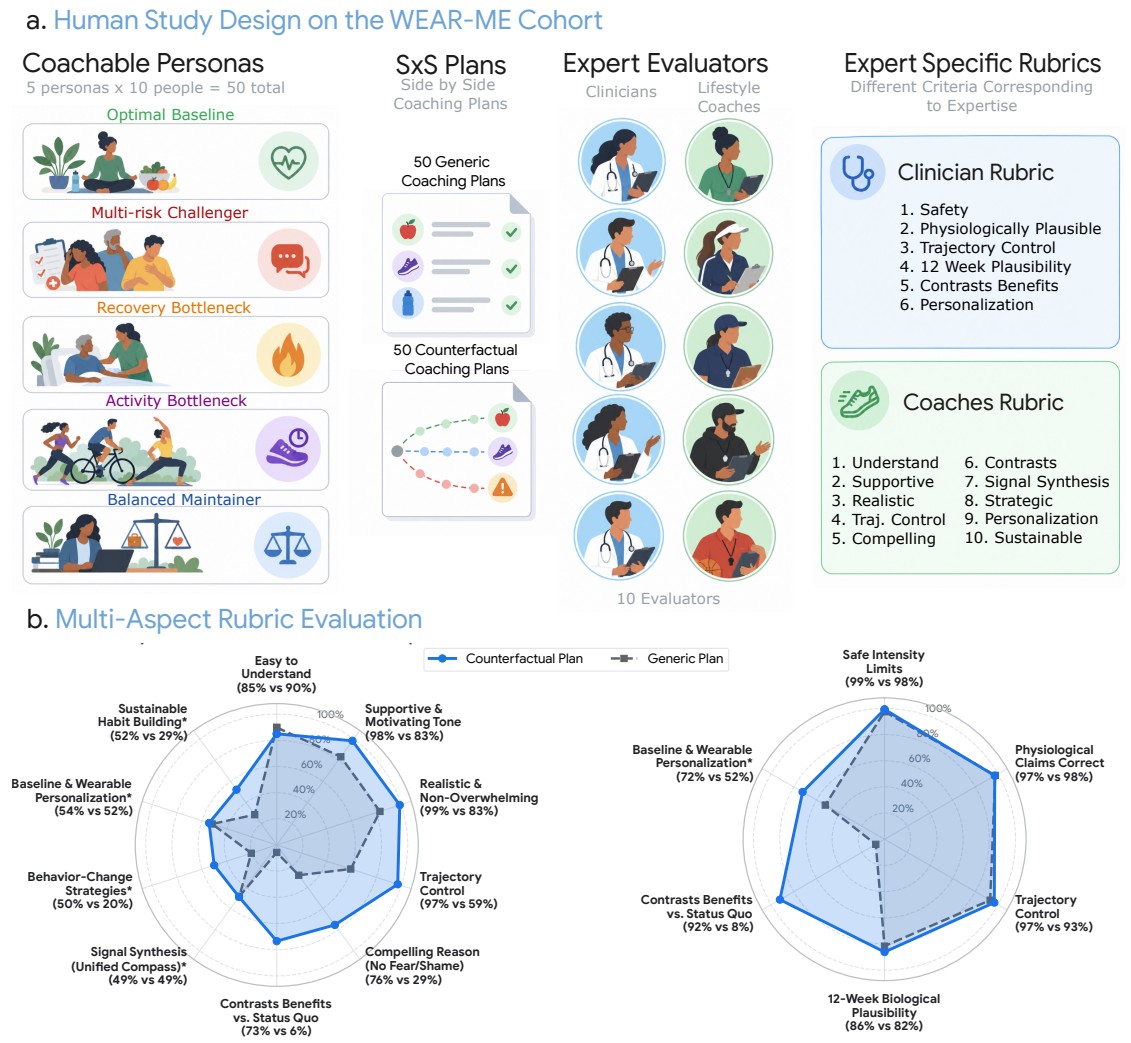
The researchers compared language-model recommendations based on SensorWM simulations with plans from the same model when it was given only the user’s wearable history. The blinded study involved five certified wellness specialists and five physicians board-certified in primary care and lifestyle medicine. They assessed 49 participant profiles representing five behavioral types, for a total of 490 paired evaluations. The researchers also conducted an automated evaluation across the full WEAR-ME sample of 2,780 people.
Source: research.google
How blood tests complement wearable data
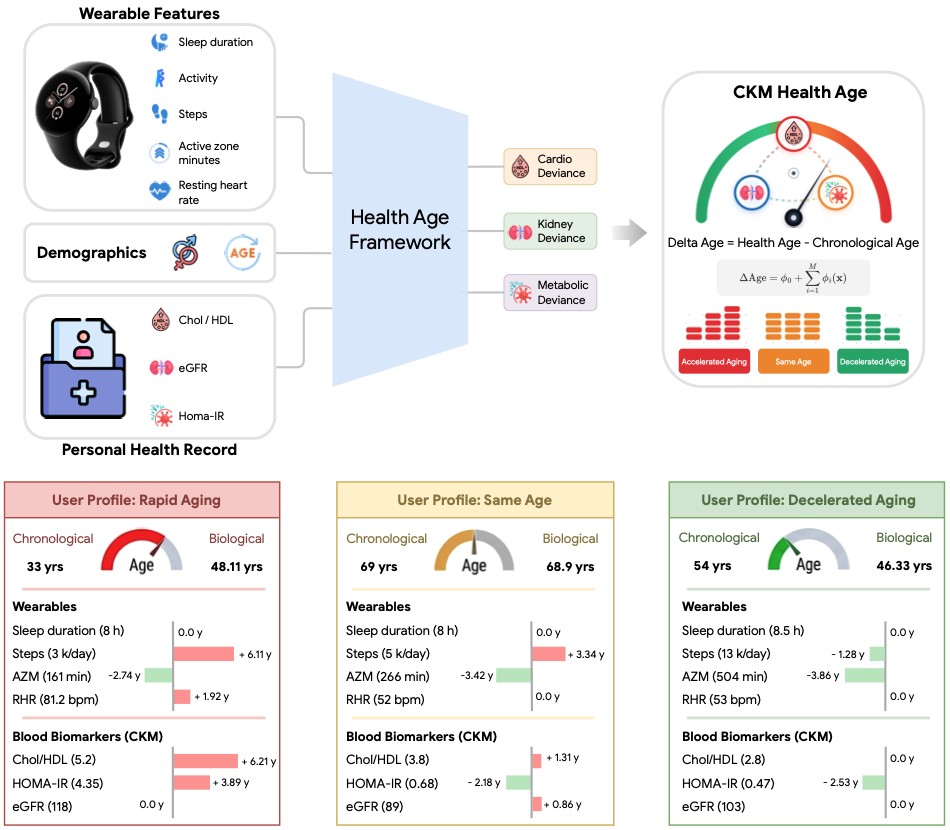
Because the health-age model is modular, routine clinical test results can be added to it. In a companion study, the authors extended the approach to assess CKM by organ system, combining continuous wearable data with blood tests that do not, by themselves, reflect everyday habits.
Source: research.google
The study included 819 people from WEAR-ME. The model combined activity, resting heart rate, sleep duration and active minutes in exercise-intensity zones with three laboratory measures:
The model estimated how far each measure deviated from clinical thresholds for good health and converted the deviation into a normalized score. The results showed that aging across organ systems does not follow one overall pattern: metabolic and cardiovascular problems are often linked, while early declines in kidney function frequently appear independently. The difference between CKM health age and chronological age was closely associated with clinical assessments — modified Life’s Essential 8 (r = −0.58) and metabolic syndrome severity (r = 0.65) — as well as with how healthy participants felt in everyday life.

Source: research.google
Across the full sample, measures of kidney, metabolic and cardiovascular health varied among participants: some had better-than-reference values, while others showed hidden abnormalities. This underscores why assessing multiple systems can provide a more detailed picture than a single health-age measure.
The authors view these results as a foundation for future prospective trials testing whether interactive “what if” scenarios help people maintain habits and improve their health over the long term. For now, the assessments were conducted offline on retrospective research samples, and the models remain research prototypes that are not intended for clinical diagnosis. Dataist’s take: the main result is a test of whether modeling possible changes can make recommendations more useful to specialists and participants. But the data do not yet show that these plans lead to lasting health changes in everyday life.
Daily AI news
Every day we pick what actually matters in AI and explain it plainly — no hype, no filler. Subscribe if you want to follow where the industry is going.
Only what matters — every day
Follow on X