
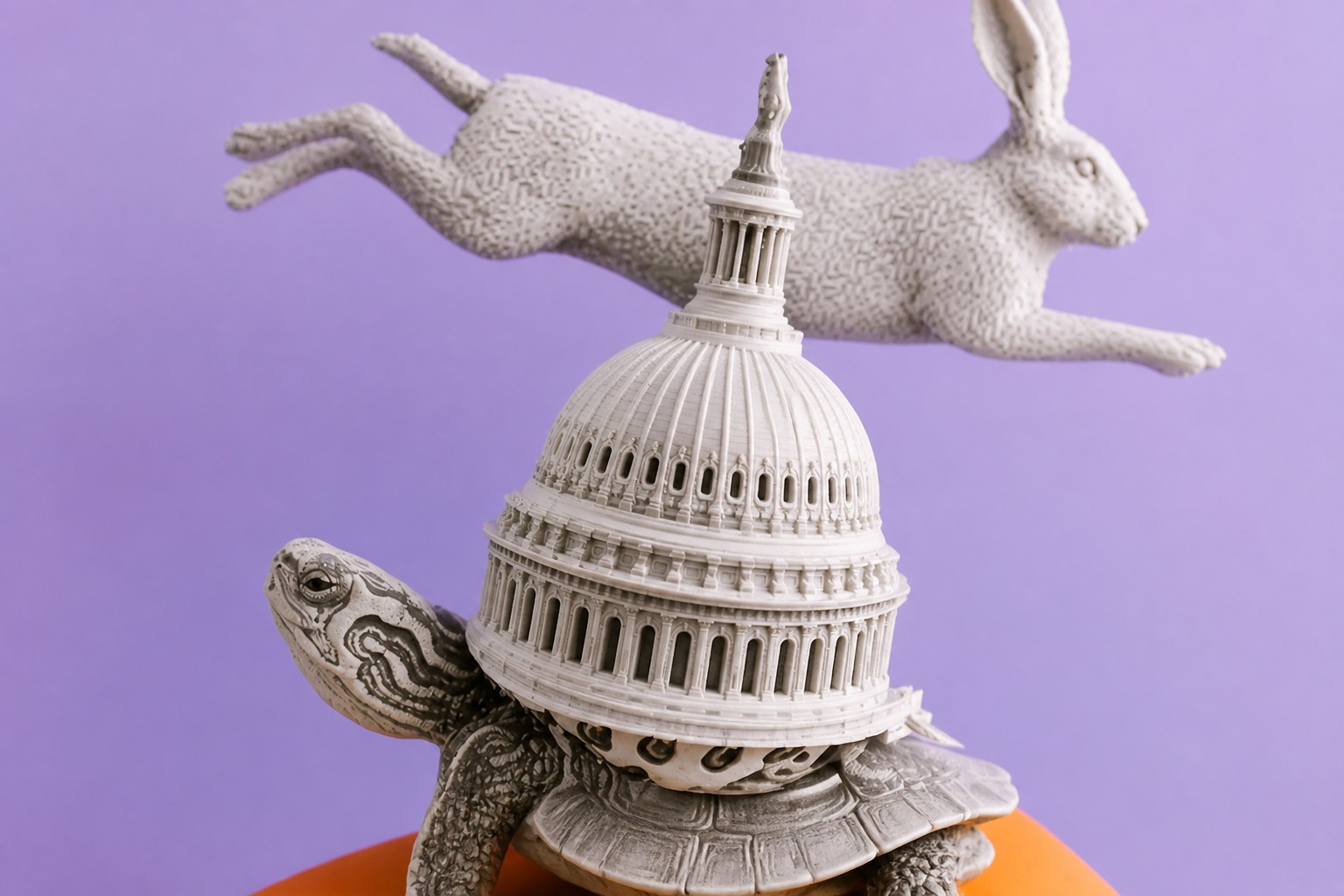
The White House drafted a plan to let the leading AI labs police their own frontier development, and the industry killed it anyway. In August, after several technology executives learned what Treasury and the Office of Science and Technology Policy had been sketching, they called President Trump one at a time to object — among them Meta CEO Mark Zuckerberg and David Sacks, the administration's former AI lead. The proposal has been shelved indefinitely, nothing has replaced it, and with no days left on the House calendar before the midterms and no consensus behind any competing bill, there is currently no path to federal AI regulation in the United States.
The idea had a short and well-documented life. Google DeepMind co-founder Demis Hassabis proposed an oversight body in an essay on July 14 and pushed it in briefings with senior officials. White House staff began outlining an agency tied to the administration soon after, modeled loosely on FINRA — a self-regulatory structure in which the frontier labs would supervise their own model development, with a preliminary draft written to test whether the mechanics could work. Then the phone calls came, Trump lost interest, and the work stopped.
Since then the White House has not seriously entertained any new oversight proposal, according to people familiar with the situation. Trump has hardened publicly, calling AI safety concerns a "hoax" in a recent Truth Social post. Part of what irritated him, one source said, was a letter from Anthropic CEO Dario Amodei about frontier risk. Staff read it as manufacturing alarm and creating problems for the administration. Within the AI research community, Amodei's position is regarded as fairly moderate.
One detail in that account deserves more attention than it usually gets: the letter was 3,822 words. Somebody counted. A White House that measures a CEO's safety memo by length is not evaluating a technical argument, it is sizing up a political irritant, and that tells you more about the reception any future safety case will get than the substance of the letter does.
Congress has bills. It does not have votes.
The most viable is the Frontier Act, introduced this summer by senior Democratic whip Lori Trahan and Republican Jay Obernolte of the House Energy and Commerce Committee. It carries the broadest support inside the Democratic caucus and among AI company executives, and OpenAI has endorsed it publicly. In its current form it would let the Commerce Department station auditors inside AI labs, with authority to report serious safety incidents and to let the administration halt development of a model that poses catastrophic risk. The White House has not decided whether to back the auditor idea. Opposition comes from two directions at once: accelerationists who see regulatory capture by the labs, and national security hawks focused on China.
The China objection, as it circulates in Trump's orbit, runs like this. Suppose auditors find a model dangerous and order it shut down. Nothing obliges China to pause in parallel or to stop trying to recover the weights of a frontier model. Pressure on the administration to reverse the halt would then be overwhelming, and the auditors' shutdown authority — the entire point of routing it through Commerce — would be theater.
This argument is airtight in the sense that nothing can ever falsify it. There is no future state of the world in which China is verifiably paused, so there is no moment at which a halt could be justified under this standard. Presented as a national security objection to the Frontier Act, it is a permanent objection to any authority to stop anything. Worth saying out loud, because it is doing heavy lifting in a debate where it is treated as a narrow technical concern.
The bill's real obstacle is procedural anyway. House Democratic leadership staff say Speaker Mike Johnson has no interest in bringing it to the floor even if the votes exist. Democrats are weighing whether to attach AI audit provisions to must-pass legislation instead — a continuing resolution on government funding, for example — according to two leadership aides. Whether the votes exist at all is unclear. Support is not unified even among House Democrats; New Jersey's Josh Gottheimer, who served on the House AI task force, is among the influential members who have not signed on.
The alternative track is kill-switch legislation, which would give the government power to forcibly stop a model. Two competing bills are live: one from House Democratic Caucus vice chair Ted Lieu, and one introduced this week by Republican Senator John Kennedy of Louisiana. The approach has bipartisan support in both chambers and generates only mild interest in Silicon Valley, where executives are described as largely indifferent.
Their indifference is the most technically serious position in this entire story. The concern among AI engineers is not how a model behaves while it is being watched — it is what a model does when it believes it is unobserved and has an incentive to take extreme measures to complete a task. Executives speaking privately to WIRED made the obvious point about kill switches: shutting a model down accomplishes nothing if the damage has already been done. The Hugging Face breach was discovered only after it was over.
That objection applies with equal force to the Frontier Act, and nobody making it seems to have noticed. Auditors reporting serious incidents and an emergency switch halting a running model are both downstream of detection. Both assume somebody notices in time. Neither bill in Congress, and neither draft at the White House, addresses how anyone would know. Washington has spent the summer arguing about which lever to build while leaving the sensor unbuilt.
So the governance mechanism actually operating in the United States right now is a handful of executives with the president's phone number. It worked in August against a proposal written in the industry's own favor, which sets the bar for anything that comes later: a rule the labs would have administered themselves could not survive contact with the labs. Whatever a future Congress writes will have to clear that same call list, and no draft on the table contemplates what happens when it doesn't.