
What happens inside data centers
Getting access to a large data center has proved difficult. Researchers told Marx that before the generative AI boom and the recent attention on these facilities, it was easier to get inside. He contacted companies but often got no response or was turned down. After visiting data centers in Northern Virginia, Ireland and elsewhere, the journalist went to New Zealand to tour one.
Marx sent his passport in advance to arrange the visit. His document was checked on arrival, and inside the building almost every door was locked; only an access card could open them. In the server room, racks of computer equipment looked like cabinets. Rather than a gloomy room with unusual lighting, Marx saw an ordinary workspace, where vents blew chilled air alongside the servers. The fans were so loud that earplugs would have been useful for a long stay.
Water and electricity as drivers of protest
Marx’s interest in the subject grew after several stories about the effects of data centers on local resources. In Chile, near Santiago, Google and Microsoft were building facilities, and residents worried about access to water and began organizing.
In Ireland, data centers consume more than 20% of the country’s electricity, which Marx says drove up prices and increased strain on the grid. In 2022, the grid operator imposed a moratorium on connecting data centers in the Dublin area. This happened before generative AI triggered a new construction boom.
In the city of The Dalles, Oregon, Google built its first company-owned data centers about 20 years ago. As the water supply agreement neared its end, the company wanted to expand the facilities and secure more water. Residents began asking how much water Google used. A journalist at The Oregonian requested the information from city officials but received a lawsuit instead. About a year later, the data became public: Google used 29% of the city’s water.
These stories coincided with the release of ChatGPT and the start of the generative AI boom. Marx saw that where data centers were already concentrated, they were putting pressure on communities, and similar disputes could begin elsewhere.
Why discontent extends beyond data centers
Marx believes the rapid construction of large data centers demands too much from local communities. The strain comes from electricity and water consumption, as well as the sheer number of facilities. In his assessment, taking total demand into account—especially demand for fossil-fuel energy—this model is incompatible with the planet’s living conditions.
He links it to the ambitions of large tech companies and billionaires who, in his view, impose their vision of the future while everyone else pays for those plans. Marx also questions the promised benefits of generative AI: its economic impact, productivity gains and improvements in access to healthcare and education have not yet materialized as expected, he says.
Environmental strain is only one of the consequences he lists. Others include the effects of chatbot dependence on mental health, the spread of false information on social media and the problem of deepfakes.
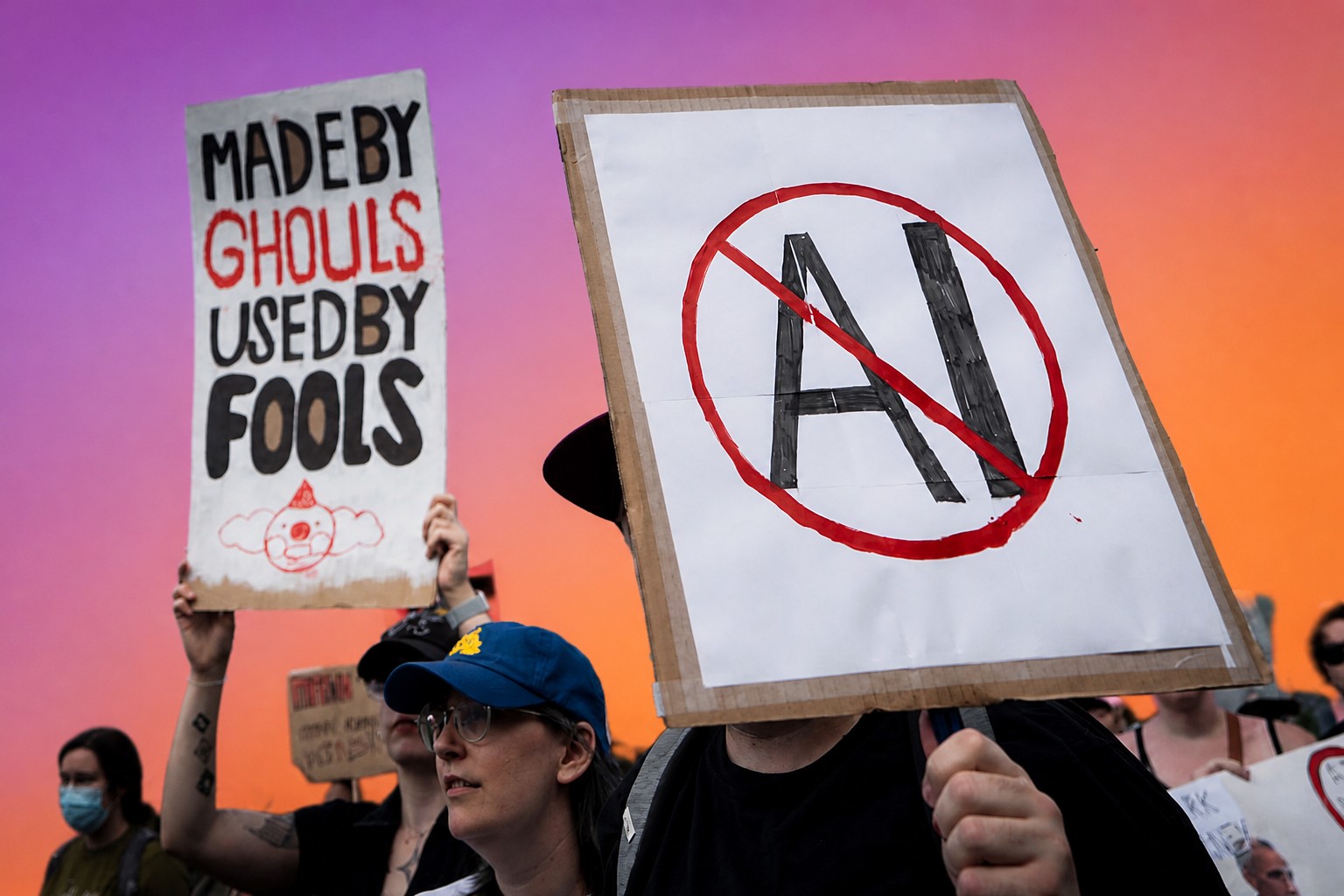
Marx says opposition to data centers brings together people with different political views because the consequences are felt directly: in electricity bills, access to water, noise levels and quality of life. Complaints about tech companies predate this, including concerns about the quality of their products and their impact on society, as well as the industry’s cooperation with the Donald Trump administration and right-wing political groups in different countries. Having a data center nearby makes these disputes tangible.
Similar resistance is emerging around other technologies. Marx cites Flock cameras being installed in the US, Meta smart glasses and Waymo self-driving cars. In his assessment, these projects are easier to challenge directly than abstract digital services: deleting an app from a phone generally does little to affect the company itself.
How companies are responding to resistance
Microsoft, Amazon and OpenAI have announced that they will no longer use nondisclosure agreements in negotiations with local authorities. Marx believes this could make it easier for residents to get information about projects. But he also links the move to the way secrecy fuels resistance: people already know what a data center is, and failing to answer their questions may only intensify protests. Dropping these agreements also lets companies present the decision as a reputational win.
Companies are proposing other measures, too: covering a larger share of the cost of the energy infrastructure data centers require, to reduce the burden on consumers, and changing cooling systems to use less water.
Marx notes that companies talk less about energy and renewable sources than they did a year and a half or two years ago, when renewable and nuclear power were being actively discussed. Now, he says, they focus more on water and use nationwide comparisons. For example, they point out that agriculture and golf courses also consume a lot of water, implying that an individual data center should not be a concern.
But data center water consumption, Marx argues, is primarily a local issue. Some areas may have enough water; others already face severe shortages, and additional consumption can add to the strain.
One industry response is to move from evaporative cooling, in which water constantly flows into the system and evaporates, to a closed-loop system. In this setup, water stays inside the data center and is cooled using electricity, so less water is needed. But cooling the water requires more electricity, Marx says, a point companies do not always mention. The pipes and circuits also contain coolants and chemicals. Residents in areas where data centers with closed-loop cooling are being built fear that leaks could contaminate local water sources.
Scale and demand for computing
Marx is not opposed to technology or data centers as such. He sees their size and pace of expansion as the main problem: in his view, these are what put pressure on local communities and the power system. Data centers have existed for a long time, but society did not pay them the same attention before. Their size and number have changed.
The question, Marx believes, is not just how many resources data centers require, but what they are needed for. If generative AI delivered tangible benefits to people, that resource consumption could be justified. But many people do not see the promised advantages. Against that backdrop, rising emissions and accelerating climate change to expand infrastructure for generative AI raise doubts about whether this is the right path.
Who gets to shape the future of technology
Marx draws attention to how tech company executives talk about the future: they often present it as a single inevitable scenario, with the debate reduced to who will be the first to profit from it. In his view, influential entrepreneurs have succeeded in promoting their own vision of the future, but that does not make it the only possible one.
Another scenario, he believes, would require a different allocation of resources and the development of technology for other purposes. Countries are discussing digital sovereignty and moving away from US companies’ technology. But Marx warns that such initiatives could amount to local companies doing the same things and using the same practices that were criticized in US tech giants.
He also believes technology could be developed more actively in the public sector. He says funding for public technology has increased in Europe, with governments developing tools they need to provide services. He calls this a first step.
Marx also links the possibility of change to the dependence of public services on large companies. He points to a recent Microsoft outage and Google’s threats to restrict schools’ access to search if they do not adopt Google’s AI-based tool. In his view, this is a reason to invest in alternatives that are not owned by large tech companies and could deliver greater public benefit.
Dataist's take: The dispute over data centers goes beyond the choice of technology. It is about who bears the costs of their expansion and who benefits from it. Ending nondisclosure agreements and introducing new cooling systems may change some of the terms of construction, but they do not resolve questions about local water shortages, strain on power grids or the benefits of generative AI.
Daily AI news
Every day we pick what actually matters in AI and explain it plainly — no hype, no filler. Subscribe if you want to follow where the industry is going.
Only what matters — every day
Follow on X