

Steven Kuhn spent four months running teach-ins and knocking on doors in Monterey Park, the city east of Los Angeles that went on to become the first in the United States to ban data center construction outright. He is now running for its city council against an incumbent who backed a large facility. He is not the only one making that move: more than 50 candidates have joined a Working Families Party recruitment drive begun in December that targets local activists who fought data centers, and the party expects the number to double or triple next year. The fight that started as land-use opposition is turning into a slate.
Kuhn's group, No Data Center Monterey Park, organized a heavily immigrant community against a planned facility earlier this year. It held discussions in multiple languages, gathered signatures and canvassed door to door. Six weeks of that produced a moratorium on new projects; a few months later, a permanent ban. Kuhn says the arrival of a data center in his neighborhood changed his life entirely and showed him how democratic machinery breaks down at the local level.
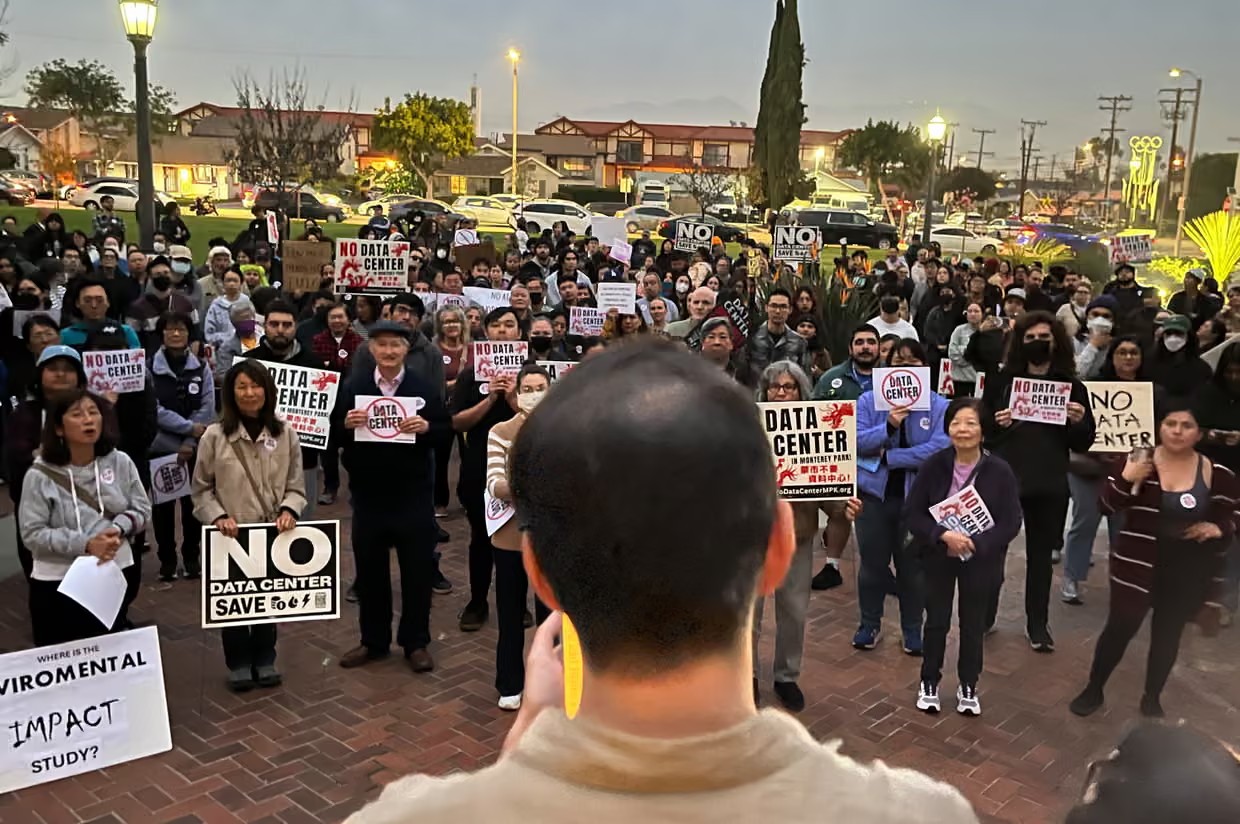
Monterey Park residents gathered at city hall on January 21 to speak against the construction of a data center
Source: theguardian.com
The coalition that produced that result does not map onto any national party. Environmentalists, people who simply do not want it near their house, conservatives and democratic socialists ended up on the same side of the same hearing. Kuhn treats his campaign as a continuation of the same fight; his campaign material shows a red dragon knocking down a facility with its tail. In neighboring Alhambra, Amy Wong, a co-founder of San Gabriel Valley Progressive Action, is also running for city council.
The scale of the obstruction is already measurable. Data Center Watch research found that in the first three months of 2026, residents delayed or killed projects worth $130 billion in total. A Gallup poll in March found seven in ten Americans oppose data center construction near where they live. Those are not fringe numbers, and they explain why a party would build a recruitment pipeline out of them.
Ravi Mangla, the Working Families Party's national press secretary, says most of the applicants are running for the first time and were pushed into it by something that happened in their own community. Many are in Michigan, Texas and Indiana, states with dense data center construction. More still come from swing states that could decide which party controls Congress. Recent wins by prominent progressives campaigning for data center bans, Mangla says, gave the effort fresh momentum.
Jackie McGuire, a cybersecurity specialist in Arizona, had no intention of representing her hometown of Marana until late last year, when she learned of a plan to build a data center on 600 acres of farmland. The project was to cost more than $120 billion. In Marana, a town of roughly 60,000 on the edge of Tucson, residents raised alarms about water consumption, noise and the prospect of higher electricity bills. They were also angry that local officials were not discussing the project openly enough.
In December, a video of McGuire confronting the developer, Beale Infrastructure, at a public hearing went viral on Instagram and her following jumped. For months she watched town officials work around residents' wishes, including rejecting a referendum on the data center. Then she decided to run.

Source: theguardian.com
In July she went into the city council election alongside a group of anti-data-center activists. Partly because of the name recognition she already had, she was the only one of them to win a seat. McGuire has said she joined the race at the last minute because the project's opponents needed a majority on the council. They did not get one, and she does not consider the fight over. As an elected official, she intends to push for a referendum that would require voter approval for data center construction.
Oregon shows what the same energy does to a state legislature. Discontent over data centers helped decide a state senate primary in July, when Myrna Muñoz, a teacher, beat incumbent senator Janeen Sollman, who had backed a contested bill allowing more farmland to be converted to industrial development. Muñoz is expected to win the general election in a district Democrats hold comfortably. She says that before her campaign began in March she had no idea how many facilities were planned for Hillsboro, the city considered the birthplace of the state's tech industry. Shortly before a moratorium took effect in late July, the city approved 17 new projects on top of more than 30 sites already operating.
Those 17 approvals, Muñoz says, came with tax breaks running to 2050, which in her view takes public money away from her children and grandchildren. She and four other state legislators support a three-year moratorium on new data center construction across Oregon, plus additional rules for facilities already running.
Mangla describes the conflict as working people against powerful oligarchs who want to go around local interests and take resources from communities, and says it is sharpest in the Midwest and South, where construction is fastest. Saul Levin, program director at the Center for Nonviolent Conflict Research, says the movement has pulled in farmers, teachers and salon workers alike. Levin notes that AI companies are spending on software and data centers a sum comparable to the US military budget, and argues the money could go to hospitals and schools instead of buildings that store data about people.
Here is what I think the numbers actually show. The movement's power is real but narrow: it lives entirely in municipal land-use authority, which is the one place where a $120 billion project is weaker than a town of 60,000. That is why the wins look so lopsided — a permanent ban in Monterey Park, $130 billion stalled nationally in a quarter — and it is also the ceiling. McGuire won her seat and still lost the majority she ran to build. Hillsboro's 17 approvals were signed before the moratorium, with abatements that outlast every official who voted for them. Winning the council after the vote is a poor remedy, and the candidates know it: McGuire's answer is a referendum requirement, Muñoz's is a statewide moratorium. Both are attempts to move the decision somewhere the developer cannot outwait them.
What nobody in this story addresses is where the compute goes. A cancelled project in Marana does not cancel the demand behind it; it relocates the facility to a jurisdiction with no organized opposition, which in practice means poorer places with weaker planning boards. The movement is measuring its success in projects stopped, which is the one metric that says nothing about whether anything was prevented or merely moved. Notably absent from any of it is the industry's own voice — Beale Infrastructure appears here only as the developer being shouted at in a hearing room.
Kuhn, meanwhile, has widened his ticket ahead of November: protecting immigrants from ICE, and cancelling the city's contract with Flock, the AI-based camera and license plate reader system that has raised privacy concerns and become its own local fight. He reads his campaign as a version of what is happening nationally, with residents seeing that something has to change.
The tax breaks in Hillsboro run to 2050. Whatever the activists win in November, they will be taking office inside contracts signed by the people they beat.