A student at machine speed
A personalized AI tutor sounds simple: the system sees exactly where a particular student is stuck and tailors the explanation to them. In practice it all comes down to one thing. Figuring out which explanation helps which student takes slow, expensive data from real people.
The authors of StudentSim propose a way around that: build the AI tutor together with a student simulator. Such a simulator has to do two things at once. First, behave like a real student: make their mistakes, pick their answers, show their skill level. Second, revise its answer after a teacher's hint the way that student would after being helped.
This is where the trouble starts. The usual approaches can do one or the other. Models that track a student's skill level well barely understand explanations written in text. Large language models are the opposite: they hold a conversation easily but keep a specific student profile poorly. They play an "average student" rather than this student with their habitual mistakes.
The authors want to merge both halves into one system — and to test whether such a simulator helps improve the AI tutors themselves.
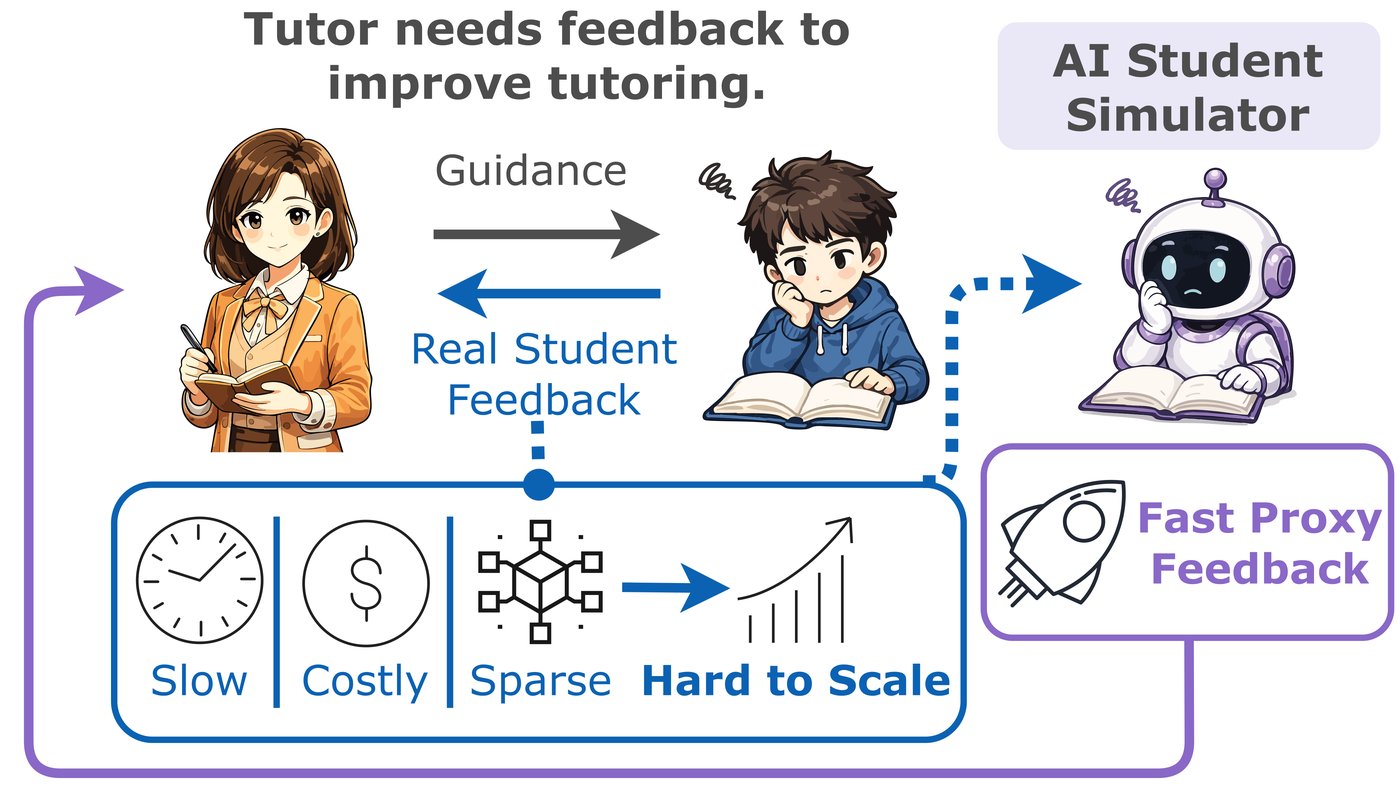
The paper's idea in one frame: real students give little feedback and give it slowly, while a student simulator gives feedback at machine speed.
What they propose
The paper's core idea is to score a student simulator on two separate axes.
🟠 Behavioral match: how closely the simulator reproduces a specific student's actual answers.
🟣 Hint responsiveness: how well the simulator corrects itself toward the right answer after the teacher's explanation.
That split clarifies a lot. If a model copies a student's mistakes well but cannot read a hint, you cannot train a tutor through it. If a model responds beautifully to explanations but starts from the wrong level of knowledge, it is a bad student double too.
The authors call the scheme StudentSim and the evaluation protocol StudentSimEval. They test all of it across three very different domains:
🟠 Chess
🟣 English writing as a second language
🟠 Math
The benchmark holds 60 students in total: 30 chess players, 15 English learners and 15 math students. Each comes with a personal history of answers. The model is fine-tuned on that history and then tested on new examples it has not seen.
In short:
🟠 2 metrics for scoring the simulator
🟣 3 domains to test in
🟠 60 students in the benchmark
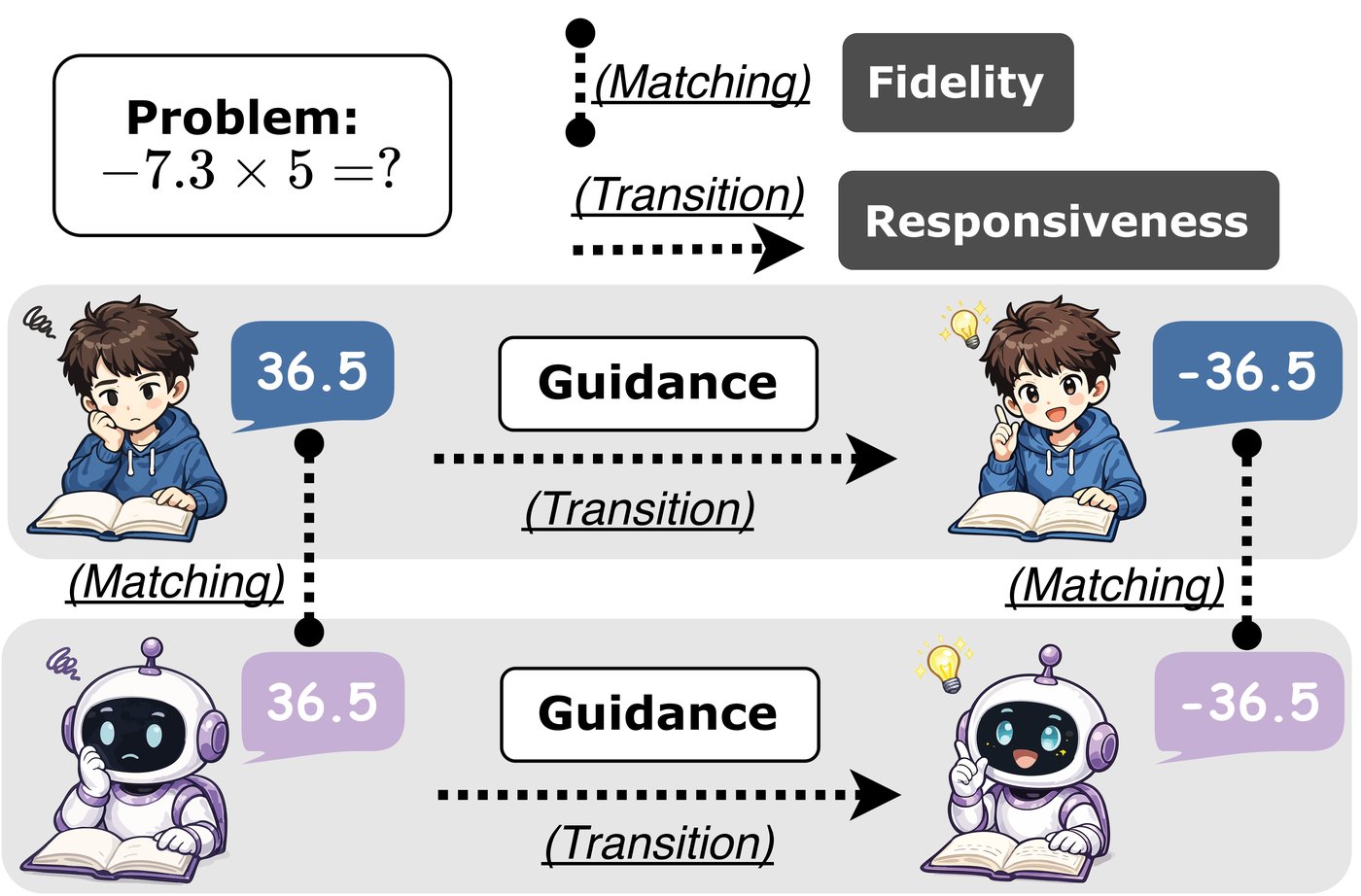
The paper's two headline metrics: the simulator has to resemble the student and to move in the direction of the teacher's hint.
Why the old approaches fall short
The problem is a practical one. The student simulator exists to train the tutor. So it has to give useful feedback.
The older approaches are lopsided here.
🟠 Knowledge-tracing models are good at guessing typical mistakes and skill level, but usually have no proper input for a teacher's natural-language text.
🟣 An LLM prompted to "play this student" reads explanations and holds a conversation easily, but often answers like a smarter model, or simply a different one, rather than like the student in question.
Chess makes this visible. Maia2, a purpose-built model, predicts players' moves from their rating reasonably well, but is close to useless once you hand it a written hint from a coach. GPT-class models are the reverse: better at reacting to an explanation, worse at reproducing a particular player's style and strength.
In the paper's terms: some models sag on behavioral match, others on hint responsiveness.
The StudentSim pipeline
Technically the solution is straightforward. The authors do not try to train a separate model from scratch for each student: there is far too little data on any one person. Instead they use a two-stage pipeline.
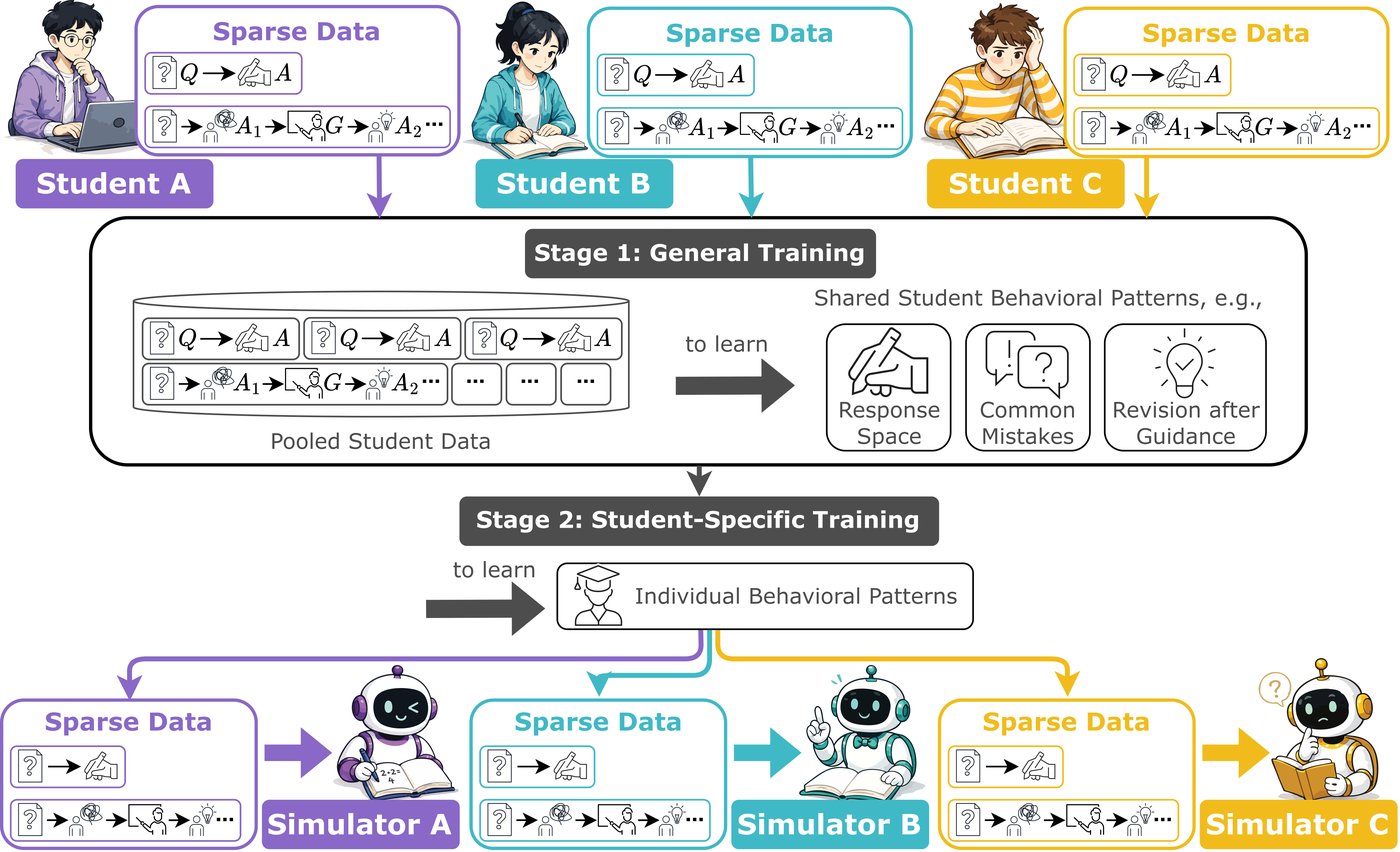
The two-stage pipeline: first a shared model trained on data from many students, then fine-tuning for one specific student.
In the first stage the model trains on data from many students in a single domain. That gives it the general regularities: typical mistakes, the format of answers, the ways of reacting to an explanation.
In the second stage that shared model is fine-tuned to a specific student on their own data. The result is a separate simulator for each person.
The base model is the same throughout the experiments: Qwen3-4B-Instruct with LoRA adapters. That matters for two reasons. First, the system is relatively compact. Second, the result is not explained away by the authors simply reaching for a giant closed model.
The mechanics, briefly:
🟠 Step 1: collect data from many students in one subject domain.
🟣 Step 2: train a shared model on the common patterns.
🟠 Step 3: fine-tune a copy of that model on one student's data.
🟣 Step 4: end up with a personal simulator that knows both the subject and the quirks of the person.
This matters because in a real education system you almost always have little data per student. In the English corpus the authors chose, the median student wrote just three texts. At that volume, without the shared pretraining stage, the model overfits fast and starts simply memorizing examples.
The pipeline, compressed:
🟠 first a shared model across many students
🟣 then personal fine-tuning for one student
How the simulator is evaluated
The evaluation is carefully built too. For each student there are two kinds of records.
🟠 Single-turn records: a problem and the student's answer. These give the behavioral match.
🟣 Multi-turn records: a problem, a wrong answer, the teacher's hint and the canonical corrected answer. These give hint responsiveness.
Chess is the easiest case to explain. There is a position and the move the player made — that tests behavioral match. And there is a position, the player's bad move, a written hint from the coach and the engine's best move — that tests hint responsiveness.
In English the target is different: the simulator has to reproduce the student's error profile in the text, and after the teacher's correction fix the right fragment. In math the model first has to guess the specific student's answer, then move to the correct one after the explanation.
The results
The headline result is simple: StudentSim beats both large closed models and purpose-built behavior models on both metrics at once.
The chess numbers are the clearest:
🟠 Behavioral match: StudentSim 0.51, GPT-5.4 0.23, Maia2 0.45
🟣 Hint responsiveness: StudentSim 0.91, GPT-5.4 0.72, Maia2 0.27
So Maia2 is still decent as a behavior model, but it barely learns from a written hint. GPT-5.4 reacts to an explanation well enough, but holds the student's identity and level poorly. StudentSim is the rare case where both axes are high at the same time.
The same picture repeats in the other two domains.
In English:
🟠 Behavioral match: 0.56 for StudentSim against 0.51 for GPT-5.4
🟣 Hint responsiveness: 0.64 against 0.60
In math:
🟠 Behavioral match: 0.64 against 0.61
🟣 Hint responsiveness: 0.92 against 0.71
On paper the English gaps look modest, while chess and math are already clear. The overall pattern matters more: a fine-tuned personal simulator consistently beats a model that is merely prompted to act out the student.
Results, compressed:
🟠 chess shows the largest gap
🟣 English shows a modest gap
🟠 math shows a clear gap again
🟣 personal fine-tuning beats prompting
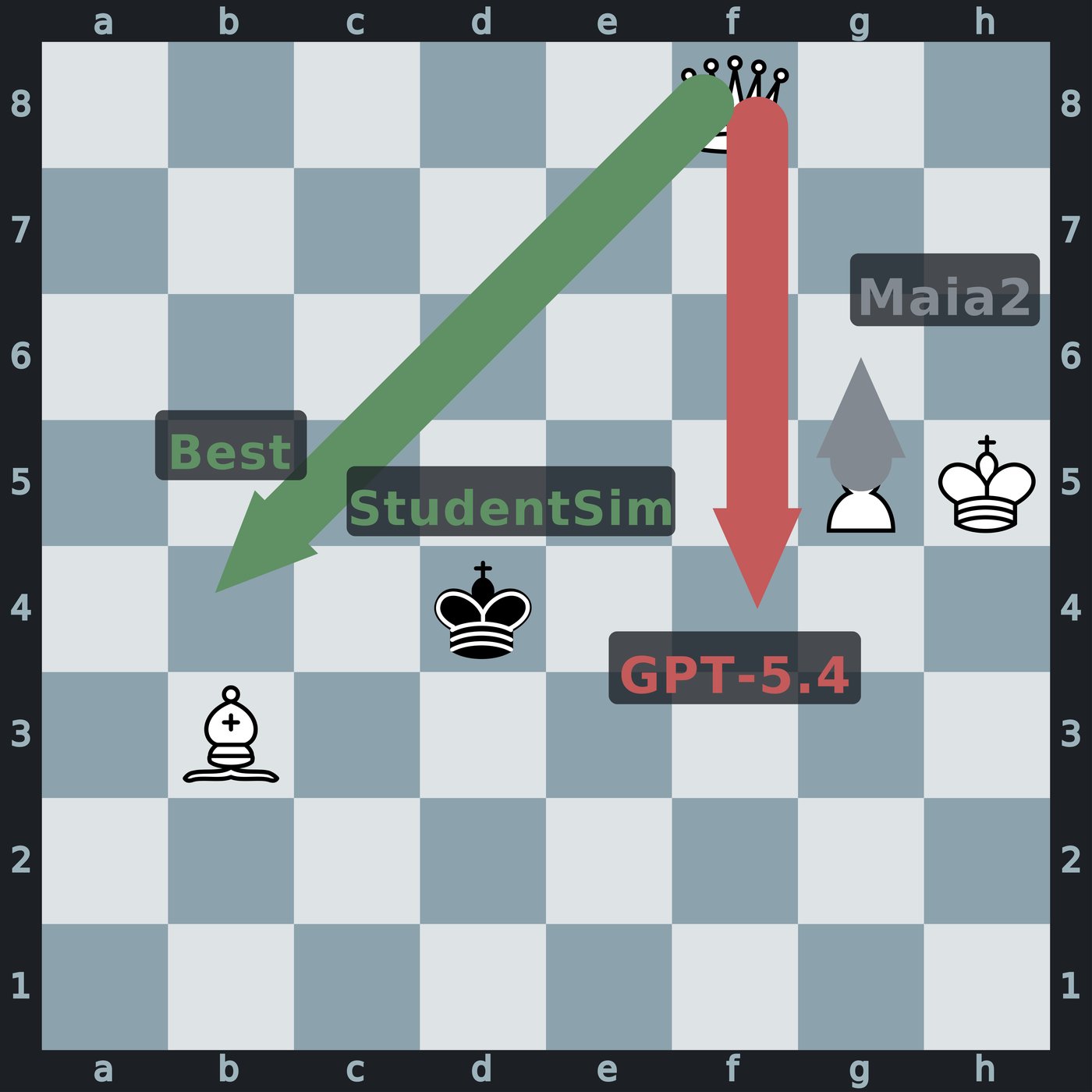
Hint responsiveness in chess: after a Socratic nudge StudentSim arrives at the right move, while the baseline alternatives get it wrong.
There is also a telling chess demo. The player blunders. The coach does not name the right move outright but gives a Socratic hint: compare this move with a queen check from the flank, think about where the king goes, what gains tempo. Maia2 simply repeats the bad move. GPT-5.4 gets the idea but picks a different, wrong check. StudentSim lands on exactly the best move. It is a test of whether the model is copying an answer out of the text or genuinely moving in the hint's direction.
What it is for
The authors use the student simulator as a reward source for training an AI tutor with reinforcement learning.
The loop works like this:
🟠 Take a real student mistake.
🟣 The tutor generates a hint.
🟠 The frozen student simulator answers again after that hint.
🟣 If the new answer is better than the old one, the tutor gets a reward.
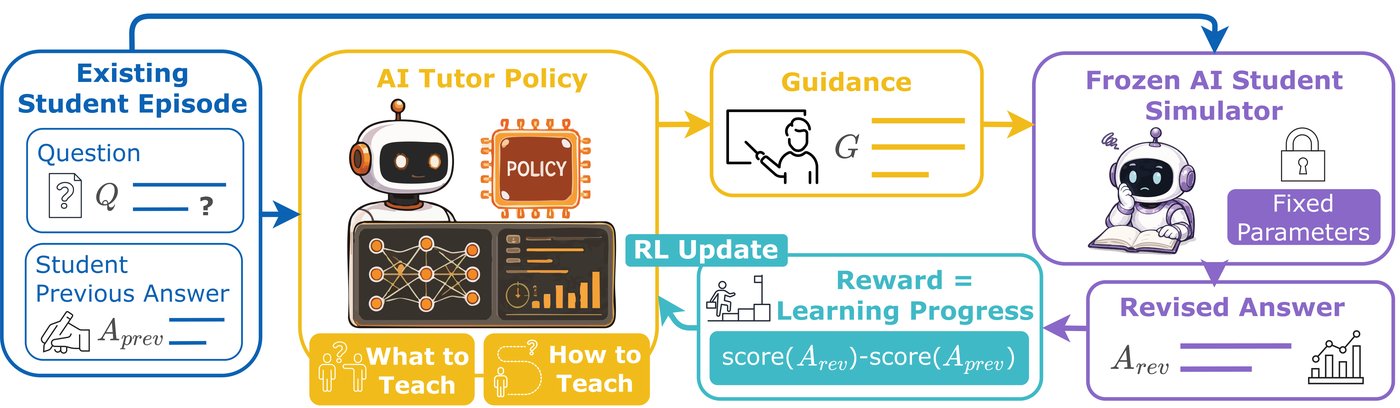
The student simulator as a reward source: the tutor offers a hint, the simulator answers again, and the improvement in that answer becomes the training signal.
The real question is whether models like this can actually improve a teaching system.
In the chess experiment the answer leans yes. Human experts rated the tutor trained on StudentSim's reward above:
🟠 the baseline tutor with no reinforcement learning
🟣 a tutor trained against a GPT-5.4-based simulator
Ratings covered three axes: accuracy, explanation quality and personalization. The StudentSim version came out ahead on all three. The accuracy gap stands out: 90.5% of answers free of serious factual errors, against 75.7% for the baseline and 71.6% for the version rewarded by GPT-5.4.
The tutor, in short:
🟠 StudentSim gave the best training reward
🟣 accuracy improved the most
🟠 in chess this already works in practice
If you want to train an AI tutor offline, a chatty fake student is not enough. You need a simulator that responds plausibly to help.
Limitations
Practical as the idea is, the paper is candid about where the approach stops.
First, hint responsiveness is still measured against a canonical correct answer, not against what this particular student would really have done after the same hint. That is reasonable for training a tutor, but it is not the same as human behavior step by step.
Second, the best tutor result is shown in chess only. Chess is convenient for the experiment: an engine gives a clean quality score for any move. For open-ended text tasks — writing, or math with a worked solution — that kind of reward is much harder to build.
Third, the simulator mostly describes a single correction step rather than a long learning trajectory. It can say how the student answers now and how they shift after a hint. It does not fully model how a student remembers, forgets, transfers knowledge to new problems and changes across many sessions.
The takeaway
StudentSim offers a new frame for AI in education: stop thinking about a student simulator as role-play and start measuring it on two concrete properties — does it resemble the student and can it learn from a hint.
Several things follow from that.
🟠 A prompted LLM is not enough if you need a specific student rather than an averaged interlocutor.
🟣 A purpose-built behavior model is not enough if it cannot understand a teacher's help in text.
🟠 A two-stage pipeline with a shared model and personal fine-tuning works better on sparse per-user data than trying to train everything separately.
🟣 A student simulator can serve as a working part of the harness for training a tutor, not just as a research toy.
Seen more broadly, the paper attacks one of the central problems in education AI: where to get scalable feedback about which explanations actually help which students. Real students are few, expensive and slow. A simulator does not replace them entirely, but it can become the intermediate layer where you at least train the tutor against something rather than nothing.
AI papers in plain words
Every day we read the new AI papers and retell what matters in plain language — no hype, no filler. If you want to see where AI agents are heading before everyone else, subscribe.
New breakdowns every day
On Telegram