A protocol that lets AI scientists share instruments across labs

Autonomous AI scientists can already read papers, propose hypotheses, run computations and even drive experiments. But in real science their abilities tend to stay locked inside one lab — a particular pile of scripts and informal agreements about where the data sits and how the instruments get used. The moment a team tries to move that stack to another lab, or to repeat someone else's experiment, the trouble starts: incompatible formats, scattered access rights, different safety rules and no shared research context.
The authors of SCP: Accelerating Discovery with a Global Web of Autonomous Scientific Agents argue the problem is infrastructural. What is missing is not one more agent with a clever prompt, but a protocol that lets agents, people, software and physical instruments operate inside the same scientific process — with legible access rights, logging and reproducibility.

SCP: a protocol for scientific context
SCP (Science Context Protocol) is meant to be an open standard that turns scattered resources — from datasets and models to robotic workstations — into interoperable building blocks. Two things matter here.
The first is a single way to describe and connect resources. A tool is not only a function in code; it can be an instrument in a lab, a complicated pipeline, or a composite procedure carried out by a multi-agent system. Resources publish their capabilities against a common schema: what they take as input, what they return, what the constraints are, and what side effects are possible. That makes composition far easier — new experiment chains can be assembled out of the same bricks.
The second is experiment lifecycle management. In SCP an experiment is not a loose set of calls but an object with an identifier, metadata, state, logs and data provenance. That is what reproducibility needs: you can see what was actually run, in what order, with which parameters, and why the system made the decisions it made.
How it works
The architecture goes like this. There is an SCP Hub — a central node that holds the experiment's context, checks permissions, proposes execution plans and supervises the run. And there are SCP Servers — edge nodes in labs, data centers or clouds that actually have access to the resources: instruments, models, databases, compute clusters.
The Hub does not simply forward requests. It tries to assemble an executable plan for the experiment's goal, weigh latency, cost and risk, and then orchestrate a multi-step pipeline. Once a run is under way, the Hub receives statuses and results in real time, and can pause the process, resume it, end it, and record all of it in an archive.

A platform of 1600+ tools
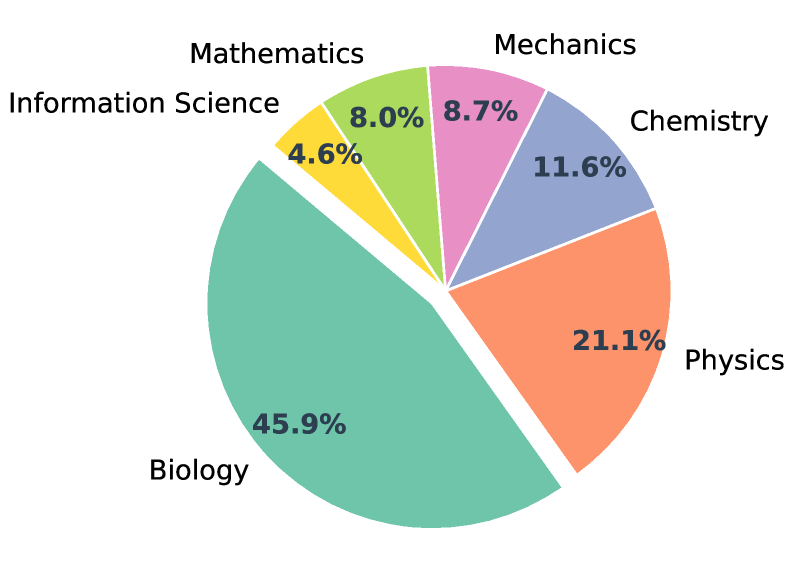
To show the scale of the idea, the authors built a platform on top of SCP called Intern-Discovery: an ecosystem of more than 1600 tool resources. These are tools reachable through one shared interface, which widens the action space available to agents and lowers the price of integration.
One detail stands out — a heavy tilt toward biology and adjacent fields: almost half the tools sit in that cluster. It makes sense. Bioinformatics and chemistry are exactly where the databases, formats and processing stages are most heterogeneous, and hardest to wire together by hand.
Four cases of the protocol at work
The first case is automated design and execution of a wet-lab protocol. The user states a goal, the system turns it into a structured plan and then into commands for specific devices. From the outside it looks like one managed run rather than a chain of manual handoffs between applications.

The second: reproducing a protocol from a PDF. Plenty of labs live in a world where the ground truth is a lab manual or a paper's supplementary material. SCP takes the PDF, extracts the steps and parameters, converts them into a standardized JSON object, then checks compatibility with the instruments on hand and compiles everything down to device-level instructions. That is a direct answer to the reproducibility problem.

The third case is computational — molecular screening. The run starts with 50 molecules, filters them on similarity and toxicity metrics, prepares the protein structure and picks a final candidate. What SCP adds here is that the entire chain of actions is recorded in one context instead of sprawling across scripts and temporary files.

The fourth case is fluorescent protein engineering: from sequence design and property prediction through assembly, culturing and measurement.

What this changes for science
For autonomous AI scientists to become portable and genuinely scalable, they need a shared protocol — one with experiment context, security, logs, identifiers and lifecycle management. That is what SCP offers, adding an orchestration layer over heterogeneous resources and cutting the manual overhead of integration.
If the approach catches on, the payoff will not only be speed. The bigger bet is on reproducibility and cross-institutional collaboration across scientific disciplines.
AI paper breakdowns
Every day we read the new AI papers and retell what matters in plain language — no hype, no filler. If you want to see where AI agents are heading before everyone else, subscribe.
New breakdowns every day.
On Telegram