BERT's word predictions track the brain's N400 during natural listening

Why the brain predicts words
We almost never hear speech as a stream of unexpected sounds. The brain is constantly guessing at the next word and checking itself as the sound arrives. That mode is cheap: the sharper the expectation, the less effort recognition takes. Prediction in vision and hearing is well documented, but semantics — the meaning of words — has long been the hard case. The authors of this study take an important step: they show that word predictability, scored by a BERT-based large language model, lines up with people's neural responses as they listen to natural speech — a German audiobook.
Testing the idea on real listening
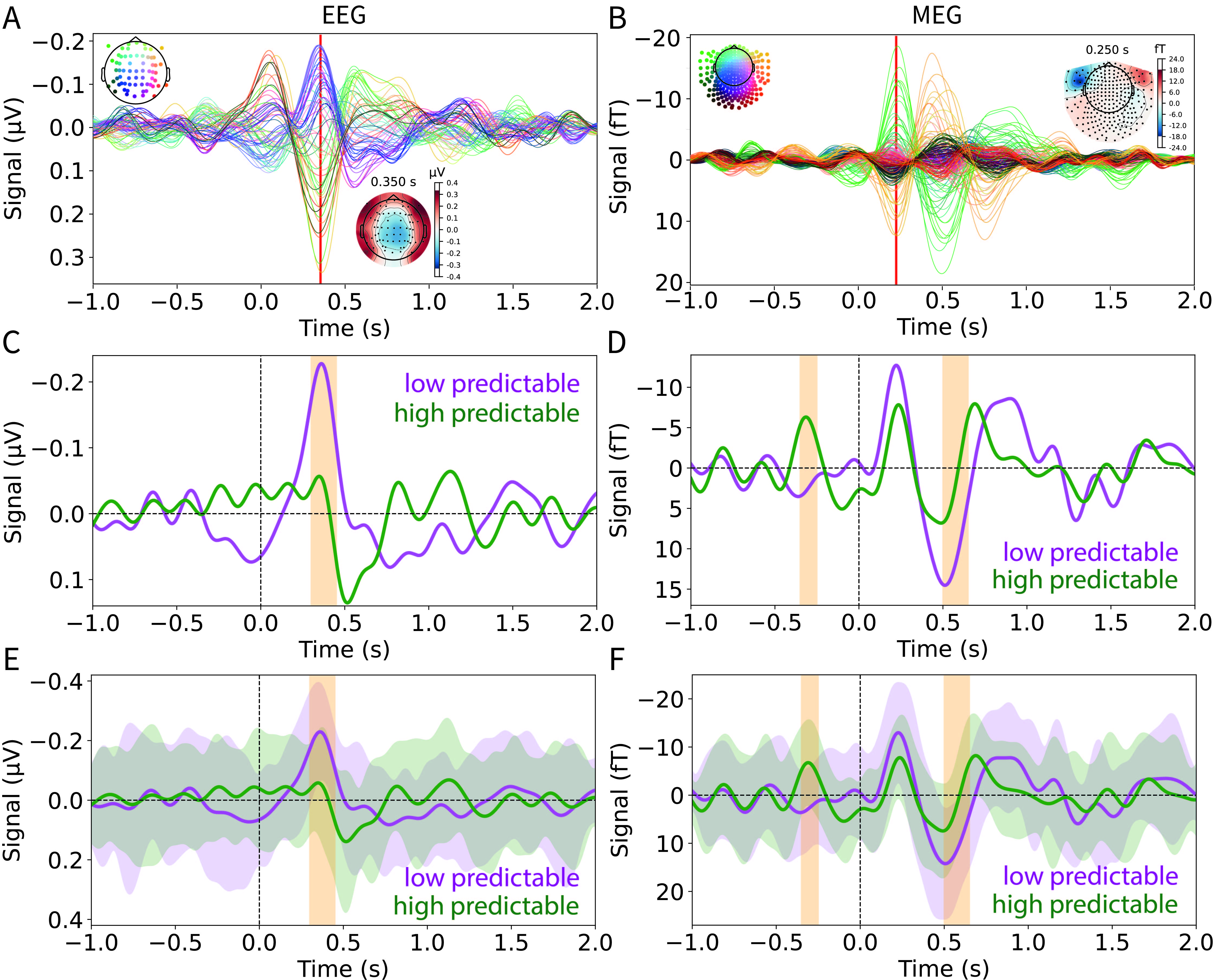
29 participants lay in the scanner listening to audiobooks for about 50 minutes. The researchers recorded MEG and EEG at the same time, to see both when and where in the brain responses to words arise. The key measure is the N400, a negative wave roughly 400 ms after word onset. It is well known for shrinking when a word is expected in context and growing when the word surprises the brain.
How an LLM put a number on expectation
To quantify how expected a word is, the authors took a German BERT and, for every noun in the text, computed the probability that this particular word belongs in the masked slot. In effect, the model of the world that BERT learned from large corpora in a single text modality supplied a numerical estimate of predictability.

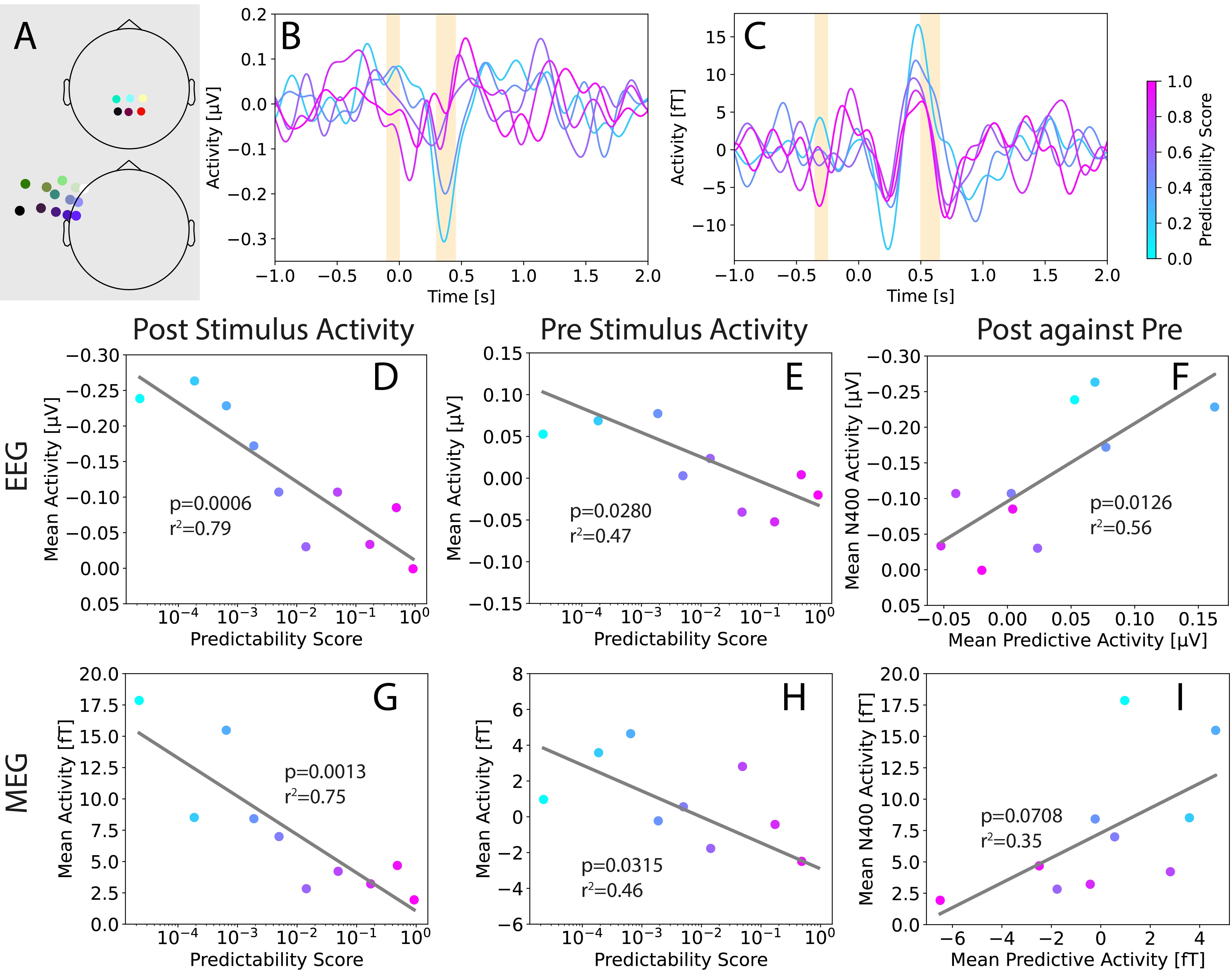
The authors cared mainly about nouns, which carry much of the meaning. They compared groups of high- and low-predictability words, and separately looked for smooth, graded effects by splitting the full range into ten bins with equal numbers of examples.
What the brain signals showed
The result is strikingly consistent. The higher the BERT predictability, the weaker the N400 in EEG — as if an expected word costs the brain less to recognize. MEG showed the same picture, plus something more interesting before the word began. In MEG, anticipatory activity appeared 300–350 ms before sound onset; in EEG, 100 ms before it. And the higher the predictability, the stronger that preparation, especially in the left frontotemporal region — a classic hub of the language network.
Where in the brain the effects come from
The authors reconstructed the cortical sources of the activity. After word onset, the stronger responses to unpredictable nouns came from parietal and sensorimotor areas. That may mean that when a word is not guessed, the brain recruits wider networks, motor ones included, to sharpen its hypothesis about what it just heard. Before word onset the pattern flips: predictable words drove more preparation in left frontotemporal circuits, as if the brain were switching on the representations it expects to need.

What matters is that the effects are graded. Split all the words into ten steps of predictability and N400 amplitude falls evenly from low to high predictability, while prestimulus activity rises. The strength of the anticipatory signal and the size of the following N400 are negatively related: the better the preparation, the less is left to process.
Why this matters for neuroscience and AI
The work shows that predictability estimates from BERT really do resonate with how a listener's brain handles language under live conditions rather than lab ones. It is a bridge between cognitive neuroscience and AI: the statistical expectations of an LLM reflect a real predictive strategy in the brain. For basic science, the key to meaning lies in the dynamics of expectation and its precision: when the context is reliable, the brain commits to the next word more boldly and is surprised less.
So the brain and large language models are not built alike, but one principle unites them — predicting the next word. It shows that the statistical expectations of AI capture the brain's predictive strategy during speech perception surprisingly well.
AI paper breakdowns
Every day we read the new AI papers and retell what matters in plain language — no hype, no filler. If you want to see where AI agents are heading before everyone else, subscribe.
New breakdowns every day.
On Telegram