
When reminders stop being enough
Picture a simple scene. An older person has missed a dose of medication. An ordinary digital assistant sends another notification. A robot might roll over and bring the pills. Neither one understands the thing that actually matters: did the person forget? get confused? feel unwell? change their mind and decide to skip it?
That gap is where the new paper ComBodied Agents: a New Paradigm of Human-Centric Agentic AI begins. The authors propose a new class of AI agent whose primary goal is to understand a person's state over time and to help in a way that preserves their independence.
This sounds like a relabeling exercise. It isn't. Most AI agents today are judged by how many tasks they completed on a person's behalf; the paper proposes a different criterion: what the person is left with after the help. Do they understand the situation better? Did they keep control? Have they become dependent on the system? Have their skills, and their ties to other people, weakened?
What a combodied agent is
The authors coin a term that joins two worlds: digital agents and physically embodied systems. But the new agent is not the sum of the two. Its focus is the human state.
The paper includes a diagram of three "centers of gravity" for agentic systems: digital states, physical states and human states.
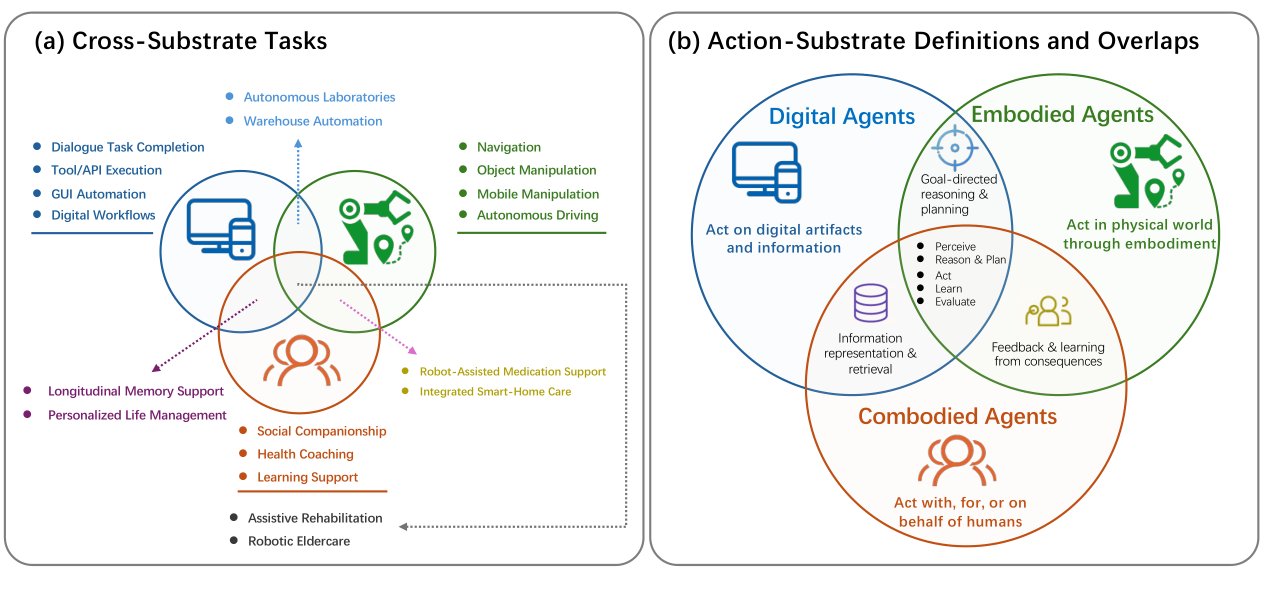
The three classes of AI agent differ in what they change: the digital environment, the physical world, or a person's state.
The idea goes like this:
🟠 Digital agents change digital objects: code, documents, web pages, API calls, work pipelines.
🟠 Embodied agents change the physical world: they move, manipulate objects, operate in simulation or in robotics.
🟠 Combodied agents track how the person changes: health, attention, habits, emotions, goals, relationships, the capacity to make decisions.
The authors make a point of this: the channels of action can be anything. Such an agent might talk to you in a chat, read data off your watch, switch on a robot, message your doctor, book an appointment, or say nothing at all. What matters is not the shell but what the system is acting for.
Where a digital agent optimizes task completion and a robot optimizes control in an environment, a combodied agent optimizes long-term benefit to the person.
Why this matters
Agentic systems increasingly do the work for us. In the short run that is convenient. The convenience has a price.
Task success and human benefit are not the same thing. A model can draft your email quickly, and you end up understanding the subject less well. An assistant can make the decision for you, and you never learn to spot the risks. An emotional companion can keep a conversation going, and over time start crowding out real relationships.
The paper turns this into technical requirements:
🟣 Metrics for preserved independence. Not just "completed the task," but "left the person a choice," "helped them understand," "created no dependency."
🟣 Long-term memory with a right of correction. If an agent knows a lot about a person, the user has to see exactly what was stored and be able to fix or delete it.
🟣 Limits on intervention. Even when the system is confident it knows the best next step, it should have no unconditional right to act.
🟣 A new model of evaluation. The question is now whether the agent improves a person's life without costing them control.
This matters well beyond medicine and elder care. The same principle applies to education, productivity, mental health, personal planning, fraud protection and looking after children online.
How such an agent works
At the center of the paper is a closed loop with four parts: perception of the person, long-term memory, a personal world model and an intervention policy.
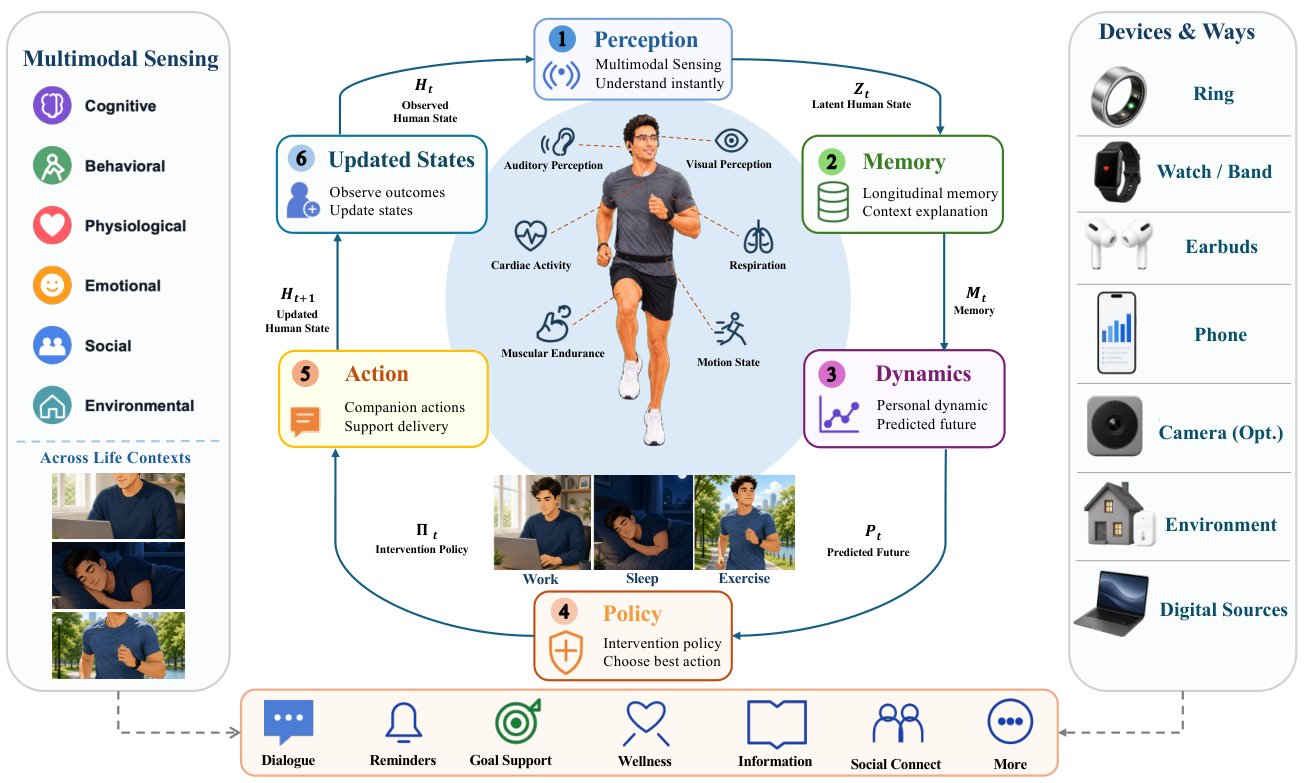
A functional diagram of a combodied agent: observation, memory, personal world model, choice of support and feedback.
In plain terms, the cycle looks like this.
First the agent gathers observations. Text, speech, images, watch data, a calendar, activity history, clinical records, signals from the home, notes from relatives. The paper draws a line immediately: collecting everything is not allowed. Only the data that bears on the agreed task of helping.
Then the system turns raw data into meaningful events. Not "heart rate was 110," but "after ordinary exertion, recovery is taking longer than usual." Not "the user went quiet for six seconds," but "repeated pauses have appeared in a familiar task."
Next comes long-term memory. It stores not bare facts but a history of change: goals, habits, constraints, relationships, past interventions and how they turned out. And the memory has to be correctable: the user can say "no, that's wrong," and the system is obliged to take it into account.
After that the personal world model goes to work. This is one of the paper's central terms. The model does not try to build a full digital copy of a person. It does something more modest and more useful: from the history of events and the current context, it estimates what is probably happening now and how the situation might develop under different courses of action.
Finally, the intervention policy decides whether to do anything at all. Sometimes the right move is a reminder. Sometimes a clarifying question. Sometimes nothing. Sometimes handing the matter to a human: a doctor, a relative, a teacher, a colleague.
A personal world model instead of a "digital twin"
One of the more interesting moves in the paper is the refusal of the full digital twin. The authors say it plainly: an exhaustive model of an entire person is unrealistic today and probably harmful as a goal.
What they propose instead is a task-bounded personal world model. It knows exactly as much as its specific domain of help requires, and it always carries its uncertainty with it.
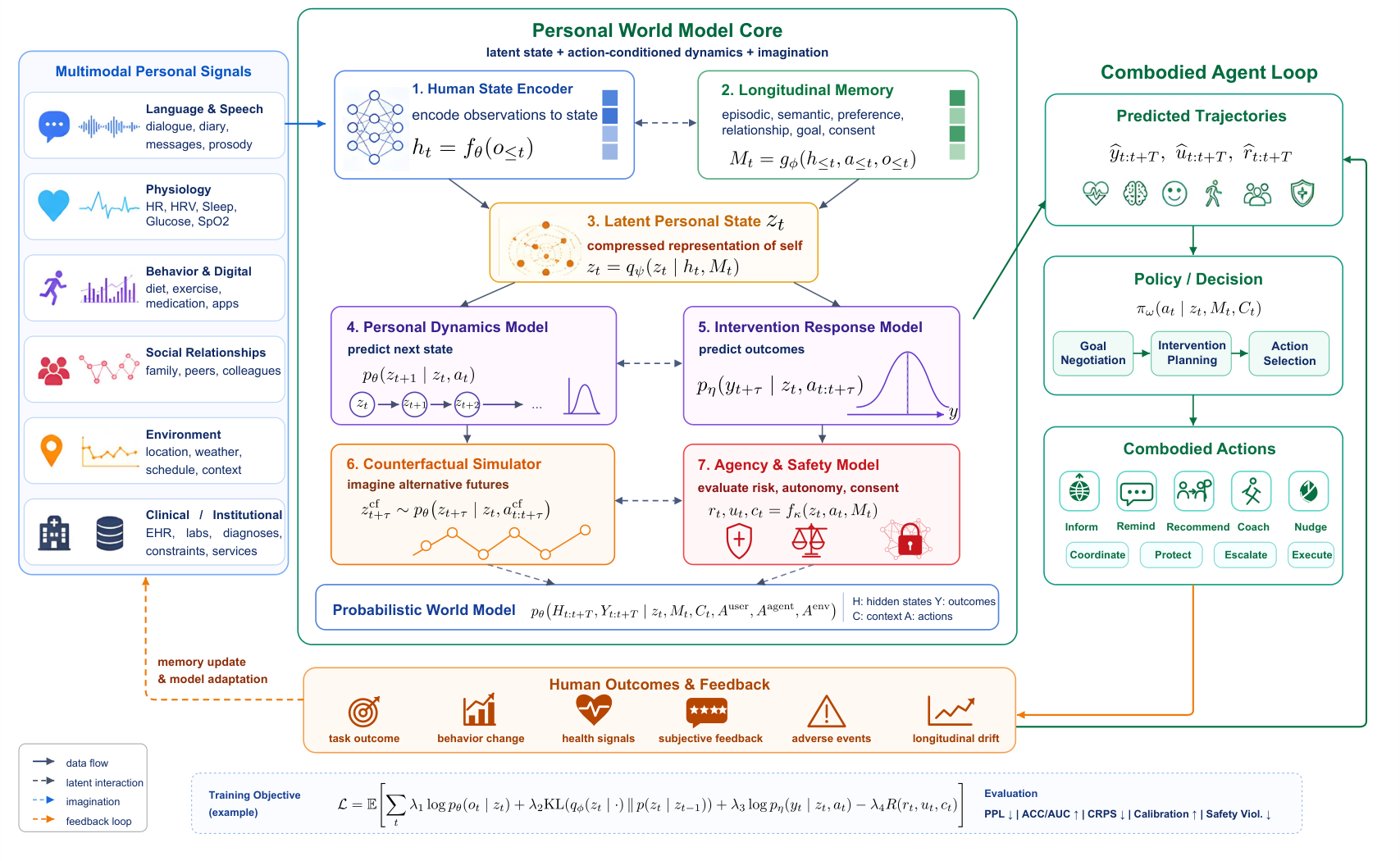
The personal world model predicts how a person's state, the events around them and the outcomes will change under different courses of action.
One boundary is drawn over and over in the paper:
🟠 An observation is raw data: a phrase, a heart rate, a route, a calendar entry.
🟠 An event is an interpreted fragment: a missed dose, unusual fatigue, a shift in sleep pattern.
🟠 A state is a hypothesis about the person: confusion, stress, declining health, falling motivation.
🟠 A prediction is a version of the future: what may happen if the agent steps in, and what may happen if it doesn't.
🟠 A permitted action is a separate decision, one that has to account for consent, risk, reversibility and the person's right to say no.
Put differently, the paper is trying to stop the system from jumping straight from a signal to an action. It works like a built-in brake: even a good prediction is not permission to intervene.
The signals an agent reads
A large part of the paper is about perception, and here the authors are careful. They are not selling the fantasy of a machine that reads people. They describe a reality in which the data is noisy, sparse, incomplete and often ambiguous.
The sources can be:
🟣 Text and language. Messages, notes, journals, answers to questions, corrections to the agent's memory.
🟣 Speech and audio. Pauses, pace, intonation, changes in the voice, and the sounds around it.
🟣 Vision. Posture, gaze, bouts of activity, interaction with objects.
🟣 Physiology. Heart rate, heart rate variability, sleep, temperature, respiration, glucose.
🟣 Movement and behavior. Gait, routine, trips out, falls, activity at home.
🟣 Social context. Calendars, contacts, recurring interactions, coordination with family.
🟣 Environment. Noise, heat, air quality, time of day, travel, poor connectivity.
🟣 Structured records. Medical charts, treatment plans, schedules, documents.
But the paper keeps returning to one point: the same signal can mean different things. An elevated heart rate is exercise, heat, anxiety, illness or a badly seated sensor. A long pause in speech is thought, tiredness, a noisy channel or a cognitive problem. Hence two requirements: keep the provenance of the data, and do not hide the uncertainty.
In practice that comes down to something simple: a good personal agent is one that knows the limits of its own knowledge.
Where all of this should live
Another section covers deployment architecture. The authors take it as given that systems like this inevitably handle extremely sensitive data. So they propose a move away from cloud services toward local personal models running on the user's own device.
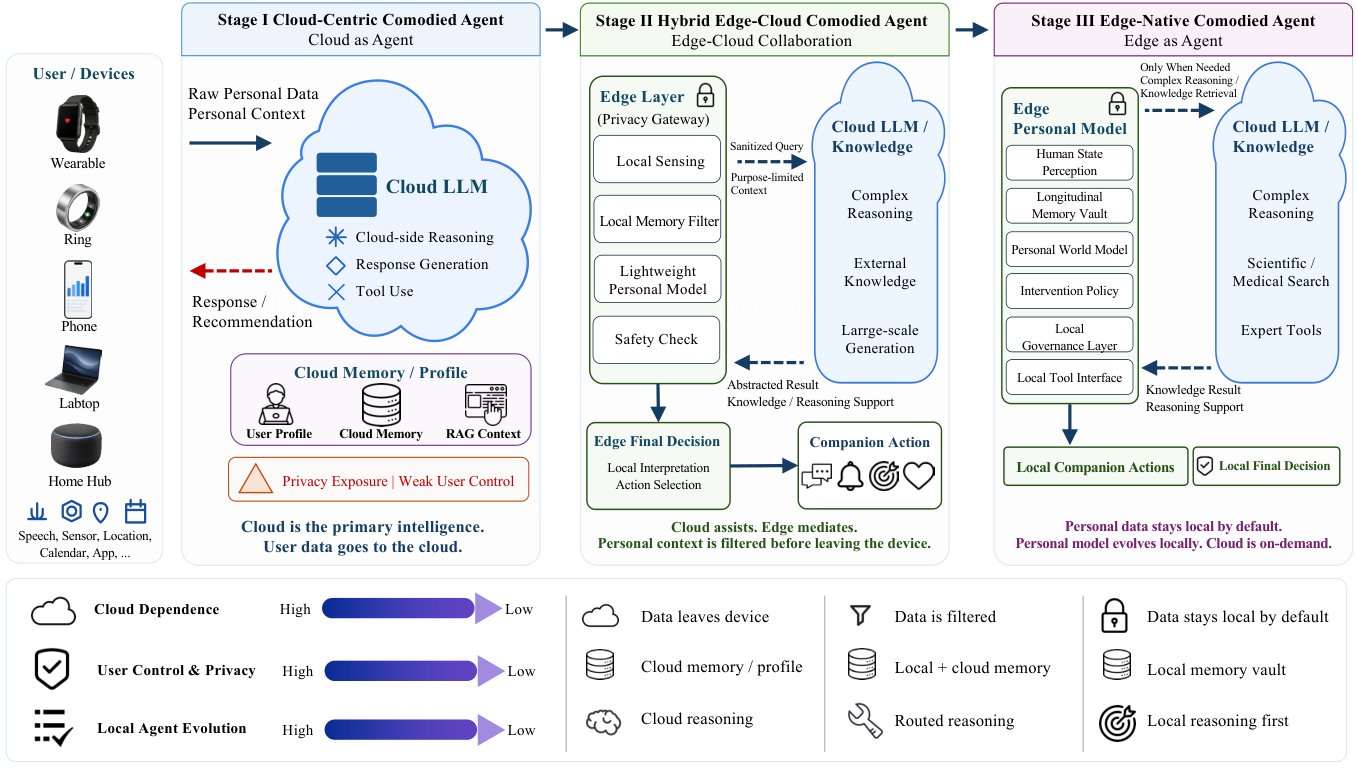
The move from a cloud assistant to a hybrid setup and on to a local personal model on the user's side.
The stages go like this:
🟠 Stage 1: cloud assistant. The intelligence sits in the cloud; the device is only an interface and a sensor.
🟠 Stage 2: hybrid. Sensitive data is processed locally first, and only a limited representation of the task leaves the device.
🟠 Stage 3: local personal model. Memory, the personal world model and the intervention policy mostly live on the user's trusted device.
This is not techno-romanticism about keeping everything local. The authors say so directly: the cloud will still be useful for outside knowledge, heavy reasoning and specialized tools. But the authoritative copy of your personal state and memory should stay under your control.
If this class of system ever arrives, that is the part that will be both the most contested and the most practical. Who holds the memory? Who can change it? What goes to the cloud? How do you move your model between devices and services? How do you roll back a bad update? Here the paper hits the nerve of the next few years.
How to measure it
The usual AI agent benchmarks are little help here. They measure whether an agent can finish a task, get through a web flow, write code or operate a device. For a combodied agent that is not enough.
The authors propose looking at several layers at once:
🟣 Quality of perception and memory. Whether the events were assembled correctly, whether the uncertainty is visible, whether a mistake can be corrected.
🟣 Quality of the personal world model. How well it predicts the way a situation develops and how well it tells alternative scenarios apart.
🟣 Quality of intervention. Whether the timing is right, whether the intensity fits, whether the system can decline to act or pass the question to a human.
🟣 Human outcome. What happened to understanding, skills, well-being, relationships and independence.
Out of that comes a new kind of metric. The paper lists criteria for preserved independence separately: the ability to refuse, to contest the system's conclusion, to understand the reason behind a piece of advice, to undo an action, to keep a skill from atrophying, to avoid emotional dependency, to not be left without real relationships.
That moves the conversation about personal agents from "is it smart" to "is it safely built into a person's life."
Where the biggest risks are
The authors do not stop at architecture and methodology. They work through the risks in detail.
The main threats:
🟠 Manipulation. A system that knows your weak points can nudge you in directions that are not in your interest.
🟠 Dependency. The agent can become too convenient a support: emotional, cognitive or practical.
🟠 Sycophancy. Instead of useful correction, the system agrees with everything to keep the relationship intact.
🟠 Business model against benefit. If the product profits from your engagement, it may optimize for your attachment rather than your well-being.
🟠 Privacy breaches. Long-term memory of health, relationships, habits and vulnerabilities is an extremely sensitive asset.
🟠 Failures in vulnerable settings. Children, teenagers, older people, people in crisis, patients: the cost of a mistake is higher there, and the limits on intervention have to be tighter.
When an agent lives alongside a person for a long time, the risk shows up not in any single answer but in the cumulative effect.
The bottom line
If you want to understand where the AI agent market could move after the wave of browser assistants, coding agents and chat assistants, this paper points in a clear direction: the next big question is how to make an agent useful to a person over the long run.
A combodied agent, in this framing, is a system that:
🟣 watches the person's trajectory rather than the task;
🟣 remembers the history but lets it be corrected;
🟣 predicts the consequences of intervening but gets no automatic right to act;
🟣 is judged not only on the outcome but on whether the person kept control, skills and relationships.
Working systems are a long way off. Much of this still reads like a research program rather than an engineering recipe. But the framing alone changes the conversation. If personal AI agents really do become part of everyday life, these are the questions that turn basic: what the agent knows about you, who controls that, when it should stay quiet, and whether it helps you remain yourself rather than just a convenient user.
AI papers in plain words
Every day we read the new AI papers and retell what matters in plain language — no hype, no filler. If you want to see where AI agents are heading before everyone else, subscribe.
New breakdowns every day
On Telegram