EnvX turns a repository into an agent that sets up and runs itself

Open repositories are full of ready-made work: scripts, models, datasets, demos. Getting any of it to actually run is still manual labor — install the dependencies, download the artifacts, read the docs, get the input arguments right. EnvX proposes something simple but powerful: agentize the repository. Turn it into an autonomous assistant that understands the project's own documents, builds its environment, executes functions from a plain-language instruction, and talks to other agents when a task calls for cooperation.
What EnvX is, in brief
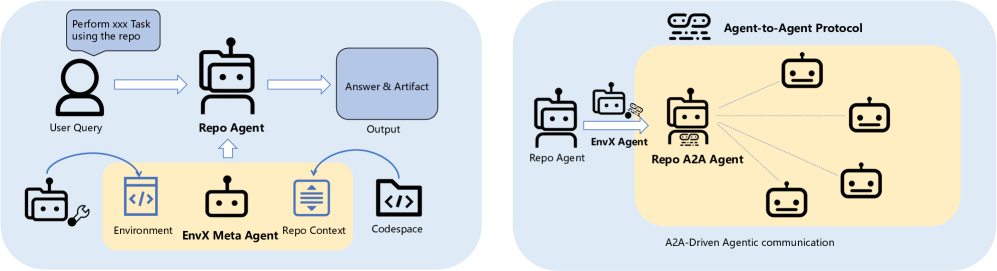
It is an LLM-plus-tools system that turns a repository into an agent with a standard interface. The agent reads the README and the usage examples, builds a working environment, calls the code's native functions, and can speak the same language as other agents through the Agent-to-Agent (A2A) protocol. One principle matters here: no wholesale rewriting of the code. EnvX works with the entry points and scripts that already exist rather than reinventing them.
How it works: three phases
Phase 1. Environment and context setup. The system automatically extracts a structured list of steps from the documentation and tutorials: which packages to install, which data and checkpoints to download, how to verify that everything works. Those steps become a TODO plan, and the TODO manager can execute, roll back, patch and retry until the setup is stable.
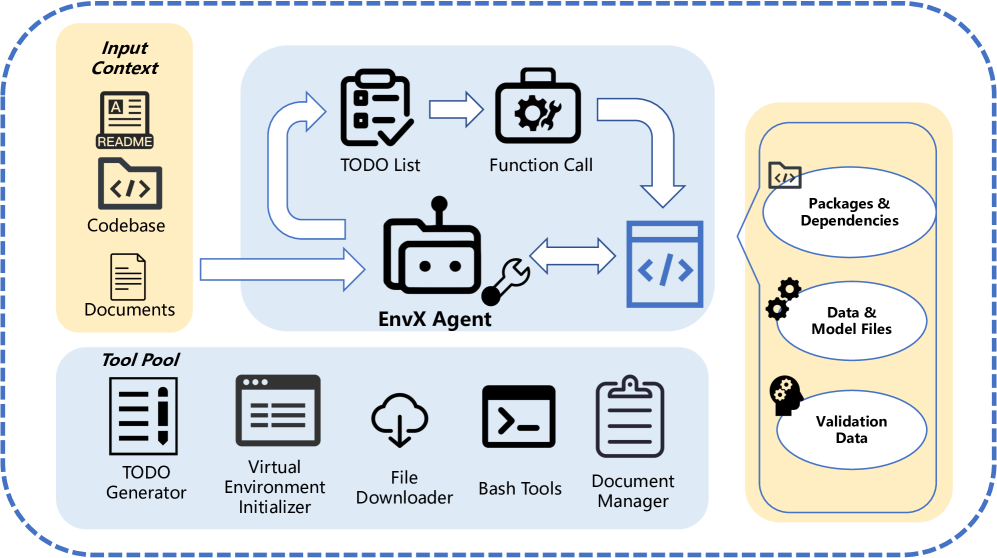
Phase 2. Agentic automation for the human. The meta-agent masters an arsenal of familiar DevOps tools and adapts them to the specific repository. It understands the user's intent, locates the relevant functions, calls them with the correct arguments, and explains what it is doing. The emphasis is on usefulness, reliability and interpretability: the result has to be reproducible and legible.
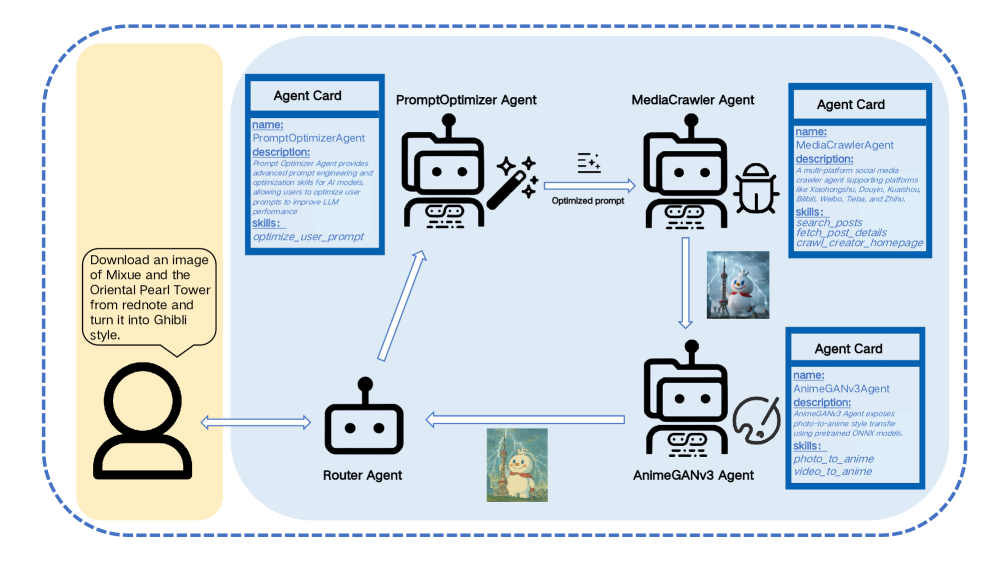
Phase 3. A2A communication. A standardized interface is added — agent cards and formalized skills. Agents exchange requests and results over a shared protocol while staying true to what each of them specifically does. That is cooperation without hand-written glue.
The tooling under the hood
To make all of this work, EnvX relies on a set of tools:
- Basic actions: reasoning, reading and writing files, running scripts, closing out tasks.
- Artifact downloads: fetching datasets and model weights.
- TODO management: auto-initializing and checking steps, small validation sets.
- Dependency management: a universal abstraction over pip, Conda and other managers.
- Code Knowledge Graph: extracting functions and their relationships so the agent can hunt for entry points deliberately.
- A2A generation: identifying skills, producing agent cards and the code that opens a port for communication.
How it was evaluated
The authors assembled GitTaskBench — 18 heterogeneous repositories (images, speech, documents, video and other domains) and 54 tasks with strict checking. Two key metrics: Execution Completion Rate (ECR), whether the task reached a correct, executable output, and Task Pass Rate (TPR), whether it passed a domain-specific quality check. The comparison was against OpenHands, Aider and SWE-Agent on several LLMs (GPT-4o, GPT-4.1, Claude 3.7 Sonnet).
What the experiments showed
EnvX gives the best balance of executability and quality to date. Paired with Claude 3.7 Sonnet, the system reaches 74.07% ECR and 51.85% TPR, crossing the 50% mark on TPR and improving on previous results. With GPT-4.1 it adds 23.40 points of ECR and 8.72 points of TPR over the strongest baseline; with GPT-4o, a relative gain of 100% on ECR and 124.90% on TPR. Token efficiency is better too: against OpenHands on the same models, EnvX often spends noticeably fewer tokens for equal or higher usefulness.
Cooperation in practice
In a multi-repository case, EnvX agentizes each repository, describes its skills automatically, and plugs them into an A2A mesh. A router agent distributes the subtasks and assembles the result — turning a free-form prompt into a finished image that meets a set of style requirements, for instance. No manual integration, and the steps stay legible.
What comes next
Long-horizon scenarios, data shift and security requirements are still hard. Validation of A2A interactions is crude in places. The authors plan to scale up their checks, move to property-based and metamorphic testing, introduce versioning for agent cards and skill contracts with transparent provenance, and study the cost-quality tradeoff across data, tools and models systematically.
Why it matters
Open source today is an enormous library of functions. EnvX shows how to make it not merely readable but conversational. Repositories become participants in a multi-agent system: they explain what they can do, set up their own stage, and play a part in a larger ensemble. That is a route to genuinely modular automation, where components plug in, cooperate and do useful work without the painful manual assembly.
AI paper breakdowns
Every day we read the new AI papers and retell what matters in plain language — no hype, no filler. If you want to see where AI agents are heading before everyone else, subscribe.
New breakdowns every day.
On Telegram