Google's AI math co-author gets further by keeping its dead ends
Most of today's mathematical AI systems are impressive in "here is a problem, here is the answer" mode. Real mathematics does not work that way. It lives in drafts, dead ends, doubts, strange hunches, half-true lemmas and a twenty-year-old paper you stumble on that changes everything. It is exactly this messy, human part of research that Google's work on an AI mathematical co-author tries to get into — not as one more LLM, but as an entire working environment with agents, memory, research branches and a built-in habit of doubting.
When AI stops being a calculator and becomes a colleague
That is what makes the paper matter. It does not simply show a model getting better at competition problems. It offers a different view: the next jump in AI for science may not come from reasoning even harder inside a single answer, but from organizing long research work better. Not an oracle, a partner.
What the authors actually built
The authors present a system they call an AI mathematical co-author. It is essentially a dedicated workbench for a researcher, where several agents can work on one problem in parallel. At the center is a project coordinator that talks to the user, sharpens the problem statement, creates goals and hands subtasks to separate work streams. Those streams handle literature search, computational experiments, writing code, draft proofs and assembling the final text.
The key idea is not that one LLM suddenly learned to "really understand mathematics." Nor did the authors train a new specialized model. Quite the opposite: the system is built on top of standard, commercially available Gemini models and bets on the architecture of the interaction — how exactly agents are assigned work, how project state is preserved, how errors are recorded and how a human can step into the process.
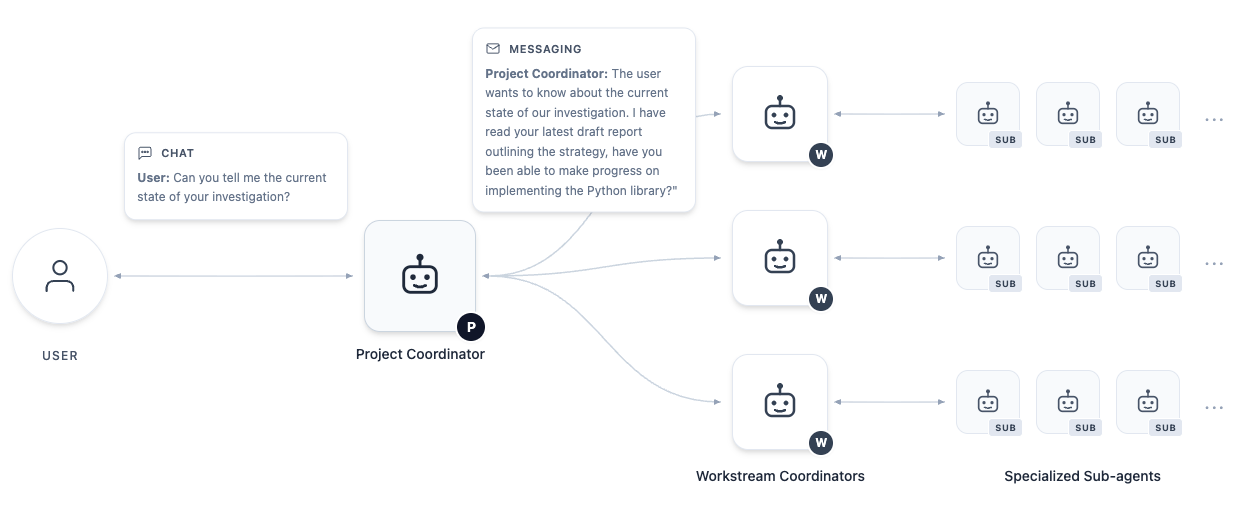
This is an important turn. AI in mathematics has moved in several directions over the past few years: some systems tried to solve problems autonomously, others to produce formal proofs, others to hunt for algorithms by evolutionary search. But in ordinary life a mathematician rarely sits in a single interface and rarely hands over work in the form of "prove this theorem from start to finish." They need to search papers, run computations, test conjectures and rewrite the statement, all at the same time. The authors say it plainly: this orchestration is exactly what has remained the weak spot.
Why a chatbot for mathematics is not enough
The short version: a chat forgets too fast, and research does not.
The authors describe a mathematician's daily work precisely, as a process where it matters not only to find the moves that work but to remember the ones that do not. A standard chat interface is badly suited to that. It is linear, ephemeral, and it forces the user to be the glue between literature search, computation, code and proofs.
The new system tries to solve this with several principles.
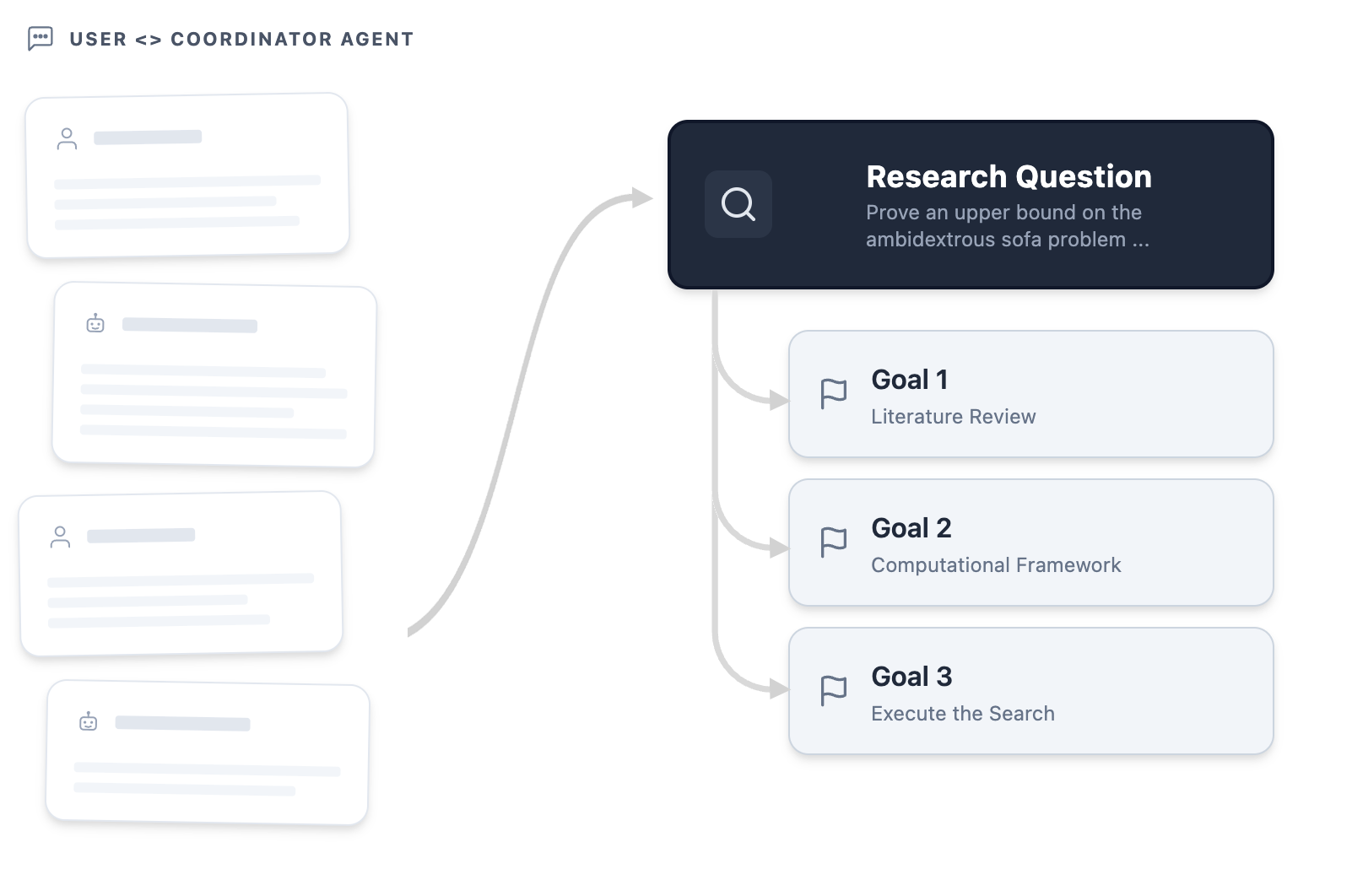
First, it supports iterative refinement of the idea. The user does not have to formulate a perfect request in the first message. It starts with a dialogue in which the project coordinator helps turn a vague idea into a research question and a set of goals.
Second, the system produces not just chat answers but artifacts that are natural to a mathematician: a living working text, sketches, margin notes, references, draft derivations, code and verification results. That is an important design detail: instead of a polished but disposable answer, an unfolding document you can read, edit and check.
Third, it is asynchronous. While one agent digs through papers, another can be writing a Python library and a third trying to assemble a proof. The user is not sitting in front of a "model is thinking" spinner — they see partial progress and can steer at any moment.
Finally, the system is deliberately built for working with uncertainty. In mathematics that is critical: one hallucinated citation or one hole in a lemma can bring the whole construction down. So doubts are not hidden here. They are flagged, tracked and pushed to the surface.
What the system looks like in practice
The most substantive part of the paper is not the tables but a walkthrough of a real session. The authors work through an example built on a variant of the moving sofa problem — the well-known question in computational geometry about the largest-area shape that can be carried around a right-angled corner.
The user begins by uploading a recent paper and writing that they want to check upper bounds for one variant of the problem. The project coordinator does not start "proving" immediately. It asks which variant to focus on, what kind of result is needed, which goals count as success. After a few exchanges the user approves the project statement.
The system then splits the work into parallel streams. One does the literature review, another builds the computational scaffolding, a third starts later and uses the library that was written to run a large-scale search.
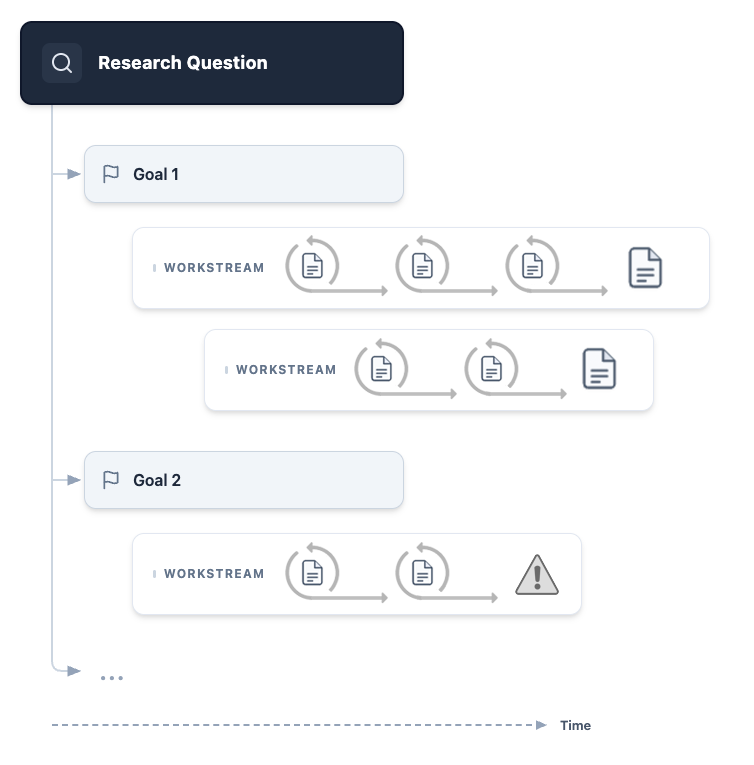
The strength of the approach is especially visible here. Instead of one monolithic stretch of reasoning, the system behaves almost like a small research group: one member finds out what is already known, another builds tools, a third puts those tools to work in a computational search.
The authors note separately that in the current prototype the specialized agents mostly rely on ordinary LLM calls, not on magical new modules. But the architecture leaves natural connection points for stronger systems — formal verifiers, say, or evolutionary search tools.
The best part: the system does not hide failure
One of the paper's best ideas is its attitude toward failure. Most AI agents today are built as if failure should be swept under the rug: restart, rephrase, act as though everything is under control. The logic here is different. If a work stream gets stuck, that does not disappear. The failed conjecture is kept as part of the project's history.
This is not cosmetic, it is fundamental. In mathematics, knowing what did not work is often no less valuable than knowing what did. The authors build that in directly: dead ends become first-class objects that later work can lean on.
Another important layer is hard programmatic constraints. If an agent writes code, it cannot declare the work finished until the tests pass and a separate verifier agent approves the result. If a proof does not survive checking, the report does not get completed status. This is an attempt to guard against the least pleasant property of LLMs — premature confidence.
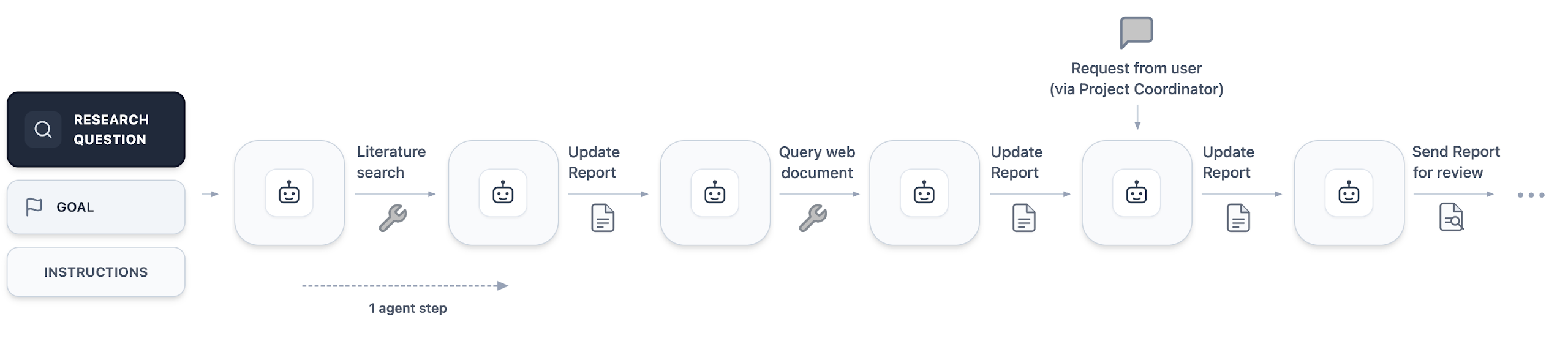
Even so, the system is not fully autonomous, and that is arguably an honest strength of the paper. When one of the computational approaches runs into a blow-up of the search space, the coordinator writes to the user directly: the current strategy is inefficient, do you have any mathematical intuition for a better way to prune the options? The human here is not a supervisor for show but a real part of the control loop.
What early tests with mathematicians showed
The authors gave a handful of professional mathematicians limited access and describe several cases. This is not a rigorous large-scale evaluation, but as a read on the potential it is telling.
In one case the mathematician Marc Lackenby used the system to explore an open question from the Kourovka Notebook. The system created two streams: one tried to prove the statement, the other to refute it. What stands out is that it first produced a proof that it then marked as incorrect itself after an internal check. But in that failed draft the researcher saw a strong strategy, and in the verifier's objection a hint for how to close the gap. Between them they got to a correct result.
That is a far from trivial signal. The value of the AI here is not that it "solved the problem itself" but that it generated a valuable intermediate object: an imperfect yet fruitful line of thought.
Other cases show a similar pattern: the system helps find literature, build computational evidence, isolate key lemmas, reach dead ends faster and, importantly, write all of it up in a form that is easy to check. Not every user came away equally happy, and the authors do not hide that. But even from the stories described, the system's strength is clearly speeding up the research cycle rather than automating it end to end.
Benchmark results: impressive, with caveats
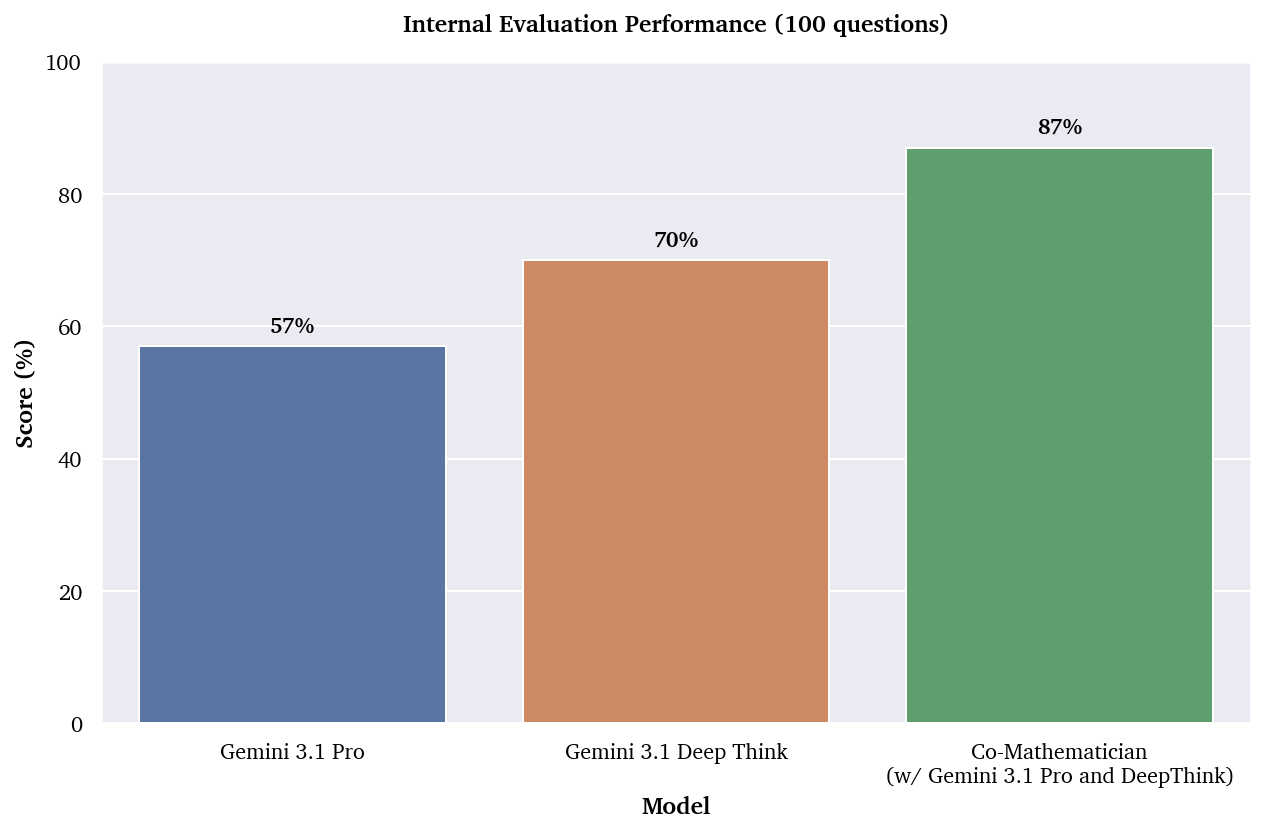
Although the paper argues at length that benchmarks alone are not enough, there is no getting around them today. The authors evaluate the system in a special mode where it is barred from receiving any further input after the initial problem and has to produce a single final answer at the end. That is essentially an attempt to squeeze an interactive research tool into the shape of an ordinary test.
On an internal set of 100 research problems with automatically checkable answers, the system is well ahead of both Gemini 3.1 Pro and Gemini 3.1 Deep Think in a single call.
The louder result is on FrontierMath Tier 4, one of the hardest mathematical benchmarks there is. The system solved 23 of 48 problems, 48% accuracy, setting a new record among the AI systems tested. For comparison, the base Gemini 3.1 Pro that all of this is built on scored 19%.
That is a serious jump. But the authors do not try to pass it off as a free gift. They admit plainly that a system like this burns more compute than a single ordinary run of a model. It has no hard cap on calls or tokens, which means part of the quality gain is bought with heavier inference. That matters whenever anyone compares "a system of agents" against "one model head-on."
Limitations: where the paper is most grown-up
The text's strongest trait is that it does not hide the ugly failure modes.
The first risk is false consensus. In a multi-step author-verifier loop, an argument can emerge that is still wrong but has learned to pass the checks the current agents run. The system may not be getting closer to the truth so much as adapting to the taste of its own internal reviewer.
The second risk is endless loops of disagreement. When agents cannot reach agreement, a work stream gets stuck in infinite editing and starts degrading into hallucination. The authors reach for an almost colloquial term, a "death spiral," and it captures the nature of the problem well.
The third risk is about the interface. Beautifully typeset mathematical text is very easy to mistake for a rigorous result. But LLMs are excellent at imitating form without guaranteeing content. Even a tidy LaTeX document cannot automatically be treated as reliable. The authors concede that the community has yet to work out new norms for presenting, checking and reviewing material like this.
Finally, there is a systemic risk: if tools like this become widespread, the mathematical literature could drown in a flood of plausible but shallow or weakly checked texts. AI can generate the appearance of research quickly, while human attention for checking it stays as limited as ever.
Why this work matters for AI in general, not only for mathematics
The paper is about mathematics, but its central claim is far broader. It shows that the next stage of AI tools will probably be defined not only by model power but by the quality of the working environment around it: memory, task decomposition, verification, preserved history, a clear way for a human to intervene.
This looks a lot like what is already happening in software development, where a coding agent is useful not because it "writes a single function better than anyone" but because it can live inside a long process: read a codebase, run tests, propose edits, fix errors, hold project state. The authors carry that logic over to mathematics almost literally, and get a noticeable payoff.
The bottom line
The AI mathematical co-author paper is not merely a report on a strong model, and not merely another FrontierMath record. It reads more like a manifesto: if we want to accelerate science, AI has to work not only with answers but with the research process itself.
The work is convincing on two levels at once. Practically: the system already helps working mathematicians find ideas, get around dead ends, dig up literature and sometimes carry an open problem all the way to a solution. Conceptually: it shows that interaction architecture, memory and the handling of uncertainty can matter as much as a model's raw reasoning power.
A fully reliable colleague is still a long way off, of course. There is too much risk in false confidence, the cost of verification is too high, the internal review loops are too fragile. But in one sense this work has already hit its target: it makes AI in mathematics look less like an exam solver and more like a real research partner. And that may be the most important shift of all.
AI paper breakdowns
Every day we read the new AI papers and retell what matters in plain language — no hype, no filler. If you want to see where AI agents are heading before everyone else, subscribe.
New breakdowns every day
On Telegram