When AI memory stops being a chat log
Today's AI assistants are good at answering questions about the here and now. But ask something like "where did I leave my badge this morning?", "what did my colleague ask me for after the meeting?" or "what do I usually do once I get to the office?" and the magic runs out fast. Answering those takes more than understanding text. It takes memory of lived experience.
That is exactly the problem LightMem-Ego goes after — a multimodal memory system for smartphones and smart glasses. It continuously captures a first-person visual and audio stream, sorts it across memory tiers, and pulls the right fragments back on request. In effect, it is a step toward an assistant that does not merely react to a command but remembers your day.
It sounds like science fiction, but that is not what makes the work interesting. What matters more is this: the authors are not building a giant experimental platform for "servers of the future" — they show a fairly practical architecture that can run on phones and wearables today.
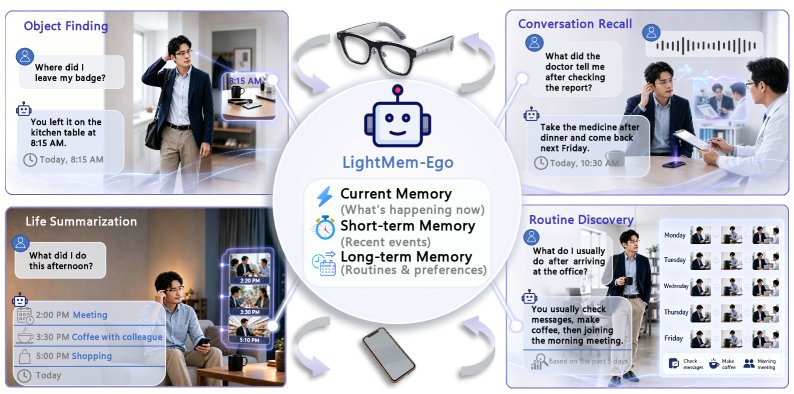
The LightMem-Ego architecture: the system routes queries across current, short-term and long-term memory to find objects, recall conversations and summarize the day.
Why this matters
AI assistants have an old problem: they mostly live in the moment. Some do keep a conversation history or saved facts about the user. But real life is not just text in a chat. It is a stream of events: you walked into the office, put your keys on the desk, talked a task through with a colleague, went to lunch, then forgot where the badge went.
To be genuinely useful, an assistant has to work with several kinds of memory at once:
This is where LightMem-Ego hits the core of the problem. The authors say it outright: long LLM context windows are not enough on their own. Dump the whole stream of a life into one big archive and the assistant drowns in data. It needs structure: what to keep close at hand, what to compress, what to promote into long-term knowledge.
This matters beyond wearables. The same logic applies to any personal AI — from an assistant on your phone to interfaces in cars, medicine and digital journals.
How the system works
At the heart of LightMem-Ego is a three-tier memory hierarchy.
First the system takes in the camera and microphone stream. Not "video as a video archive", but a sequence of timestamped observations. The stream is then cut into short events — a conversation, a walk, a purchase, desk work. Those events are distributed across three stores.
The key idea here is not storage but query routing. When the user asks something, the system first decides where to look at all. A question about the present goes to current memory. One about a recent conversation goes to short-term. One about a routine or a summary over a long stretch goes to long-term.
That is a real departure from "let's just search the whole archive". Such an archive can be enormous, expensive and slow. Here retrieval is cheaper, because the system decides up front which type of memory fits which type of question.
What LightMem-Ego actually does
The authors walk through several everyday scenarios. They explain well why this class of system is needed at all.
This is no longer just "vision plus speech". It is an attempt to turn the stream of a life into working memory for an AI.
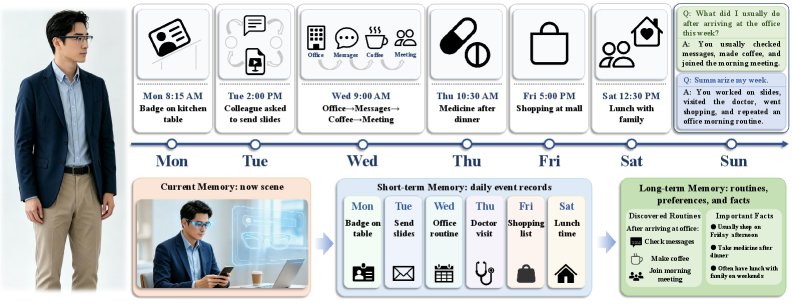
Example scenarios: instant help, conversation recall, a summary of the day, and spotting recurring habits, all built on hierarchical memory.
What stands out in the method
From an engineering standpoint, what grabs you is not hard math but a sensibly built system.
First, the authors try not to overload the device. The phone or the glasses do only the light part of the work: capture frames, record audio, stamp the time and pass the data on. The heavy operations — speech recognition, refining descriptions, indexing, extracting meaning — move to a server and often run asynchronously.
That is the right call. A wearable should not be firing up a heavy model every second and draining the battery in half an hour.
Second, the system works with events rather than a raw stream kept forever. That is an important shift. People also remember their lives as episodes rather than as a pile of frames. That level of representation makes later retrieval far simpler.
Third, the work leans hard on grounding answers in evidence. The system returns not an abstract guess but a linked set of signals: frames, timestamps, transcript fragments, a description of the event. For personal memory that is critical. The user needs not just an answer but a reason to trust it.
The comparison with existing systems deserves a mention of its own. The authors show that some of them handle real time, some handle long-term memory, some handle only text context. But the combination of streaming multimodal input, short- and long-term memory, plus explicit semantic memory, is rare.
What the experiments show
The work makes no claim to product maturity, but it does put down first numbers.
On retrieval quality, overall Recall@3 came to 74.1% and mean MRR to 0.627. In plain terms, in most cases the right memory fragment landed in the top three results. The system did best on life summaries: Recall@1 there reached 88.9%, and Recall@3 and Recall@5 hit 100%.
The worst results came exactly where you would expect: finding objects and recalling conversations. Those are finer tasks. The object has to be pinned to a time and a place and not lost among similar scenes; with conversations, speech recognition also has to be right and the line has to be tied to the correct episode.
On question answering the picture is more restrained. Overall accuracy is 51.9% by LLM judge and 55.6% by human raters. For summaries it is 77.8%, and noticeably lower for conversations and objects.
This does not look like a finished super-assistant ready to ship to millions. But something else matters more here: the architecture already works on real question types, and quality sags precisely where almost every system of this kind is weak today — in fine-grained temporal retrieval and in a noisy multimodal world.
What about latency
Latency in systems like this is not a detail, it is a matter of survival. If the answer to "where is my badge?" arrives half a minute later, the assistant starts to grate.
For short-term memory queries LightMem-Ego posts acceptable numbers: median end-to-end latency is about 5.9 seconds on the phone and 7 seconds on the glasses build. Not instant, but already close to a workable flow.
Long-term memory is harder. Median latency there runs to roughly 14.9 seconds on the phone and nearly 20 seconds on the glasses. That is a "give me a summary" or "remind me what usually happens" mode, not a quick exchange on the move.
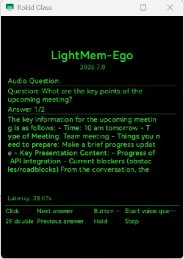
The smart-glasses interface: the thin client has to stay responsive while the real memory work moves into background processing.
The practical conclusion is simple: short memory can already be interactive, long memory is still retrospective. And that is an honest limitation, not a drawback hidden between the lines.
The main limitations
The authors do not paper over the weak spots, and that is arguably one of the most useful parts of the work.
That last point may be the most important one here. Personal AI memory is not merely a convenience. It is one of the most sensitive categories of data there is. And the danger lies not only in the raw recordings but in what is derived from them: transcripts, summaries, embeddings, semantic facts about a person.
The authors state plainly that the prototype has no real privacy protection yet. There is no mature filtering of sensitive content, no fine-grained access control, no deletion policy, no consent from the people around the user. Which means technical progress here has to advance together with very strict security engineering.
What this changes in the personal-AI debate
LightMem-Ego matters not as a record holder on metrics. It matters as a shift in framing. We are used to discussing personal assistants as a chat, a search box, a voice interface or a set of tools. Here AI is treated as a system that accumulates experience over time.
That changes the architectural requirements considerably. If you are building an assistant like this, a good LLM is no longer enough. You need:
That is why the work reads as an engineering reference point. It suggests the direction assistants on phones and glasses are likely to take over the next few years.
Takeaways
LightMem-Ego demonstrates a simple but strong idea: personal AI becomes genuinely useful when it can remember not only the conversation but the user's experience over time.
The memory hierarchy here is not decoration, it is the necessary frame. It separates the present, the recent past and the long horizon without turning the entire life stream into a chaotic archive.
For now the system does best on summaries and high-level questions. Precise object search and reconstructing conversations are the hardest. That marks where the real boundaries of such assistants run today.
The most interesting thing in this work is the direction, not the absolute numbers. The next generation of AI assistants will probably be built not around one large context window but around memory as infrastructure: with tiers, consolidation rules, retrieval over time, and grounding in multimodal evidence.
If this direction takes off, the assistant in your phone stops being just a smart conversationalist. It becomes external memory that can find what you lost, remind you of what matters, and assemble the fragments of a day into a clear picture of your life.
AI papers in plain words
Every day we read the new AI papers and retell what matters in plain language — no hype, no filler. If you want to see where AI agents are heading before everyone else, subscribe.
New breakdowns every day
On Telegram