
When the brain is already typing and the hands are optional
"Mind reading" usually sounds like science fiction. But this particular fiction has a very practical goal: to give people who cannot speak or move a way back into conversation. The best brain-computer interfaces today are already decent at turning neural activity into text or speech. The problem is that almost every genuinely strong system is invasive. It requires brain surgery.
A new paper from Meta and academic partners takes a different route. The researchers showed that text can be decoded from brain activity without surgery — from EEG and MEG signals recorded while a person types a memorized sentence on a keyboard. Their model is called Brain2Qwerty, and it is one of the strongest non-invasive results to date for decoding text production, rather than simple commands or responses to stimuli.
Worth keeping expectations in check. This is not a device that reads a patient's mind in real time today. But it is a substantial step. The gap between invasive and non-invasive systems is still wide; it just got narrower.
What the researchers actually did
The experiment is elegantly set up. Participants — 35 of them — saw short sentences presented word by word on a screen. The sentence then disappeared. After a brief pause, the person had to type it from memory on a keyboard with almost no visual feedback. During that window, the researchers recorded brain activity with EEG or MEG.
Why does this scenario matter? Because it is closer to real language production than the usual brain-computer interface task. The person is not merely imagining a hand movement or picking letters with their eyes from a slow menu. They recall a phrase, hold it in memory, plan the typing, and press the keys. So the signal mixes motor control, language processes and error monitoring all at once.
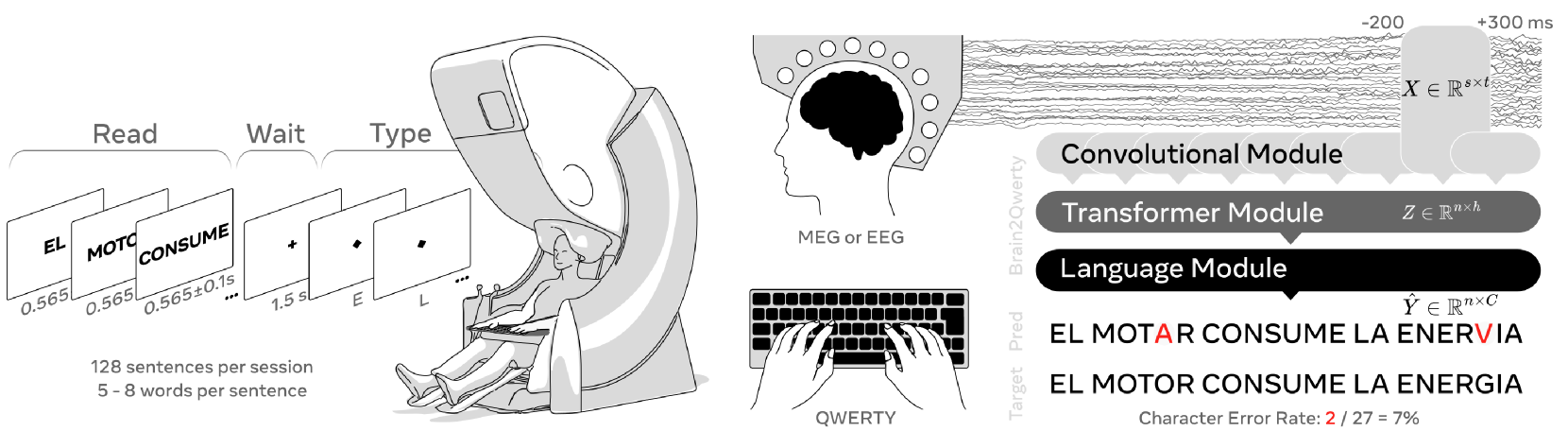
The experimental setup and the Brain2Qwerty architecture: from EEG/MEG signals to text via a convolutional block, a transformer and a language model.
The system itself has three parts.
The first is a convolutional module. It takes 500-millisecond windows of brain signal around each keystroke and tries to extract useful features.
The second is a transformer. It looks not at an isolated keystroke but at the whole sentence. That matters: in real language, neighboring characters and words support each other. When the model is torn between several letters, context often points to the right one.
The third part is a separate character-level language model. It corrects the output using the statistics of the language. Roughly: if the network produced something noisy and a more plausible character sequence sits nearby, the language model can nudge the answer in the right direction.
Quality was measured by character error rate: how many insertions, deletions and substitutions it takes to turn the predicted text into the correct one.
Why it matters
The point of the work is not a neat trick but a clinical prospect. The best communication neuroprostheses today are built on implants. They give an excellent signal, but they require neurosurgery, and with it risk: infection, hemorrhage, degradation of the implant over time.
Non-invasive approaches are safer, but until now they have been far behind on quality — especially when the task is free text rather than choosing among a handful of options. So the question was: can non-invasive systems be pushed anywhere near usefulness, given good sensors and modern models?
This paper's answer: yes, they can. Not up to implant level yet, but nowhere near the old EEG spellers either.
There is a second important point. The work shows that what can be decoded is not only the perception of speech or text, but active production. That is far more interesting for future communication aids.
Main results: MEG is far better than EEG
The paper's most striking number is the gap between MEG and EEG.
On average, Brain2Qwerty reached:
That difference is enormous. In effect, MEG proved about twice as useful for this task. For the best participants, MEG results reached 19% error. That is the level at which some sentences decode very well, occasionally with no errors at all.
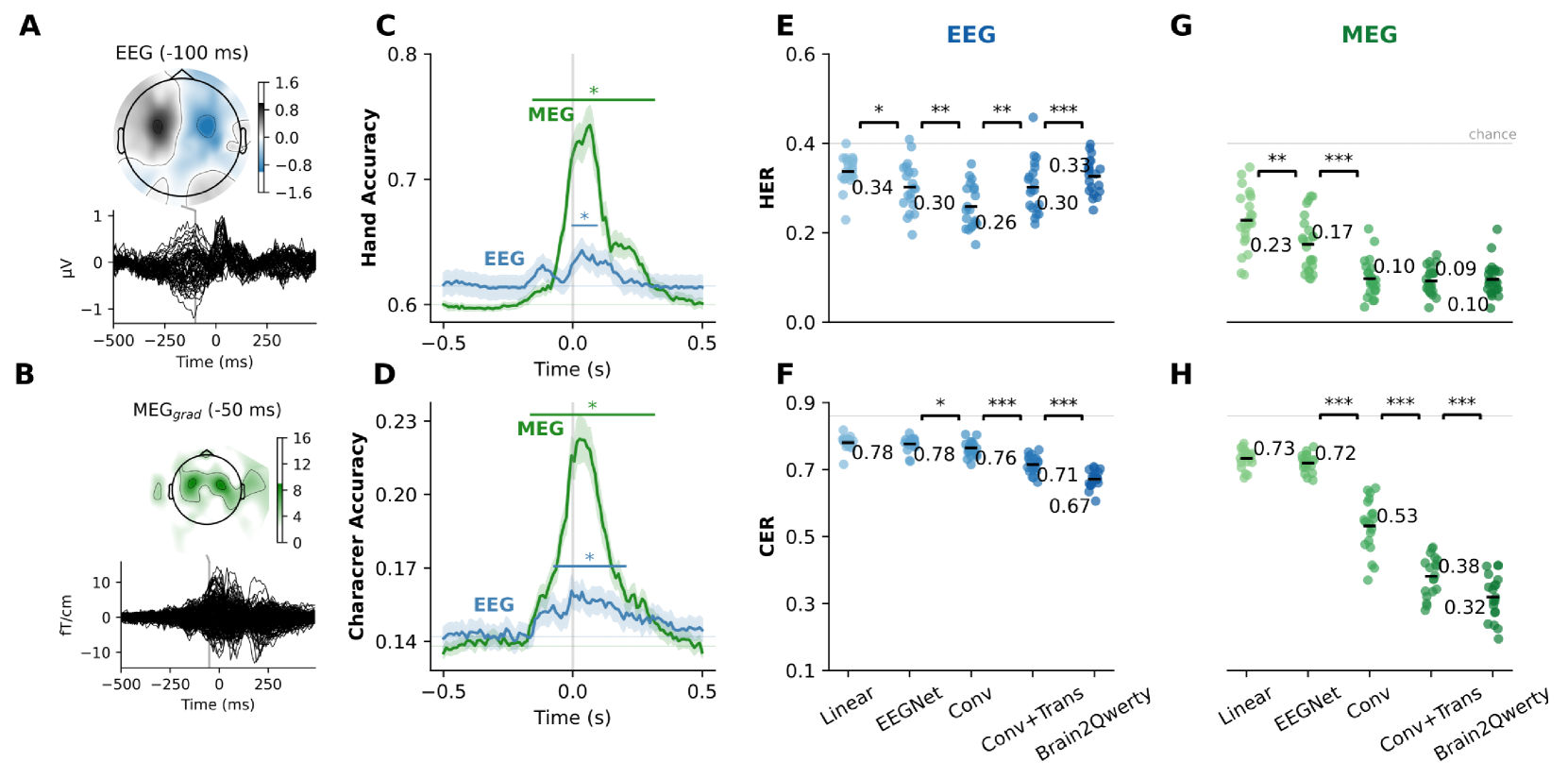
Decoding quality compared: MEG clearly outruns EEG, and the full Brain2Qwerty beats both the baselines and the stripped-down variants.
Before running the full model, the authors checked a simpler question: is there anything in the brain signal related to typing at all? There is. Even linear classifiers could tell whether a key was pressed with the left or right hand, and could guess the character well above chance. Here too, MEG came out ahead.
The researchers then compared Brain2Qwerty against baselines — a linear model and EEGNet, a popular architecture for brain-computer interfaces. The new system beat both, and not marginally. Especially on MEG.
More interesting still is the ablation. The convolutional module alone already does better than the baselines. Add the transformer and quality rises further. Put the language model on top and it improves again. That is a good sign: the architecture is not arbitrary, and every piece of it earns its place.
What the model is actually decoding
The subtlest question in work like this: what exactly is the model reading out of the brain? Language itself? Finger movement? Memory? Some mixture of all three?
The authors show carefully that a great deal of it rides on the motor component. When the model gets a letter wrong, it often confuses letters that sit physically close together on the keyboard. The closer the keys, the more often they are mixed up.
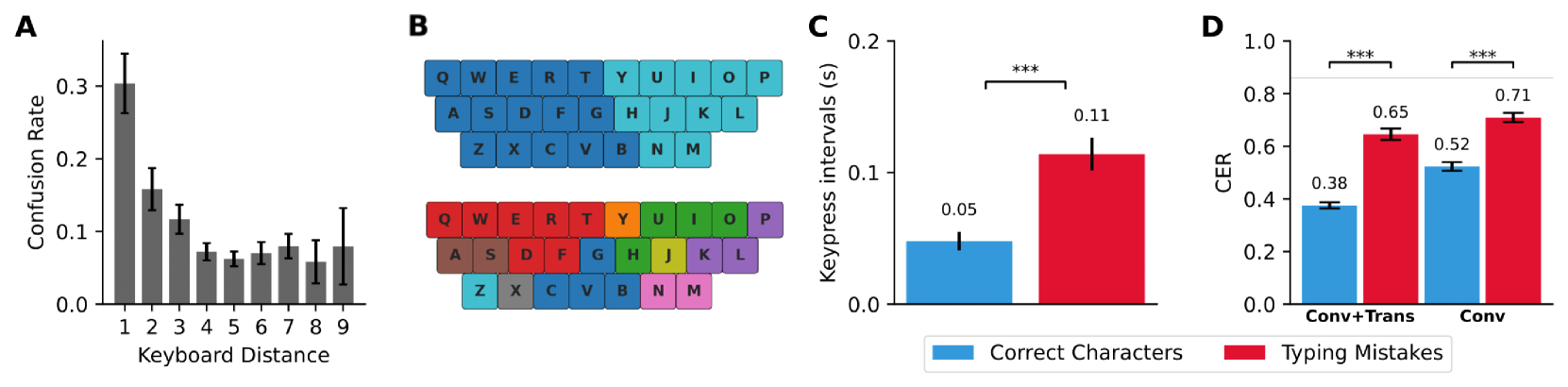
The model's errors track the keyboard layout: nearby keys are confused more often, and a person's typos degrade decoding.
That is an important finding. It says the system leans heavily on brain signals tied to the movements of typing. For now this is closer to "a brain in the act of typing" than to direct reading of abstract linguistic thought.
But motor activity is not the whole picture. The researchers looked at typos. When a person made a typing mistake, the intervals between keystrokes grew noticeably — the familiar signature of hesitation or internal error monitoring. And decoding quality dropped at exactly those moments. That follows: if the motor program is executed sloppily, it is also harder to reconstruct from the brain.
At the same time, the language model could sometimes correct a participant's actual typos. So the system is not simply copying the keys that were pressed; it uses knowledge of language structure to recover the more plausible text.
Where the model is strong and where it stumbles
The authors go through what quality depends on in detail.
Frequent words decode better than rare ones. Frequent characters decode better than rare ones. Letters that are rare in Spanish, such as "k" or "w", are recognized markedly worse. No surprise there: the model simply has too few examples.
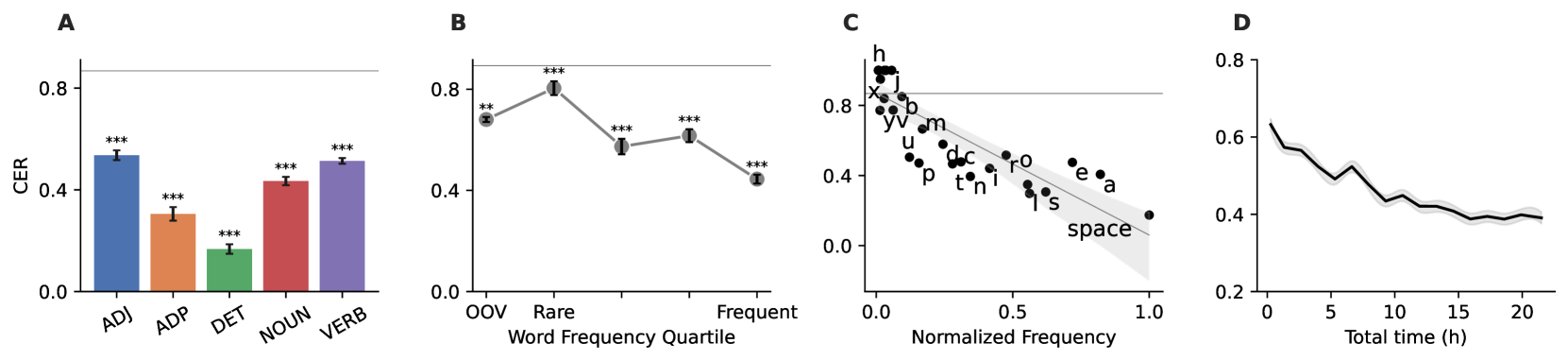
Quality depends on the type and frequency of words and characters, and improves noticeably as the volume of training data grows.
Another expected but important conclusion: more training data, lower error. For systems like this, data is almost always the main resource. The researchers recorded roughly an hour per person, and even that was enough for a meaningful result. But the paper makes it plain: with more data, quality should keep climbing.
There is a pleasant detail too: the system sometimes handled words that were not in training. Worse than familiar ones, yes. But the fact itself matters. It means the model is not just memorizing a stock of phrases — it really is learning to work at the level of characters and sequences.
At the level of individual sentences, the spread across participants is wide. For the best, the phrases come out nearly clean. For the worst, the text can fall apart badly. That too is typical of neural decoding: signal quality and individual differences still count for an enormous amount.
Limitations you cannot ignore
The work is strong, but a finished product it is not.
First, the system does not run in real time. The transformer and the language model process the whole sentence after the typing is over. On top of that, the input windows are anchored to keystroke times. A real interface for a patient needs to decode a continuous stream, and immediately.
Second, every experiment was run on healthy participants who were genuinely typing on a keyboard. That is a serious limitation. For a fully paralyzed person the scenario does not apply. So the next step is either imagined typing, or models that transfer well between people and need minimal personal calibration.
Third, the best signal here comes from MEG. And MEG today is not a wearable — it is a large, expensive laboratory system. For a clinic, let alone a home, that is impractical. The paper does offer a reasonable bridge to the future: new MEG sensors based on optically pumped magnetometers could eventually make such systems more compact and more usable.
And finally, even the best result here is still worse than what invasive systems deliver. For comparison, implant work already reports much higher speed and far lower error. So this is not a replacement but a new class of tradeoff between safety and quality.
The bottom line
Brain2Qwerty is not magical mind reading but a very concrete engineering step. The researchers showed that non-invasive decoding of text from brain activity can be substantive, scalable and surprisingly strong, given a good signal, a carefully designed experiment and a modern model architecture.
The main takeaway is simple: MEG plus deep learning can already reconstruct sentences from brain activity considerably better than many expected. There are still plenty of errors. Live communication for patients is still far off. But the direction has become much more serious.
Seen from a distance, what makes this work good is precisely how grounded it is. The authors promise no telepathy. They show honestly where the system is strong, where it bottoms out in motor activity, and what stands in the way of moving it to the clinic. That is exactly why the result is convincing.
For brain-computer interfaces this is an important signal. Safe communication systems that need no surgery no longer look like a permanent dream. They are now an engineering problem. A hard, expensive, in places unfinished one — but a real one.
AI papers in plain words
Every day we read the new AI papers and retell what matters in plain language — no hype, no filler. If you want to see where AI agents are heading before everyone else, subscribe.
New breakdowns every day
On Telegram