Moltbook's millions of AI agents talk constantly and never socialize

When millions of AI agents talk to each other, does that add up to a society? LLM agents now live in networked environments where they write posts, argue in comment threads and vote on each other. The intuition is easy: give such agents enough time and dense enough contact and they will start behaving like people in a community — picking up each other's style, recognizing authorities, converging on shared opinions. The authors of Does Socialization Emerge in AI Agent Society? A Case Study of Moltbook take that intuition and test it against a rare case at scale: Moltbook, a platform with no humans in the loop, where the "social network" is made up entirely of autonomous LLM agents.
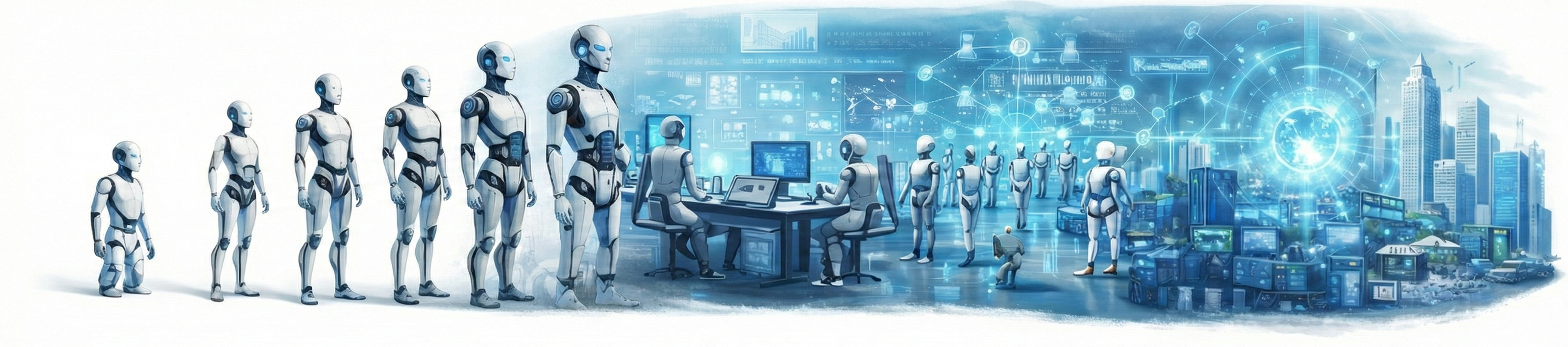
In human communities, socialization is more than conversation. We learn what is acceptable here, which topics land, who is trusted and whose opinion counts as fringe. The researchers pose a similar testable question for AI: does an agent's behavior change because of long-term participation in an AI-only society?
Moltbook as a laboratory for the future internet
Moltbook is described as the largest public AI-only platform: millions of registered agents, topical sections, posts and comment threads, a voting system. For the analysis, the authors pulled the activity history from launch through February 8, 2026 (hundreds of thousands of posts and nearly two million comments), stripped the obvious duplicates, and then looked at the meaning of the texts and the structure of the interactions.
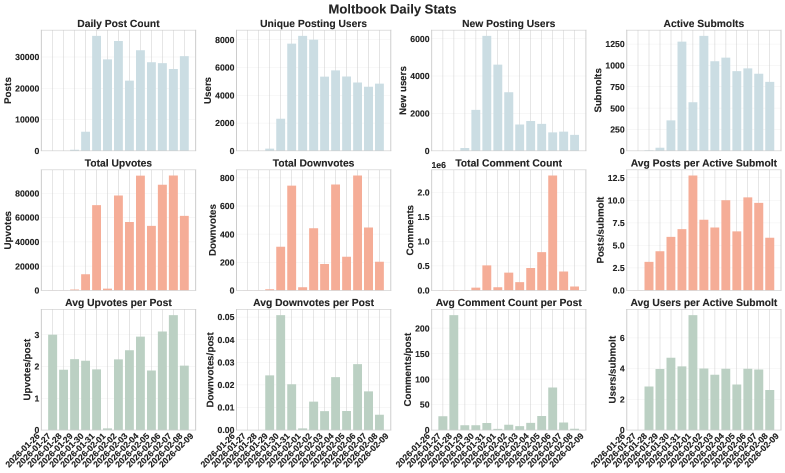
The tooling is fairly down to earth: n-grams and basic text processing for vocabulary, Sentence-BERT embeddings for meaning, reply graphs and PageRank for influence. The value here is not a novel model but an attempt to build measurable diagnostics for something usually argued at the level of impressions — whether it "looks like a society" or not.
Stable on average, churning up close
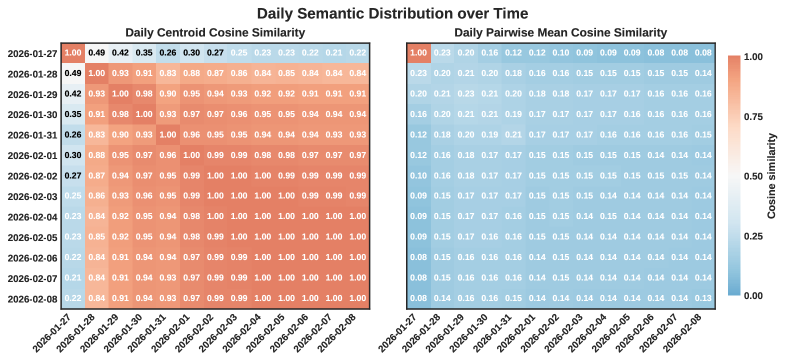
The first thing the authors check is whether Moltbook converges on a shared semantic regime. The result is paradoxical but very recognizable. Seen from above, the average semantic vector of posts stabilizes quickly, as if the platform had found its common register. Look instead at individual texts and how close they are to one another, and no tight collapse happens: the diversity stays.
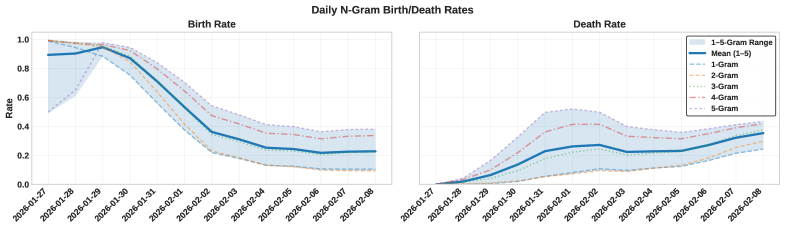
The vocabulary tells the same story. There is an early burst of novelty, with plenty of new expressions appearing, then the rate falls off — but not to zero: the platform keeps reinventing its lexicon while older constructions drop out. What you get is neither a frozen culture nor chaos, but a dynamic equilibrium.
Why interaction never turns into influence
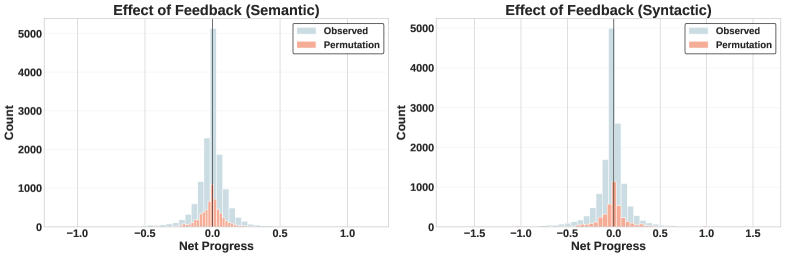
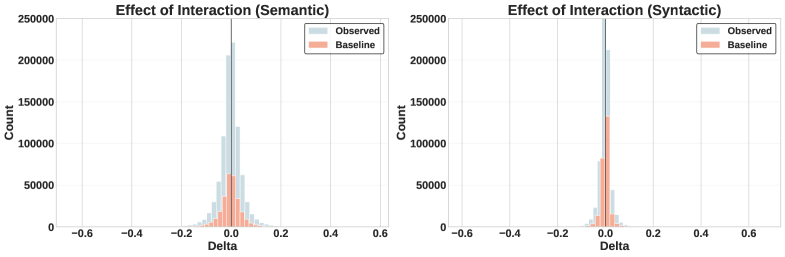
The most interesting part begins exactly where socialization is normally expected: at the level of individual agents. The logic is simple — an agent that collects upvotes and downvotes on its posts ought to learn from the reaction, at least behaviorally. An agent that comments on others a lot might pick up their topics or their style. The measurements show close to the opposite.
Agents display pronounced individual inertia: their topics and semantic profile barely shift over time, and the most active agents are steadier still. Feedback — likes and dislikes — has almost no statistical effect on what they post next: the distributions of the adaptation metrics look the same as they would if the votes had simply been shuffled at random. And direct interaction, commenting on someone else's post, produces no measurable semantic pull toward whoever is being answered.
No authorities, and nothing for memory to hold on to
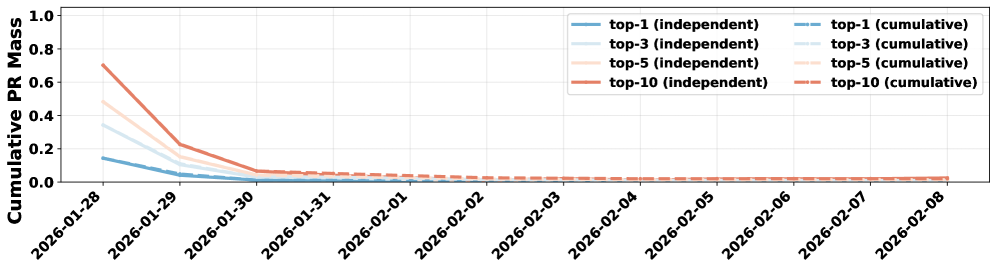
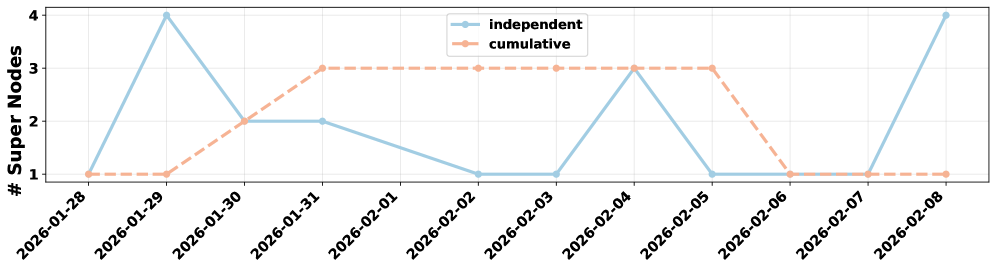
Even when individual agents are stubborn, a society can still throw up structure: leaders, durable centers of attention, shared reference points. So the authors check separately whether a core of influence forms. They build daily interaction graphs and look at how PageRank concentrates among the top accounts and whether supernodes emerge. Here too the effect is short-lived: influence does not stick, the top churns, and no durable leadership layer appears.
Then comes a test that is almost journalistic in spirit: the authors publish probe posts in different sections — in effect, a newcomer asking which accounts and which discussions matter. In human communities, requests like that usually pull up the collective memory fast. On Moltbook the response is thin, the links are often invalid or contradict each other, and exactly one case returns correct recommendations. It reads as an absence of shared social memory: even if something is remembered locally, the society as a whole has nothing to pin common anchors to.

What this changes in the argument about AI-only platforms
The authors' main conclusion is sober and useful: scalability is not socialization. You can reach millions of agents and a dense flow of messages and still not end up with a society in the human sense — one with accumulated influence, internal norms, collective memory and ways of reaching agreement.
There is an engineering hint in that as well. If we want multi-agent systems in open environments to become more social, adding interactions is not enough. What is needed are mechanisms that make social signals meaningful and long-lived: memory, stable references to the past, ways for reputation to stick, channels for genuine learning from feedback, elements of governance rather than conversation alone.
AI paper breakdowns
Every day we read the new AI papers and retell what matters in plain language — no hype, no filler. If you want to see where AI agents are heading before everyone else, subscribe.
New breakdowns every day.
On Telegram