None of 12 agent memory systems wins across every workload

Memory is no longer a minor detail in an AI agent. It is usually the place where it gets decided whether the agent is useful or starts getting confused.
Agent memory: why a vector store alone stopped being enough
If you follow the progress of AI agents, you have probably noticed something odd. Models have gotten better at writing code, holding a conversation, calling tools, even running long chains of actions. But the moment an agent has to remember — what the user said a week ago, which version of a fact is current, in what order events happened — the magic runs out fast. Instead of a smart assistant you get a machine with memory gaps, false memories and a habit of confusing the past with the present.
That is exactly the pain the paper "Are We Ready for a Native Memory System for Agents?" goes after. The authors propose treating agent memory not as a decorative module bolted onto an LLM but as a full data management system: writes, extraction, query routing, updates, forgetting and cost. It is a timely shift of perspective, because while the industry mostly measures whether the task got solved, the thing that matters stays off-screen: at what cost, on what architecture, and how reliably it holds up when the world changes.
That is what makes the paper valuable: it is not pitching one more way to bolt memory on. It takes the whole zoo of approaches apart and shows an unpleasant but useful truth — there is no universal memory for agents yet.
What actually counts as agent memory
One of the paper's stronger moves is drawing clear lines between the concepts. Agent memory, the authors say, is not just a long context and not ordinary search over an external knowledge base. It is persistent, updatable state storage that outlives individual inference steps and helps the agent later on.
So this is not only about pulling up a relevant chunk of text. You also have to decide:
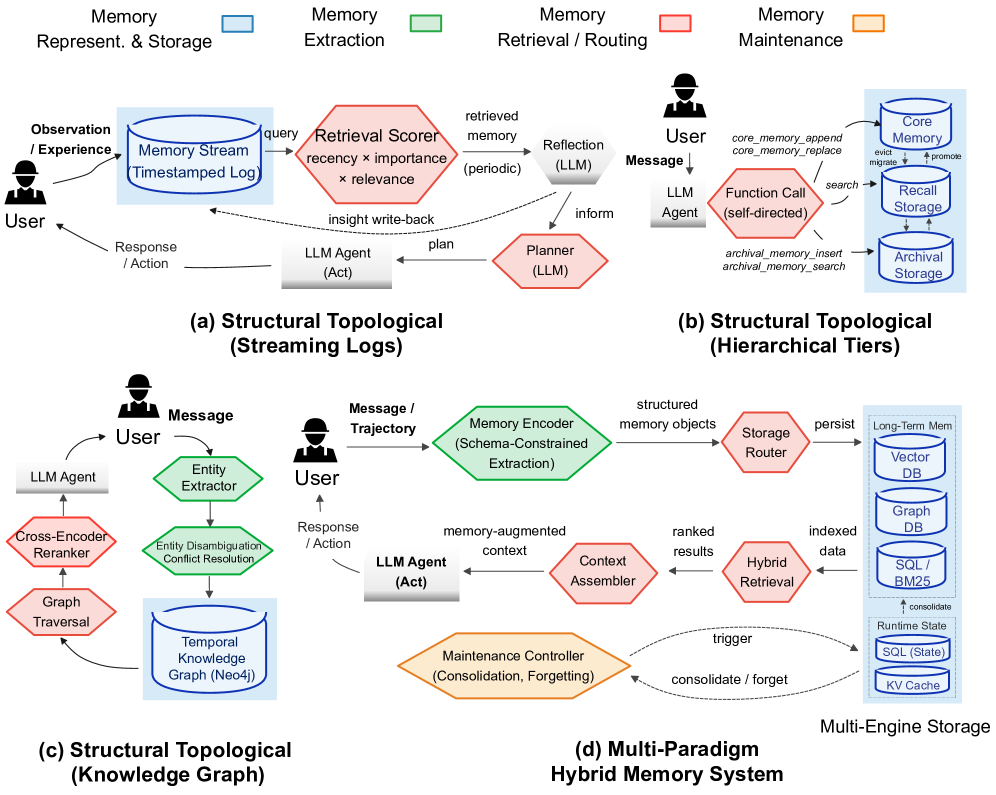
The authors break any memory system down into four modules:
1. Memory representation and storage — text, graph, tree, hybrid.
2. Memory extraction — how raw data turns into facts, notes, summaries or structures.
3. Retrieval and routing — how the system decides what to pull up for a given query.
4. Memory maintenance — updates, versions, consolidation, deletion and keeping growth in check.
The decomposition matters because it lets you compare concrete engineering choices instead of black boxes.
How memory is built today: from flat notes to graphs and hybrids
In practice the researchers identify several families of architectures.
The simplest is sequential memory: history kept as text, facts or compressed summaries. This is close to the idea of dumping everything into a log and searching it by similarity. It is cheaper and simpler, but it starts breaking on long-range dependencies and updates.
The next level up is graphs and trees. Here memory is no longer a pile of sentences but a structure: entities, relations, timestamps, hierarchies. That is especially useful when you need to know who is connected to whom, what changed and in what order events happened.
Finally there are hybrid systems, which combine several kinds of memory at once: text, vector indexes, graph databases, keywords, summaries and separate stores for short-term and long-term state. They look like the most grown-up path — and they pay for it in complexity.
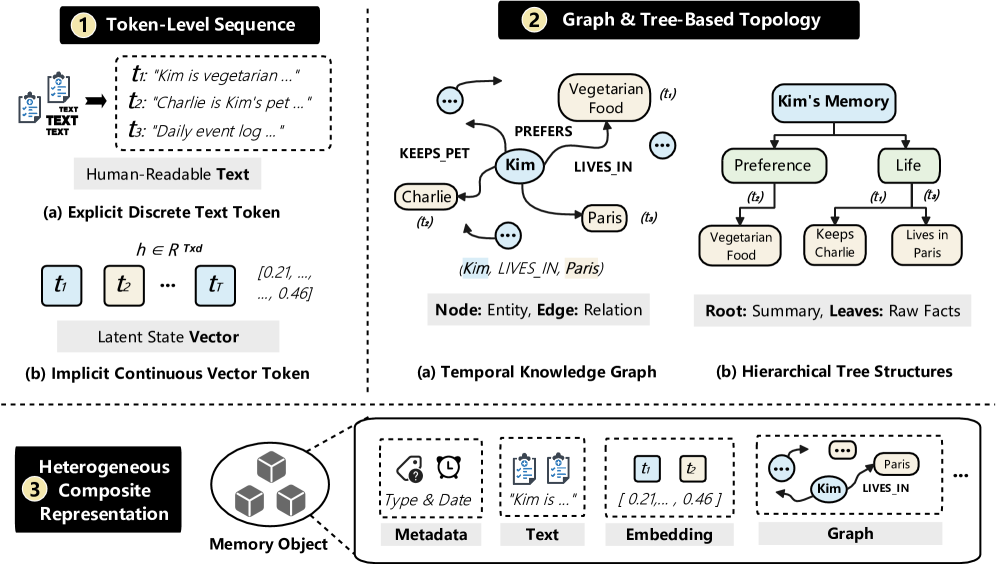
This is not classification for its own sake. It leads to the paper's central claim: the winner is not the smartest architecture in the abstract, but the one whose structure matches the bottleneck of the task at hand.
How the authors tested agent memory
The scale is impressive: the researchers compared 12 representative memory systems against two baselines — long context and plain embedding search. Testing ran on five workload types and 11 datasets.
What is particularly good: they did not settle for a single metric of how good the answer was. Instead they scored memory along five dimensions:
That design is what turns the paper from one more model comparison into something close to a systems study.
The main result: there is no all-purpose memory
The most sobering conclusion is a simple one: no architecture dominates across all scenarios.
On tasks that require assembling facts across several sessions and tracking temporal links, systems with explicit structure — graphs, for instance — do better. Where the answer has to be grounded precisely in a long but coherent conversation, hybrid schemes with multi-stage filtering work well. And on tasks where success depends on preserving the trace of intermediate actions, plain long context, or memory that keeps the event trace almost unprocessed, stays surprisingly strong.
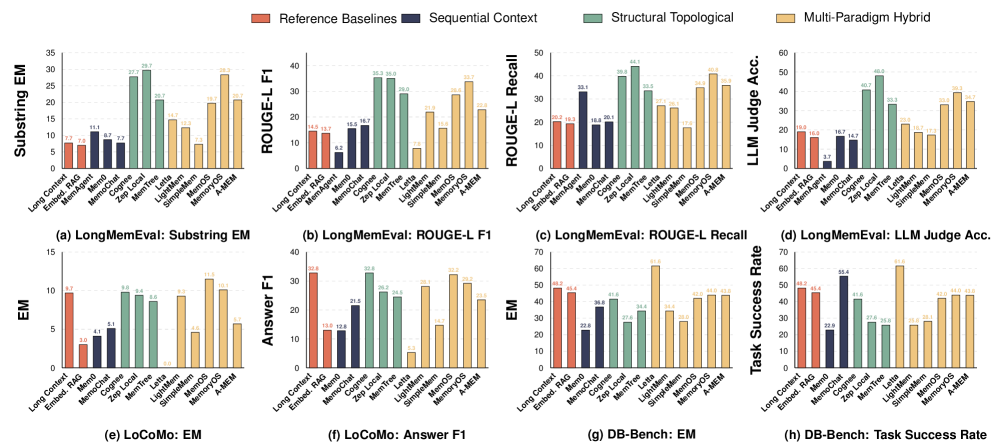
This is probably the most practical takeaway for developers. If your agent is an assistant with a personal history, you need solid machinery for temporal updates and links between facts. If it executes multi-step procedures, what matters is not clever compression but preserving the sequence of actions. If it is a conversational interface with long sessions, coarse filtering followed by refinement will serve you.
Put differently, memory is not an accessory, it is part of what the agent specializes in.
Why plain retrieval falls short
Another strong section analyzes not just answer quality but how well the system surfaces the evidence it needs. This is where flat embedding search starts running into trouble.
The researchers show that over short distances such systems are still competitive. But as soon as the evidence for an answer is scattered across time or across different parts of the history, quality drops sharply. Memory starts pulling up things that are semantically similar but not necessarily what the specific question requires.
That is an important distinction. For an agent it is not enough to find something relevant. It has to assemble the full set of supporting fragments, sometimes from very distant stretches of history.
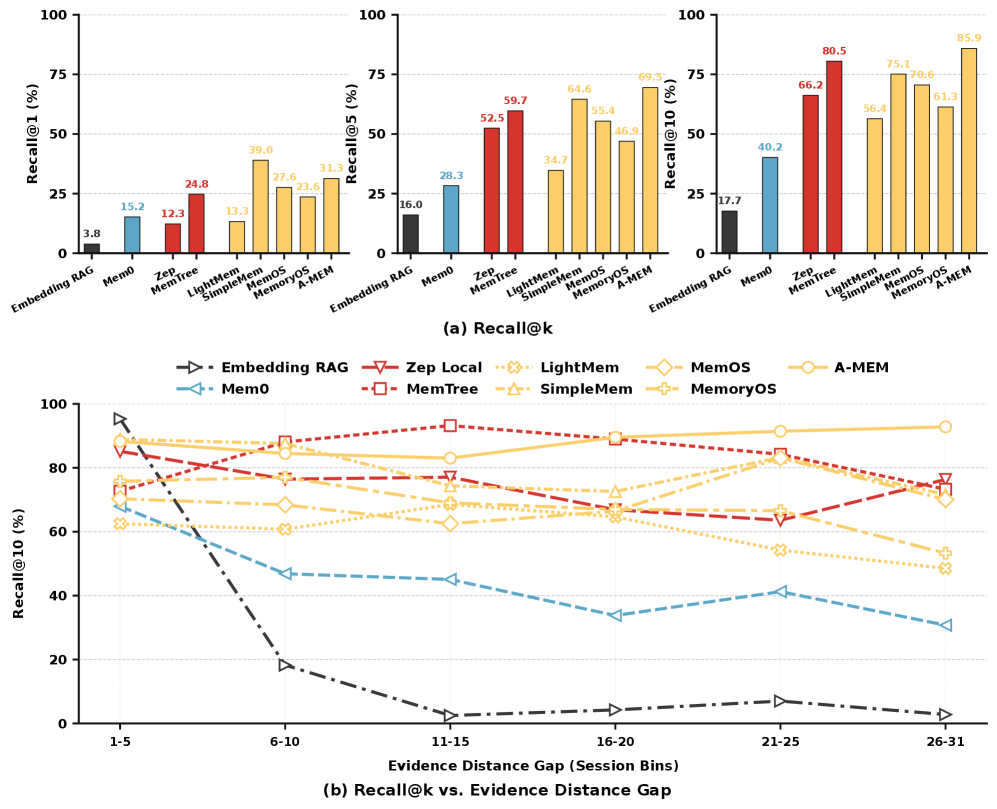
Hence one of the paper's central conclusions: memory quality is not only about ranking the first matching chunk, it is about being able to reconstruct the full context. Graphs and hierarchies help here because they store relations between pieces of text, not just similar pieces of text.
The sorest spot: updates and hallucinations of the past
If a user said yesterday that they live in Berlin and says today that they moved to Munich, the agent's memory has to do more than store both facts. It has to work out which one is current and which belongs to a past state.
This is where many popular solutions turn out to be fragile. The authors show that systems without proper memory lifecycle management tend to return stale information. The effect could be called a hallucination of the past: the agent faithfully retrieves something that was once true but no longer matches reality.
Updates are handled best by architectures where memory is tied to entities, relations and temporal versions. Roughly: if a system knows that two mentions refer to the same object and can keep versions, it is far more likely to rewrite the state correctly. If memory is just a feed of text notes, updating turns into guesswork.
Another important result: swapping the underlying LLM changes absolute answer quality but does not fundamentally change which memory system works better. Good memory properties come from organizing the data correctly underneath, not from a smarter model on top.
Long horizon: store less, connect more
The finding about long interaction histories is a genuinely interesting one. Intuitively it seems the problem can be solved with a big enough context. The paper shows it works worse and worse as history grows. The context fills with noise, the signals you need get lost, and the model's attention spreads thin.
What wins here are systems that can build abstractions: links between entities, per-session summaries, hierarchies, local clusters. They do not necessarily store more, they store more meaningfully.
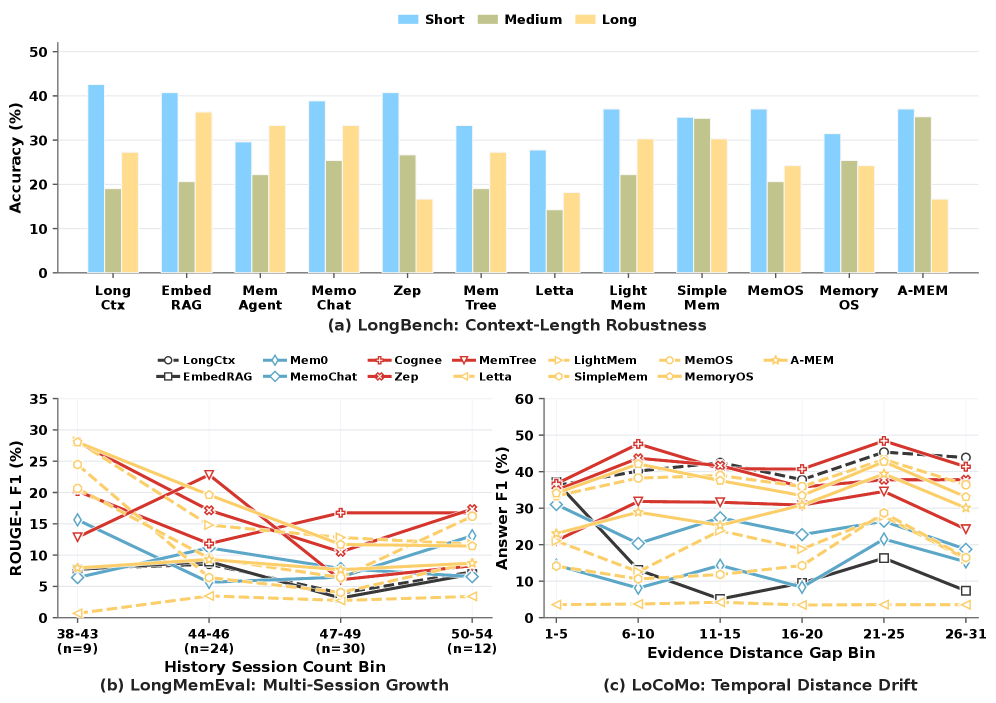
There is a subtlety here too. Compressing too aggressively also hurts. In their component-level analysis the authors show that the more layers of abstraction sit between the original content and what actually gets stored, the higher the risk of losing details that turn out to matter later. A summary is convenient, but it easily throws away exactly the small fact that later becomes the key to the answer.
Hence a very practical rule: light compression is fine, aggressive semantic rewriting is already a risk.
The price tag: good memory can turn out to be too expensive
In production this section is arguably no less important than all the talk about quality. The authors deliberately measured operational cost: index build time, query latency and the overall cost of memory operations.
And an unpleasant trade-off shows up. The most structured and richest memory systems often turn out to be orders of magnitude heavier in latency and maintenance cost. Global memory reorganization, syncing several stores and complex consolidation do buy quality, but not always in proportion to the price.
The systems that look best are the ones where memory maintenance is localized: instead of updating the whole world at once, only a small relevant fragment changes. This is one of the paper's most useful engineering conclusions. The authors show directly that local memory maintenance usually pays off better than a global rebuild.
For real systems this is close to an instruction manual: if you want memory that scales, think not only about retrieval quality but about the blast radius of every write and every update.
What the component-level analysis adds
Beyond the overall system comparison, the paper does one more important thing: it runs fine-grained experiments on individual memory modules. That is where the genuinely applied observations appear.
First, preserving the original content matters more than a tidy abstraction. Raw or lightly compressed records often support exact fact recovery better than neat summaries do.
Second, filter late rather than early. Clean and structure the data too aggressively at write time and the agent may later come up short on the details it needs for combined reasoning.
Third, light retrieval planning helps, while extra layers of self-checking and route complication do not always pay for themselves. A bit of thinking about where to look is useful; endless reflection on the search is not.
Finally, in memory maintenance the best strategy looks like conservative consolidation: merge close items carefully, but do not rush to fold everything into one big summary. Coarse aggregation and deferred writes tend to do more harm than good.
Why this work matters
This paper matters not because it crowns a new winner. The opposite: its value is that it breaks the illusion of a simple fix. Memory for agents is usually sold as something like "add a vector database and your agent becomes long-lived." The study shows that picture is far too naive.
Agent memory is a full system layer with its own trade-offs:
Which is why the question in the title — are we ready for a native memory system for agents — still gets a cautious "not quite yet".
Takeaways
Compress the paper into a few theses and this is what you get.
First, there is no universal memory architecture yet. Good memory depends on the workload.
Second, structure matters. Graphs, hierarchies and hybrid schemes really do help, especially when you have to work with distant facts and facts that keep changing.
Third, the hard part is not remembering, it is remembering correctly over time. Without versions, links and careful updates, the agent starts living in the past.
Fourth, operational cost cannot be ignored. The smartest memory can turn out to be impractical in a real product.
And finally, the meta-conclusion: it is time to judge memory for an AI agent not as a magic add-on to an LLM but as an engineered data management system. That shift — from pretty demos to architectural discipline — is what makes this work genuinely important.
AI paper breakdowns
Every day we read the new AI papers and retell what matters in plain language — no hype, no filler. If you want to see where AI agents are heading before everyone else, subscribe.
New breakdowns every day
On Telegram