Open tooling and human-in-the-loop RL train real robots in one to two hours
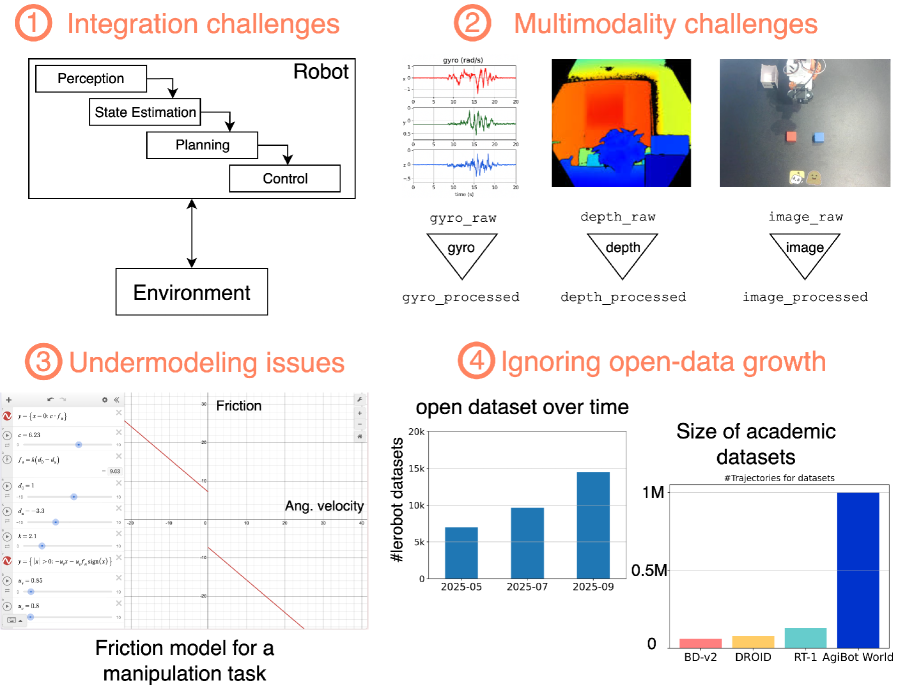
For decades robotics ran on one recipe: build a map of the world, solve inverse kinematics, tune the controllers, then do it all again when the task or the robot changed. That works in sterile conditions and falls apart in the real one, with noisy sensors, contact and soft materials. Researchers at Oxford argue for a different route: when the world is too tangled to describe object by object, statistics and large datasets generalize faster and further than hand-written models.
What the researchers actually built
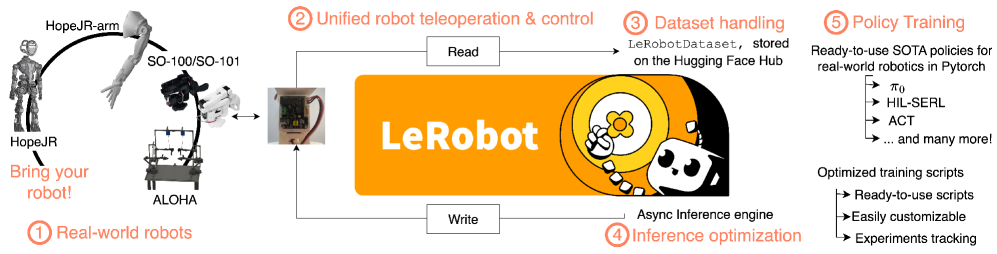
At the center of the system is lerobot, Hugging Face's open library. It ties together low-level control of real hardware, a standardized data format, fast implementations of RL and imitation methods, and ready-made scripts for experiments and inference.
The authors are not rewriting the textbooks on control or deep learning. They are showing why learning from data and the new action models are converging right now: from single-task controllers to general, language-conditioned policies that run on different robots.
Data as fuel
LeRobotDataset is a single format for multimodal time series — sensor readings, motor commands, multi-camera video and task metadata. It stores tabular features and video compactly, streams from the Hugging Face Hub without eating RAM, and supports windowed history sampling for policies. In practice you can record a teleoperation session, turn it into a dataset immediately and start training, without stitching together a pile of incompatible files.

When trial and error earns its place
Reinforcement learning treats control as a dialogue between an agent and its environment. In robotics that is appealing because the policy is learned directly from interaction, with no explicit model of the dynamics. Two things get in the way: safety and efficiency. On real hardware every failed attempt costs time and wear.
The authors show how to soften those constraints:
- off-policy RL and offline-to-online schemes make careful use of the episodes already collected;
- reward classifiers trained on success and failure examples replace painstaking hand-designed reward shaping;
- a human can correct individual actions, and the system learns faster for it.
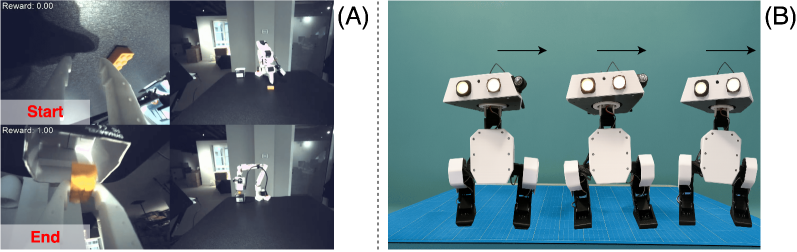


What comes out of it is a usable pipeline: train a reward classifier on an open dataset, start reinforcement learning, add human interventions, mix offline and online data. In the authors' own experiments this takes difficult manipulation tasks to near-perfect success in one to two hours on affordable hardware.
When copying an expert works better
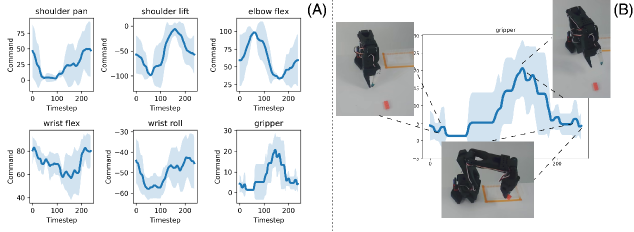
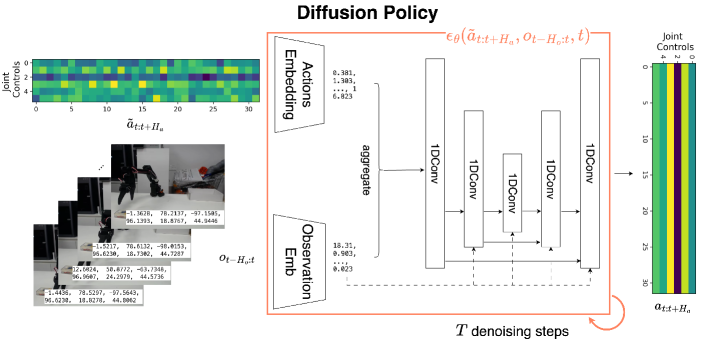
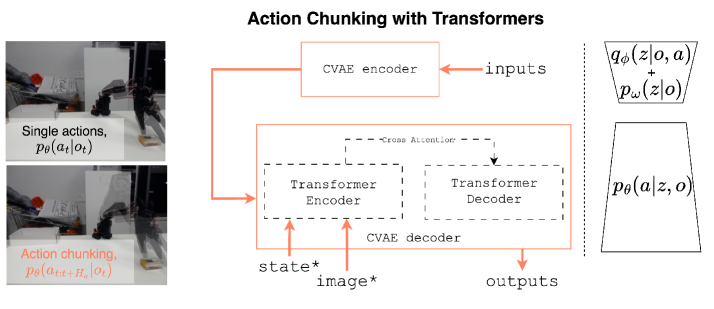
Imitation learning removes two more obstacles: no simulator required, no reward to design. But plain regression on actions breaks down on multimodal demonstrations and compounds its own errors. So the researchers put the weight on generative policies — diffusion models, flow matching, transformers. These reconstruct chunks of actions from observations and hold together better in the real world.
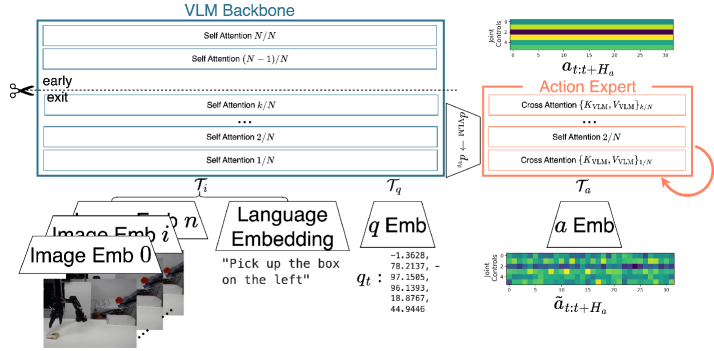
The next step is general-purpose models. Here the authors line up the current systems: SmolVLA trains on millions of heterogeneous demonstrations, takes text instructions and vision as input, and recovers actions through flow matching. The interesting part is that models like this transfer across tasks and across robots without losing quality.
What this buys you in practice
The tutorial ships working scripts for recording data off a robot, building a dataset, training a reward classifier, running RL with an actor and a learner, and a quick start for imitation on open datasets. Built-in streaming from Hugging Face delivers dozens of iterations per second with no digging through storage, and a unified API lowers the entry cost for labs that cannot afford expensive manipulators. The result is a shorter path from an idea to a policy that runs.
Robotics, then, is entering a phase where intelligence stops being the product of exact equations and becomes a property of data and architectures. That is the turning point from manual tuning to systems that learn on their own.
Robots do not need one perfect algorithm; they need a connected set of tools — standardized data, RL methods that are safe and sample-efficient, strong generative models for imitation, and infrastructure that is pleasant to use. The more data and code get shared, the sooner we get general, language-conditioned policies that hold up across tasks and platforms.
AI paper breakdowns
Every day we read the new AI papers and retell what matters in plain language — no hype, no filler. If you want to see where AI agents are heading before everyone else, subscribe.
New breakdowns every day.
On Telegram