Predicting the answer's latent image beats text-only chain of thought

Multimodal LLMs have learned to recognize objects, but how do you give them visual imagination? A look at the Cognitive Supersensing idea.
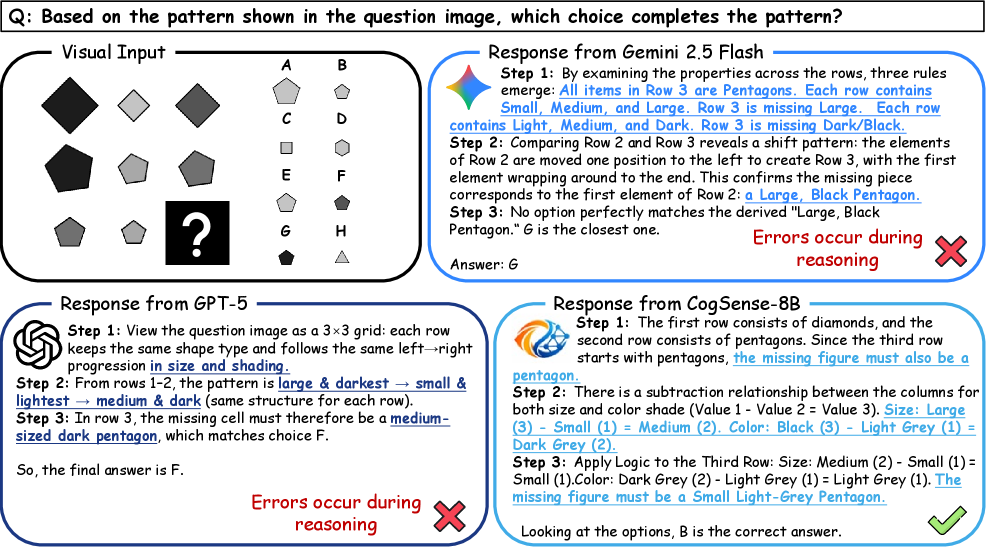
Over the past few years, multimodal LLMs (MLLMs) have learned to recognize objects, read captions, answer questions about an image and even give a decent account of what is happening in a frame. But they have a stubborn weakness: the moment a task asks for more than a description — hold the visual details in memory and run several steps of transformation over them — accuracy falls off a cliff. Infer the rule in a matrix of shapes, rotate an object in your head, predict the outcome of a simple “physical” action, or walk attention across a diagram in the right order.
The authors of Toward Cognitive Supersensing in Multimodal Large Language Model call this the gap between perception and visual reasoning. Current approaches usually try to close it with textual chains of thought: the model produces a step-by-step explanation and is said to be “thinking.” The problem is that text is an awkward interface for spatial operations. When you rotate a cube in your head or extend a pattern, you do not put every micro-check into words. Models, by contrast, have to compress space into a sequence of tokens, and on long visual tasks that becomes the bottleneck.
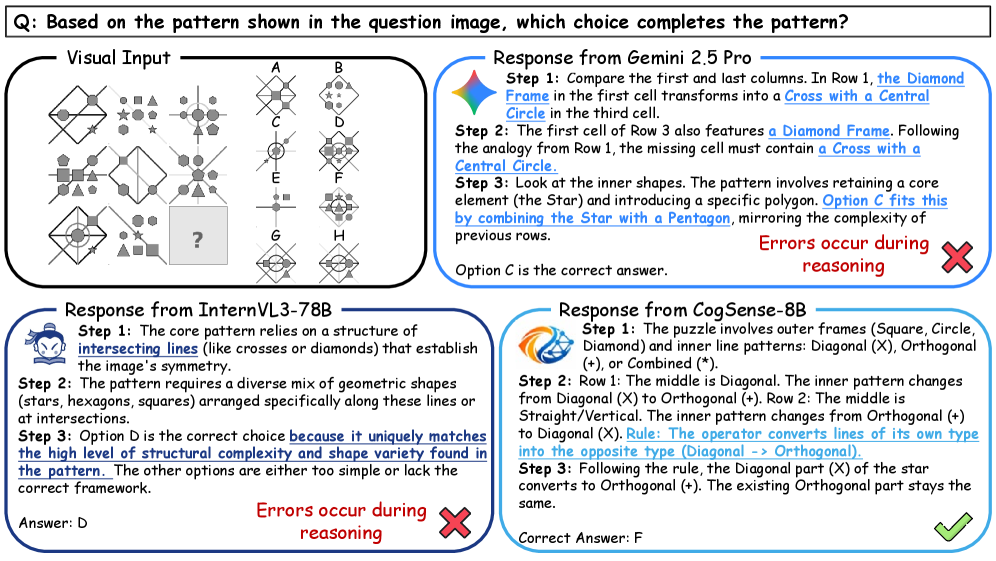
A benchmark that tests visual reasoning, not description
To measure visual reasoning specifically, the authors built CogSense-Bench and a companion dataset, CogSense-Dataset-105K. The questions span five cognitive dimensions: fluid intelligence (solving new abstract problems), crystallized intelligence (drawing on learned knowledge), visuospatial reasoning, mental simulation and visual procedures — tasks where what matters is directing attention correctly and carrying out a sequence of visual operations.
The logic of that step is simple: a benchmark that tests only recognition lets a model look smart while remaining a passive camera with a good vocabulary. CogSense-Bench is built so that a model doing no internal visual work gets more answers wrong.

Cognitive supersensing: inner visual imagery in latent space
The paper's central idea is to move part of the reasoning out of text and into the representation space where visual features live. The authors propose a Cognitive Supersensing paradigm: the model gets an extra head, LVIP (Latent Visual Imagery Prediction), trained to predict the latent visual representation of the correct answer. Put plainly, alongside generating text the model builds an internal image of what it is supposed to arrive at, and that image becomes the scaffold for a multi-step solution.

Training: clean reasoning first, then the latent image, then RL
Training runs in several stages. First the authors collect chains of thought from a teacher model and filter them so that hallucinations and wrong answers do not get dragged into training. Then comes supervised fine-tuning: the model learns to produce the answer and, at the same time, to predict the latent visual image of the correct option through LVIP. The final stage adds reinforcement learning, which rewards reasoning trajectories that agree with the answer not only in text but in the latent visual representation. It amounts to disciplining the model: think in a way whose intermediate internal states actually lead to the right visual target.
What it does in practice
On CogSense-Bench, CogSense-8B averages 73.8% accuracy. For comparison, the GPT-5.2 figure reported in the paper is 40.3%, and many other strong MLLMs land in the 30–37% range. The telling part is that LVIP adds a clear margin over plain SFT, and adding RL improves the result further.
On general benchmarks such as ScienceQA, GQA and others, the changes on average do not look like crude overfitting: the model stays comparable to its base backbone on standard tasks but jumps sharply where visual reasoning is the actual requirement. The authors also check out-of-domain generalization on EMMA (image-based chemistry and math questions) and see gains there too — math, for instance, rises from 26.0 to 34.8.
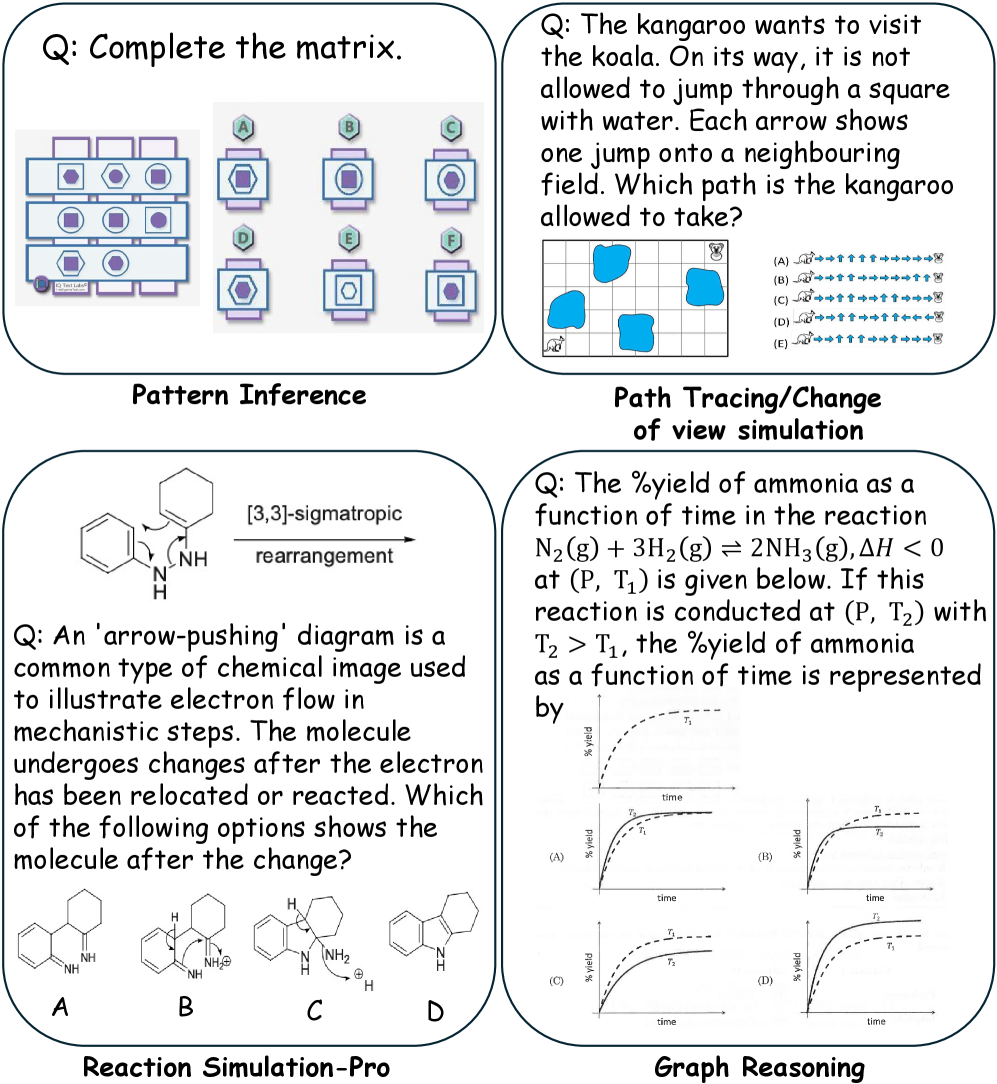
Why it matters and where it could lead
The paper states plainly what many people have felt in practice: more chain of thought does not guarantee better visual reasoning, because text on its own is a poor medium for storing and transforming spatial structure. Cognitive Supersensing offers a split: language stays for control and explanation, while the inner visual skeleton of the reasoning lives in latent space, closer to how a world model works in state-prediction tasks.
If the direction holds, we may get MLLMs that do not just answer questions about an image but can genuinely run an internal simulation — not by drawing, but by holding stable visual states across many steps.
AI paper breakdowns
Every day we read the new AI papers and retell what matters in plain language — no hype, no filler. If you want to see where AI agents are heading before everyone else, subscribe.
New breakdowns every day
On Telegram