PresentAgent-2 turns a one-line prompt into a narrated video talk

When the model stops making slides and starts giving the talk
Presentation generation has spent years in a fairly dull mode: you have a document, you have a set of talking points, the model turns them into slides. Useful, but predictable. A new paper, PresentAgent-2, tries to raise the bar considerably. Here the system is handed no article, no report, not even a finished outline — just a short user prompt along the lines of “explain flow matching.” From there the agent searches for material itself, gathers visual evidence, writes a script, voices it and edits a full video presentation.
This is no longer a slide autogenerator but the first outline of a digital presenter. And a presenter with several modes: it can speak alone, it can stage a discussion between several speakers, and it can take questions from the audience as it goes. For education, corporate training, technical documentation and popular science this looks genuinely practical: what a user usually needs is not a document but a finished explanation.
What the authors actually propose
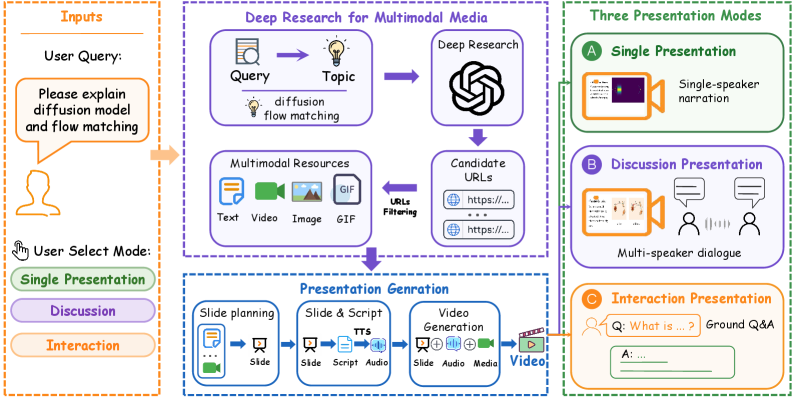
The central idea is simple and ambitious at the same time: turn an open-ended prompt into a finished video presentation without leaning on a source document supplied in advance. To do that, PresentAgent-2 is built as an agent system with several stages.
First the model narrows the user's prompt to a more focused topic. Then comes a stage the authors call deep research: the system looks for suitable sources on the web — not just any sources, but ones that work well in a presentation, with good text, images, animations and video clips. After filtering, the agent assembles a multimodal set of resources: text, images, GIFs and clips.
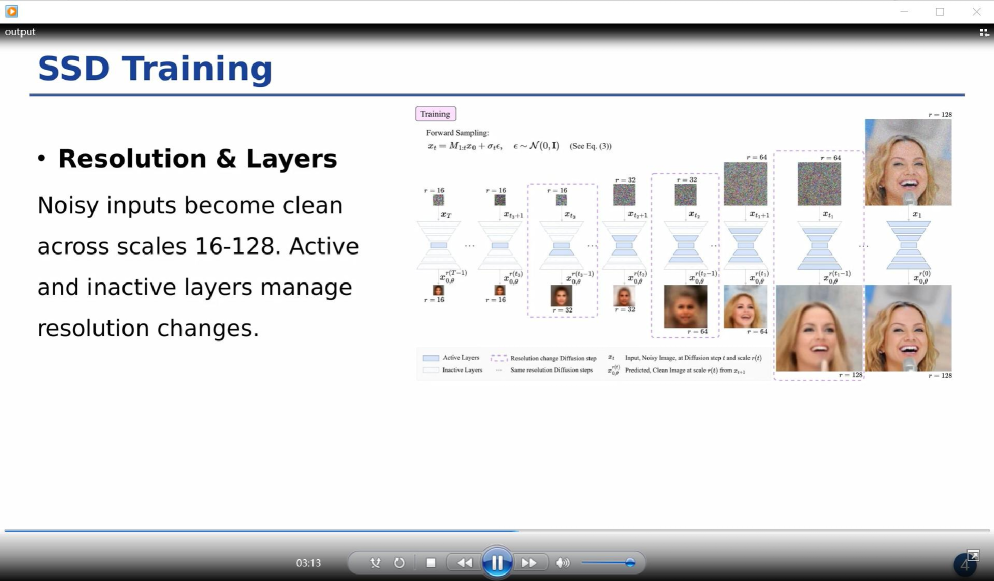
Then the presentation itself gets produced: a structure is built, slides are generated, a script is written, speech is synthesized and the final video is assembled. One detail matters here: GIFs and video are not flattened into static screenshots but kept as live content inside the slides. That sounds like a minor point and isn't one. In practice, a moving example is often the best way to explain an algorithm, an interface or a physical process.

The system supports three modes:
This is probably the paper's strongest conceptual move. The authors are not merely automating the packaging of content; they are modeling ways of delivering knowledge.
Why it matters
At first glance this can look like the next step after slide generation. In practice the problem is markedly harder, and more interesting.
Most earlier systems assumed the user brings the raw material: a paper, a report, a blog post, a pile of notes. The model then compresses, rearranges and visualizes what is already there. PresentAgent-2 works in a more lifelike scenario: the person states an intent rather than supplying a source. That is much closer to how people actually use AI.
The difference is fundamental. With no source document, the system has to:
The task shifts from formatting toward research, selection and explanation. That is why the work matters: it shows how LLMs and vision-language models can move from retelling documents to acting as more autonomous knowledge agents.
How the methodology works
The authors did not stop at a handful of attractive demos — they built their own benchmark for evaluating systems like this. That is a second strong point: without a clear test, work of this kind turns quickly into a reel of impressive clips with no way to tell what is actually working.
The benchmark holds 60 prompt–reference video pairs, 20 per mode: single presentation, discussion and interactive. The reference videos are drawn from public educational and professional sources. Critically, the models are given the prompt only, not the document the reference video was once built from.
Evaluation runs in two layers.
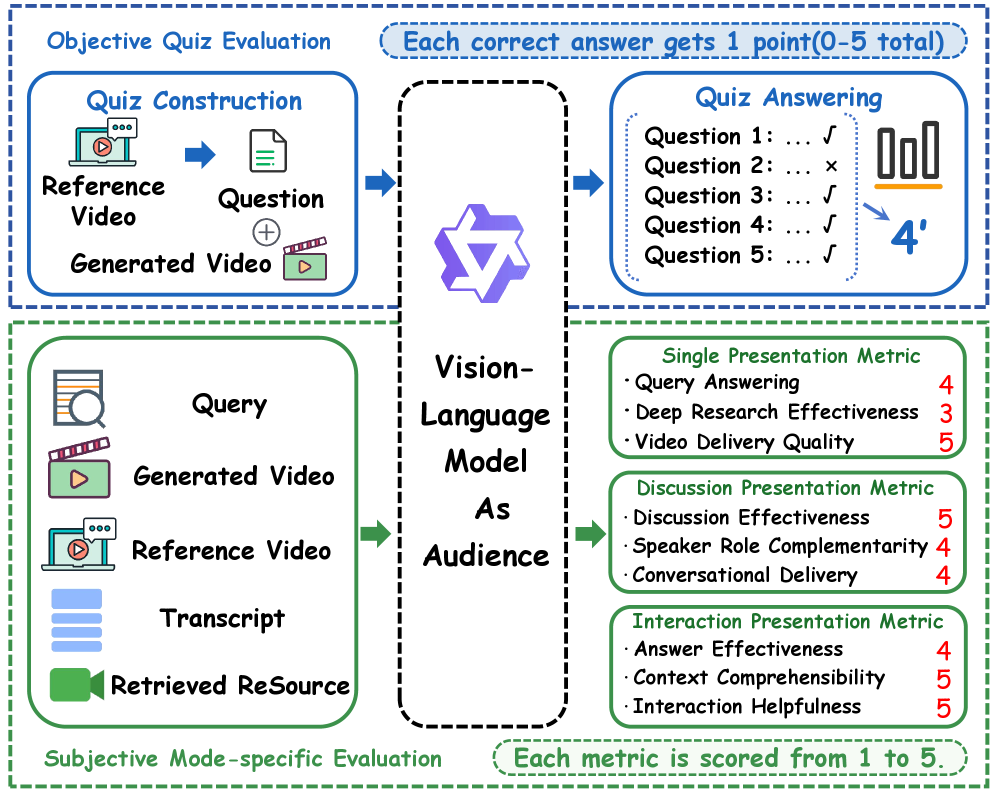
The first is an objective check of knowledge transfer. Five multiple-choice questions are written for each example. A vision-language model then plays the viewer: it watches the generated video, reads the speech transcript and answers those questions. That measures whether a hypothetical viewer came away with the key ideas.
The second is a subjective assessment of delivery. Each mode has its own metrics here. For a single presentation, the judge looks at whether the video answers the prompt, how well the retrieved material is used, and how good the delivery is. Discussion adds metrics for dialogue effectiveness, the division of roles between speakers, and how natural the conversation sounds. Interactive mode is scored on answer accuracy, clarity and usefulness to the audience.
This approach has obvious limits — the judge is once again a model rather than a person. But at this early stage of the field, it still beats having no systematic check at all.
What the experiments show
PresentAgent-2's results look unexpectedly strong. On the knowledge-transfer tests the system scores about 4.8 out of 5 in nearly every mode — comparable to, and in places slightly above, the human reference videos under the same protocol. The subjective scores are high too, roughly in the 4.3–4.5 out of 5 range.
It would be easy to overread those numbers. They do not mean the machine is already a better presenter than a person. They mean that, inside this benchmark, the system reliably produces substantive, coherent videos that cover the prompt and hold their structure.
The spread across backbone models is especially interesting. The best results come from the version built on Qwen3.5-VL-Plus, but Claude, Gemini, GPT and GLM land close behind. That is indirect evidence that the gains come not only from the base model but from the architecture of the process itself: retrieval, filtering, script generation, video assembly.
Another important finding comes out of the ablations — experiments that strip individual components out of the system. When the agent is left with text material only and barred from using images, GIFs and video, quality drops noticeably. When dynamic media is flattened into static frames, the result gets worse as well. And when discussion mode is done crudely — simply slicing a monologue into lines for two voices — dialogue quality falls off further still.
That is arguably the most useful practical takeaway in the paper: multimodality and the form of delivery are not cosmetic here, they do part of the explaining. You cannot take a text outline, read it aloud in two voices and call the result a good presentation.
What is new compared with earlier systems
The authors compare their approach head-on with work that generates posters, slides or video from scientific papers. Against that background, PresentAgent-2 stands apart in three places.
First, it works from an open-ended prompt rather than a document. That puts the system much closer to real use.
Second, it is designed as a multimodal agent from the outset. Images, animations and video enter the pipeline as a source of explanation, not as decoration.
Third, the system covers three presentation modes within one framework. Work in this area usually settles on a single format — slides only, say, or voice-over only. Here the authors show that the same research foundation can support a solo talk, a discussion and a question-and-answer session.
This sits neatly inside a wider trend: AI is increasingly treated not as a generator of a single artifact but as a system that can search, gather, structure and explain.
Where the work is weak
For all the polish, the paper leaves several questions honestly open.
The first is its dependence on the quality of what gets retrieved. If a topic has little good material, multimodal material in particular, the presentation will be weaker for it. The agent does not create knowledge from nothing; it leans heavily on the external information environment.
The second is cascading error. Bad pages chosen during retrieval will spoil the slides, the script and the answers in interactive mode alike. The longer the chain, the greater the chance that a small mistake near the top becomes a visible problem in the final video.
The third is the modest size of the benchmark. Sixty examples is a reasonable start for a new task formulation, but plainly not yet enough to support wide conclusions — especially in fields where mistakes are expensive: medicine, law, engineering.
And finally, using a vision-language model as the judge is a compromise, not an ideal. Human perception matters for presentations: pacing, clarity, the sense of being overloaded, whether the visuals belong. A machine judge catches some of that, but not all of it.
Takeaways
PresentAgent-2 is an interesting and well-timed step from the automatic assembly of slides toward automatically explaining a topic as a full presentation. The work matters not because it shows off another attractive interface but because it proposes a new formulation of the task: not “make a presentation out of this document” but “work out what the prompt is asking, find the material and explain the topic in a fitting format.”
The paper's strengths are a well-considered architecture, the emphasis on multimodal sources, support for several modes of delivery, and a purpose-built benchmark with a reasonably sensible evaluation scheme. The most convincing part is the idea that a good presentation is not only correct facts but structure, visual evidence, movement and a chosen way of addressing the audience.
A general-purpose AI lecturer is still a long way off. But PresentAgent-2 is a clear signal of where this is heading: models are becoming not just generators of text or images but agents of communication that can search, gather and convey knowledge. If this class of system really matures, it will change more than how presentations are made — it will change the way we teach, explain and spread difficult ideas.
AI paper breakdowns
Every day we read the new AI papers and retell what matters in plain language — no hype, no filler. If you want to see where AI agents are heading before everyone else, subscribe.
New breakdowns every day
On Telegram