Sophia gives agents autobiographical memory and cuts reasoning steps by 80%

Today's AI agents can plan, call tools, run chains of actions, even operate inside a multi-agent system. But most of these setups share an awkward property: they are fundamentally reactive. An agent can answer well in the moment, yet after deployment it rarely changes its own habits, rarely revisits its strategies, and almost never modifies itself. When the environment shifts — new interfaces, new rules, new goals — the agent tends to approach every task as if for the first time.
The authors of Sophia: A Persistent Agent Framework of Artificial Life propose a wider view of the problem. Their argument: we already have a fast layer of skills (roughly System 1) and a slower layer of reasoning and planning (System 2). What's missing is a third level — a meta-level responsible for long-term coherence of behavior, self-checking, autobiographical memory and intrinsic motivation. In other words, for whatever turns a system from an executor into something closer to a "living" entity.

System 3 watches the thinking itself
The paper's central idea is to introduce System 3. Not another prompt and not "Yet Another RAG", but a control loop that continuously observes how the agent thinks and acts and intervenes when it has to: reordering priorities, setting new goals, storing experience, and keeping the agent's sense of self intact.
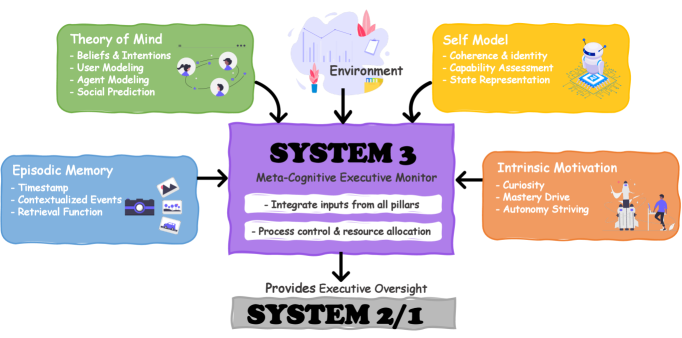
The authors lean on several constructs from psychology and translate them into engineering terms. Four pillars matter: metacognition (self-checking and reflection), theory of mind (a model of the other party — the user or a partner), intrinsic motivation (curiosity, a drive toward mastery), and episodic memory (events and experience over time, not just facts).
Sophia: a wrapper over any LLM stack
The paper describes Sophia as a "persistent" agent — a framework you can drop on top of an existing System 1 / System 2 pairing. Simplified: System 1 handles perception and action (tools, the external environment), System 2 handles reasoning and planning, and System 3 governs when and how all of that runs, what counts as success, and what to learn next.
Technically, Sophia is assembled from four mechanisms.
- The first is a controlled search over thoughts. The agent generates candidate thought processes, then runs them through an "audit": self-critique, checks, and selection of what is worth keeping as useful experience. The emphasis matters — not everything is stored, only the higher-quality reasoning chains that can be reused so the agent doesn't repeat unnecessary steps.
- The second is a memory module that holds a narrative identity: what happened, which goals were set, what worked, where the agent went wrong. The point is to keep the agent from dissolving into disconnected sessions, so it can continue a single line of behavior and learning.
- The third is a user model plus a self-model. The first tracks the user's beliefs and preferences (and makes the interaction more accurate). The second records what the agent can and cannot do, what principles it holds and what state it is in — so that gaps turn automatically into learning goals.
- The fourth is a hybrid reward: a mix of external feedback (task success, cost, latency) and internal drives such as curiosity and a push toward coherence. That lets the agent do more than chase immediate success — it can invest in future competence.

What came out of it
The authors stress that the work is largely conceptual, but they do show a compact engineering prototype and a long-running deployment in a dynamic web environment. In that setup Sophia doesn't wait to be told what to do: it initiates intrinsically motivated tasks itself — finding something worth improving, setting a goal, and running through a cycle of actions while recording the experience.
Two effects are claimed in numbers. First, on repeated operations the agent cuts the number of reasoning steps by roughly 80% — it starts solving similar tasks more economically, reusing accumulated "good" trajectories instead of inflating its reasoning chains. Second, on hard tasks the success rate rises by about 40%: the meta-level helps where a static agent gets lost in a long search or in badly formed plans.

Why any of this matters
The study's strength is the attempt to build a long-lived agent out of legible engineering blocks that support continuity: memory, self-identification, a user model, internal incentives, and regular quality checks on the thinking process. In that form, System 3 becomes a way to connect short-term actions to an agent's long-term "survival" in a changing world.
A caveat is in order: the claimed results come from a prototype in a limited environment, and the architecture itself has a lot of free parameters — from how the thought audit actually works to how intrinsic motivation gets measured. But as a first engineering approach to persistent, personalized agents, it looks convincing.
AI paper breakdowns
Every day we read the new AI papers and retell what matters in plain language — no hype, no filler. If you want to see where AI agents are heading before everyone else, subscribe.
New breakdowns every day.
On Telegram