The next intelligence explosion is social, not a single superintelligence
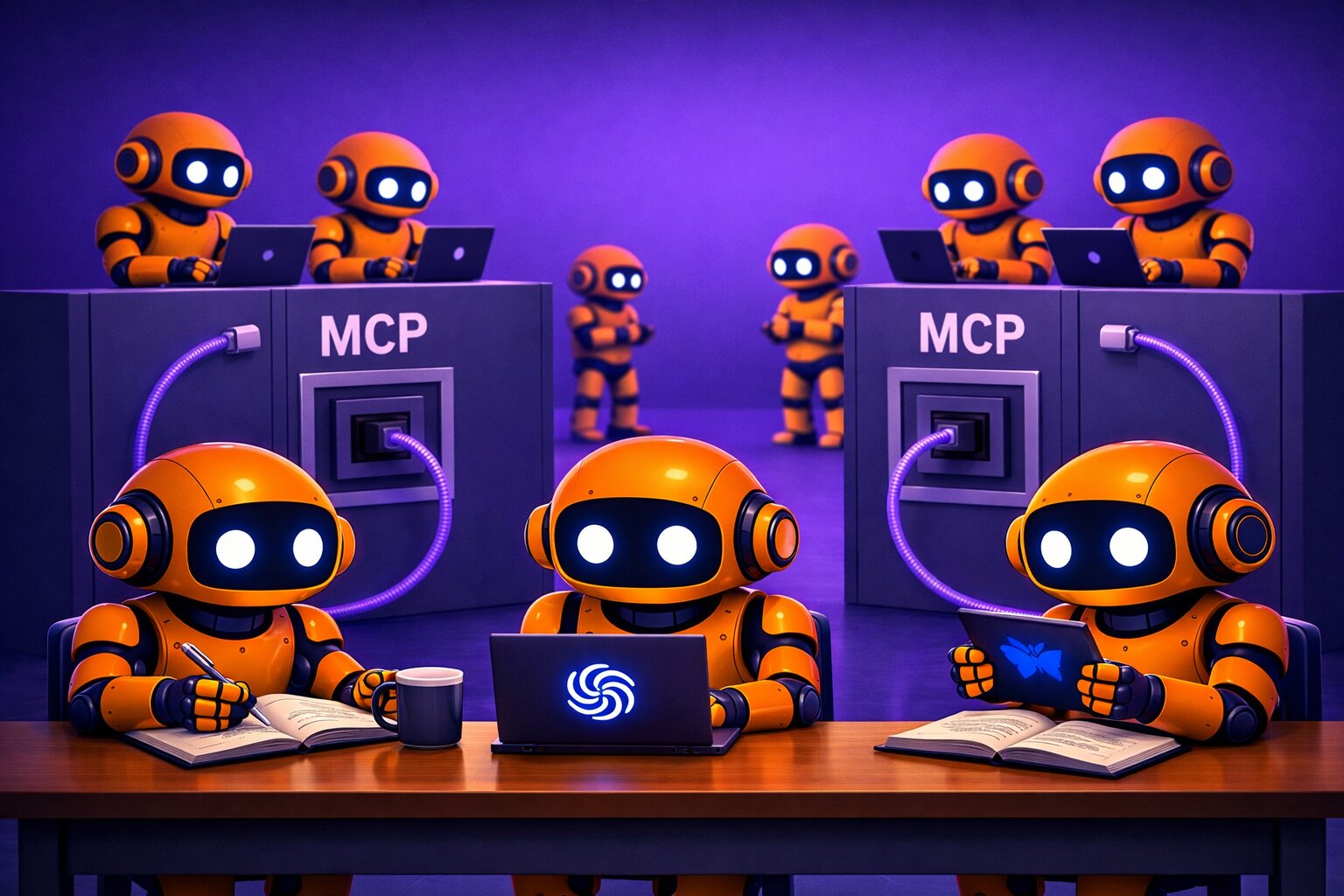
The next intelligence explosion will be the growth of a complex social system — a mass of AI agents, humans and hybrid centaurs that together form a new layer of collective thought.
For a long time, talk of a coming AI singularity has sounded like a myth about the arrival of one superintelligence: it gets smarter than a human, then smarter still, and from there accelerates itself to some incomprehensible level. The paper Agentic AI and the next intelligence explosion offers a different picture, far more mundane and, for that reason, more unsettlingly plausible. The next intelligence explosion, if it happens at all, will be the growth of a complex social system — a mass of AI agents, humans and hybrid centaurs that together form a new layer of collective thought.
Why a single superintelligence may be the wrong model
The Google researchers start from a simple premise: intelligence is not one scale on which you can mark the human level and then keep climbing. It is multidimensional and relational — it depends on interactions, context, language, institutions, the division of roles. And human intelligence has been collective for a very long time already: we think through culture, writing, organizations, markets, law, science.
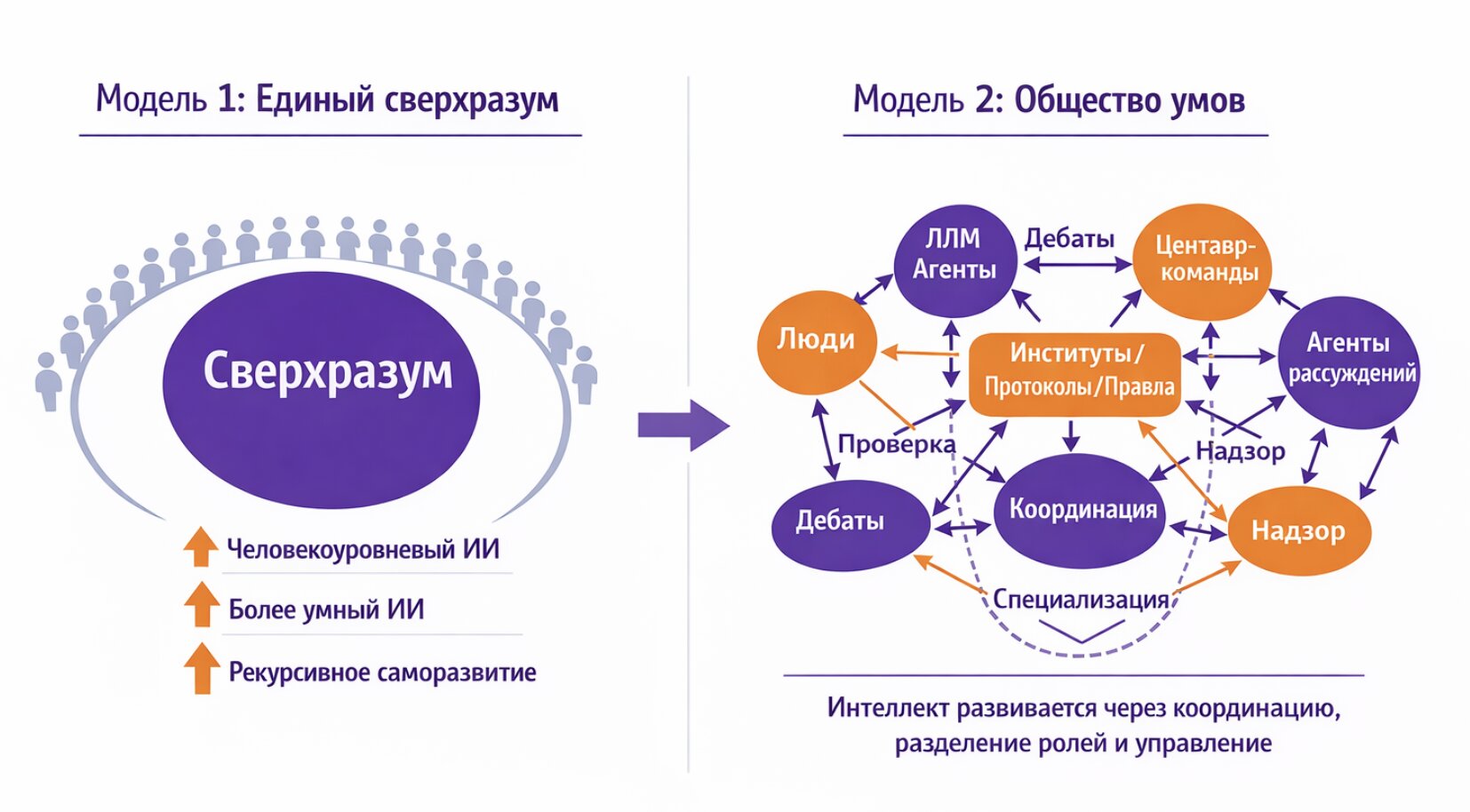
So if the big jumps in intelligence across the history of life and society came through new forms of cooperation rather than through upgrading the individual, then the current jump in machine intelligence makes more sense to look for in the same place — in social organization.
What is changing right now: agency and the debates inside an LLM
The most interesting part of the paper is its attempt to read reasoning models as a space of internal interactions. Citing recent work on frontier models (DeepSeek-R1 and QwQ-32B), the authors describe an effect: the gain on hard problems does not come simply from the model thinking for longer. How it thinks matters just as much. Inside the chain of thought, different perspectives, checks, questions, objections and reconciliations show up unprompted, close to a small-scale debate. The authors call this a society of thought: something resembling a multi-agent system starts running inside a single LLM.
Crucially, none of this behavior is wired in directly. When reinforcement learning rewards the model for accuracy, the model finds the more reliable route on its own — through internal argument and the cross-checking of claims. That yields an unexpected bridge to cognitive science and epistemology: good reasoning is often structured socially, even when it all runs inside one head.
Institutions you can engineer
Today most reasoning models emit a single stream of thought, as if we had the transcript of one meeting where every remark follows the last. Real teams work differently: roles, hierarchies, procedures for disagreement, a devil's advocate, independent checks, protocols for reaching agreement. The authors treat this as an enormous engineering surface — the social and organizational sciences have spent decades studying which rules make groups smarter, and that knowledge can now be carried over to AI reasoning and to multi-agent systems.
In practice this leads to the idea of recursive communities of agents: an agent can fork itself, spin up copies for subtasks, gather their conclusions and, where needed, run an internal society of thought at every level of difficulty. Intelligence grows the way a city does — through specialization and coordination, not through one super-brain.
The hardest question: how to govern it
The more agentic systems enter high-stakes domains — hiring, the courts, benefits allocation, market regulation — the more governance matters. Here the paper makes a sharp turn: conventional alignment in the RLHF mold resembles a parent-child model and scales badly once agents number in the billions. What is needed is a different level — institutional alignment: rules, roles, norms and protocols that set the bounds of behavior the way human societies rest on courts, procedures, regulators and the separation of powers.
From there comes an almost constitutional logic: AI systems should check each other rather than regulate themselves. If power is what constrains power, then a world of agentic AI needs mechanisms of mutual oversight — built into the infrastructure, not bolted on after the fact.
What this view ultimately proposes
The future is not the sudden awakening of a single superintelligence but the combinatorial growth of a hybrid society, one in which humans stay in the loop and intelligence is amplified through new forms of cooperation and conflict. This is neither utopia nor dystopia but an evolutionary scenario: intelligence becomes more powerful as we learn to build the social infrastructure for it.
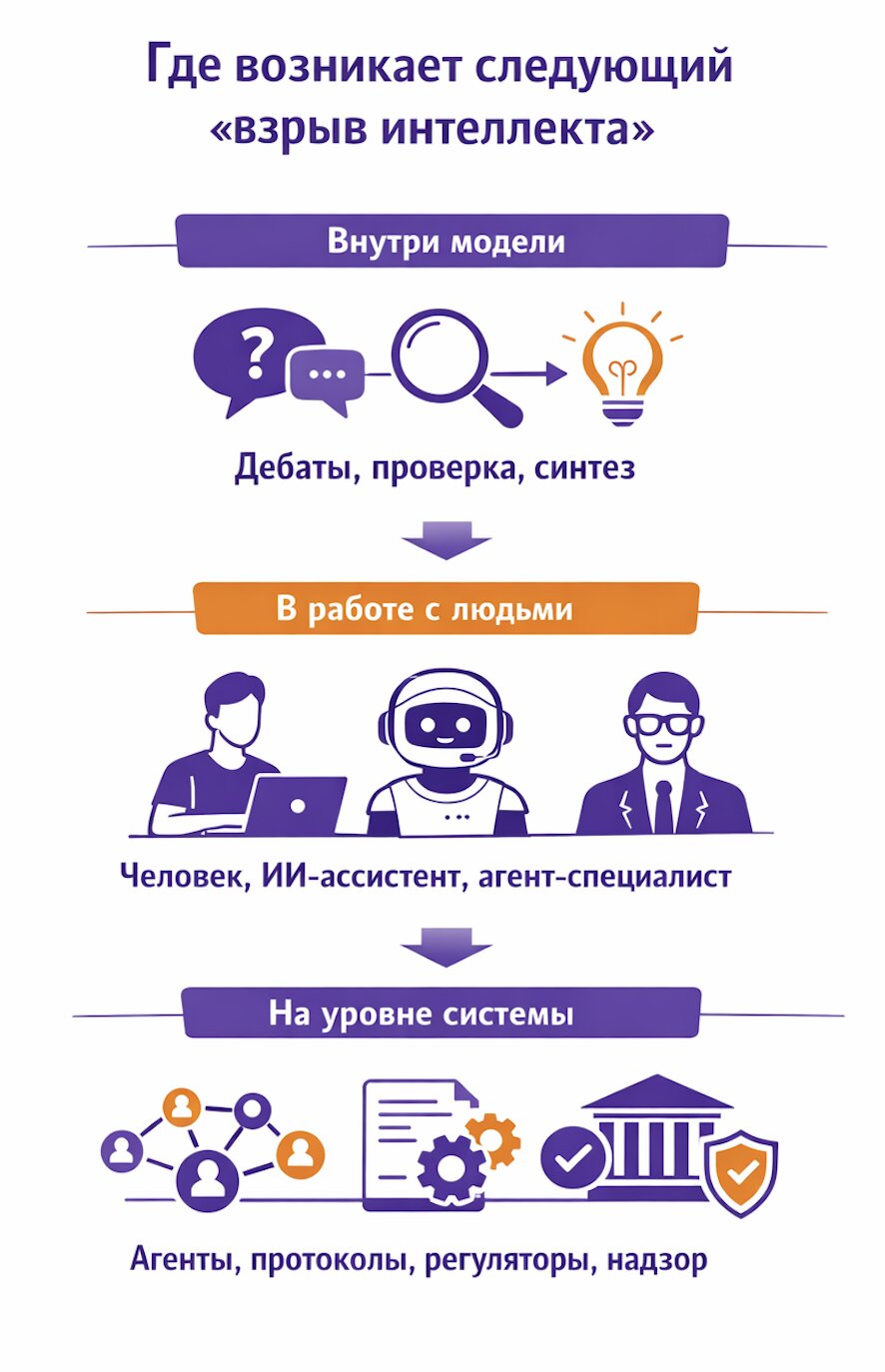
And if you go looking for the next intelligence explosion, it is already visible in three places: in the internal society of thought of reasoning models, in the hybrid workflows reshaping knowledge professions, and in the nascent communities of agents that copy themselves, specialize and negotiate. The question now is not only what these systems can do, but whether we can build rules and institutions worthy of this new scale.
AI paper breakdowns
Every day we read the new AI papers and retell what matters in plain language — no hype, no filler. If you want to see where AI agents are heading before everyone else, subscribe.
New breakdowns every day
On Telegram