Why AI agents break on real APIs, and how Auton tames them

Auton Agentic AI Framework: how to move agents off stochastic generation and onto verifiable contracts and specifications.
Agentic AI is what you get when a system doesn't just talk but acts: it calls APIs, queries databases, files tickets in a tracker, posts to Slack, kicks off pipelines. And that is where it turns out that natural language is a weak way to drive real software.
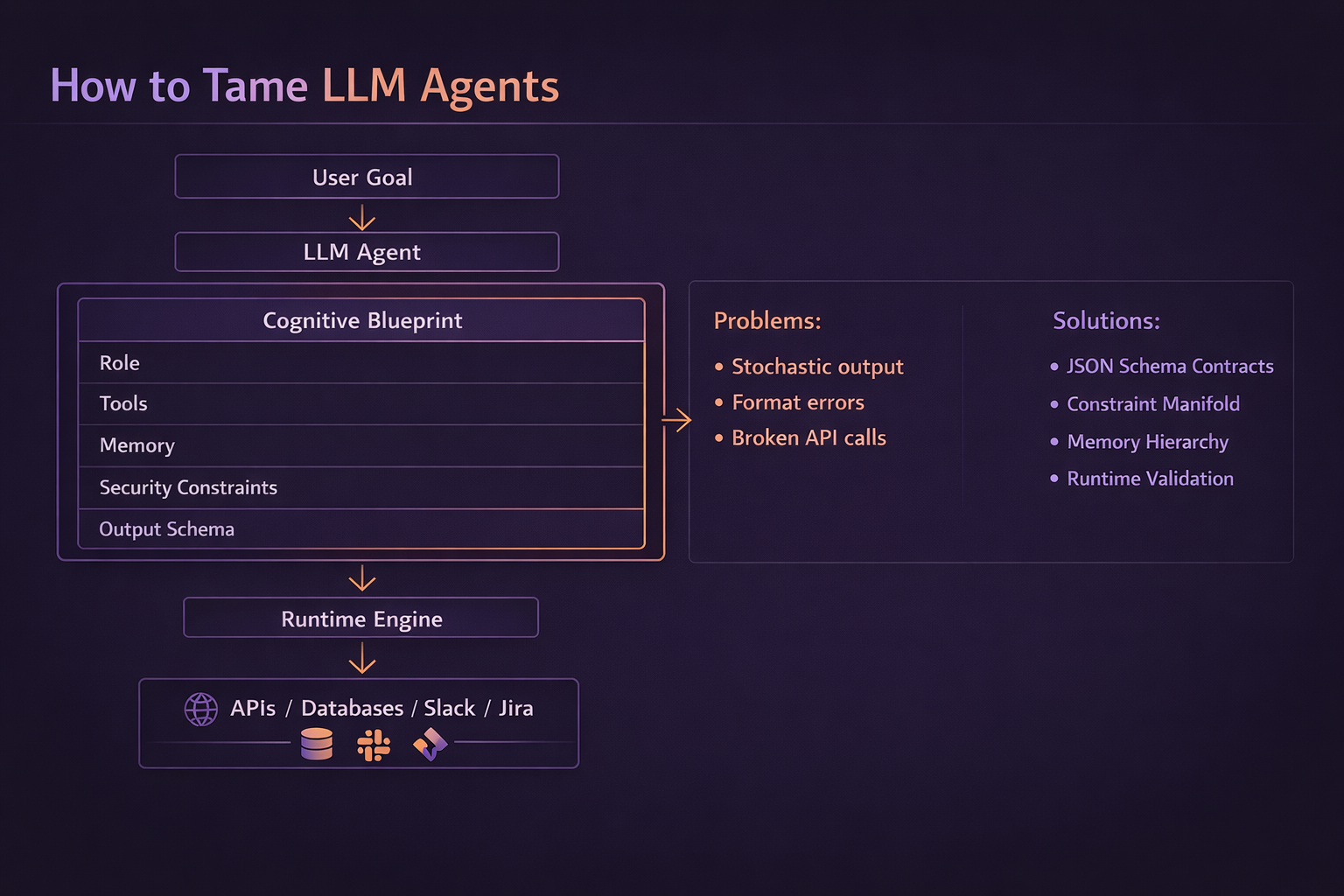
The authors of The Auton Agentic AI Framework describe the central pain of that shift. LLMs are stochastic by nature: they guess the continuation of a text, and the same request can come back worded differently. Enterprise infrastructure works the other way around — it needs deterministic, checkable, strictly structured inputs, governed by schemas, contracts and access rights. The smallest error in format or data type breaks the chain. So developers accumulate scaffolding: regexes, retries, validation, hand-built limiters. This is what gets called the integration paradox: the smarter the generation, the harder it is to wire it reliably into a world of strict interfaces.
The agent as a specification, not a script
The framework's central idea is to split the agent in two.
The first part is the Cognitive Blueprint: a declarative description of who the agent is, what it can do, which tools it can reach, how its memory is arranged, which safety constraints apply, and the format it is required to return results in. This is close to the Infrastructure-as-Code approach: what matters is not the code but a checkable specification you can version, review and carry between environments.
The second is the Runtime Engine: the concrete executor that takes the blueprint and brings the agent to life on whatever platform you need — Python, Java, take your pick. The authors emphasize portability: the specification should survive a change of language, of infrastructure, even of the particular agent SDK, without rewriting the logic in a new idiom.
How to tame stochasticity
To stop the agent from being merely a text generator, the framework introduces several practical mechanisms.
Why this is also about speed
If an agent takes many steps and calls external tools often, the delays turn into minutes fast. The authors propose runtime optimizations: parallelize independent steps as a task graph, and while you wait on an API response, trim the context dynamically so it doesn't balloon and slow inference down.
What the authors end up proposing
Put together, the Auton Agentic AI Framework looks like an attempt to turn agent systems from a pile of prompts and scripts into a proper engineering system: a portable specification, checkable contracts, managed memory, constraints built in, and a runtime you can reason about.
The main conclusion, readable between the lines: in an enterprise setting the question is usually whether an LLM can be trusted with a real action in a way that is checkable, repeatable and compatible with strict interfaces.
AI paper breakdowns
Every day we read the new AI papers and retell what matters in plain language — no hype, no filler. If you want to see where AI agents are heading before everyone else, subscribe.
New breakdowns every day
On Telegram