
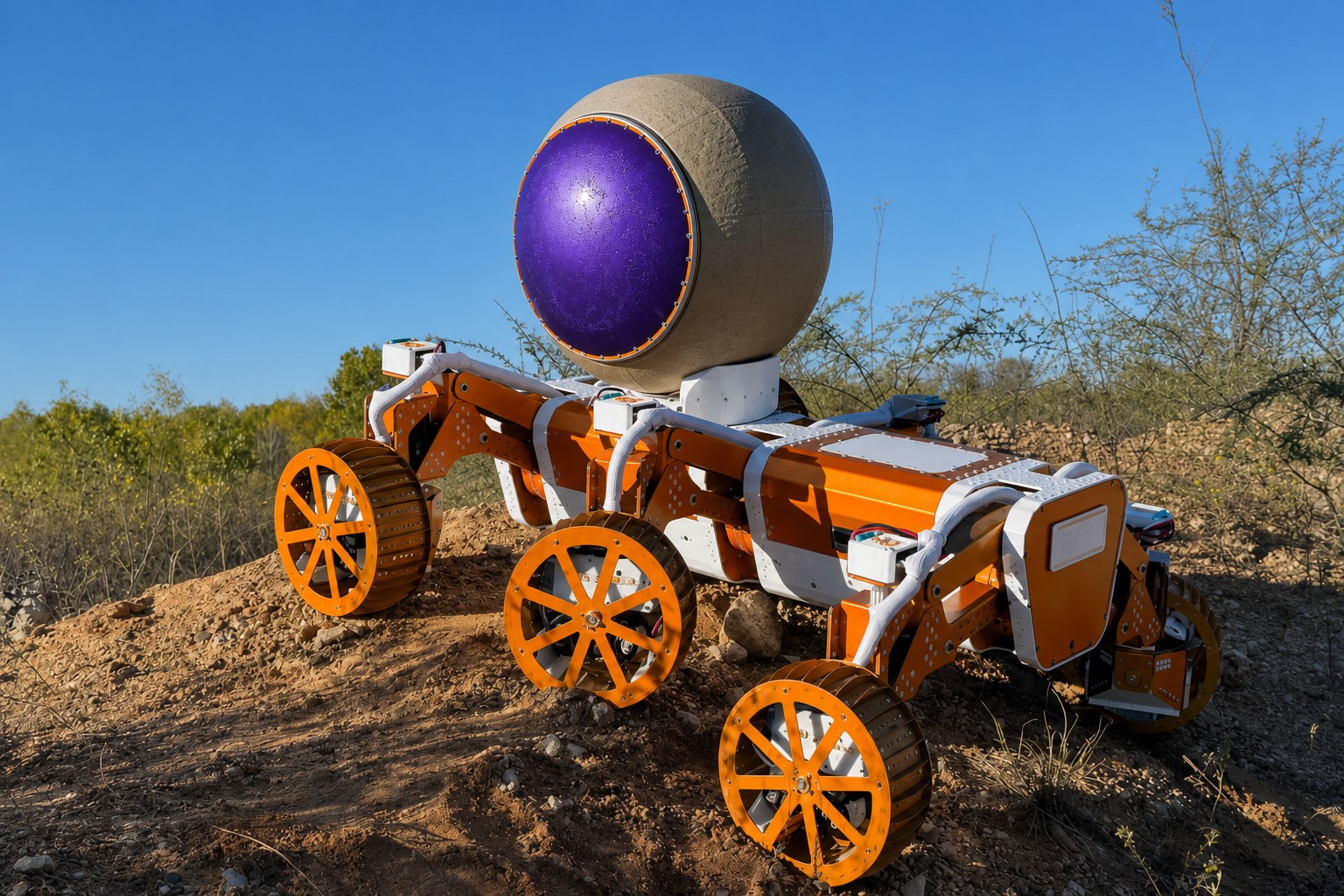

A team at Texas A&M University in College Station has published the design of RoboBall, a large inflatable sphere meant to roll into lunar craters that astronauts cannot safely enter, along with a hypothetical mission plan and the results of its first field tests in a quarry in central Texas. The target is somewhere like Shackleton crater at the Moon's south pole: 21 kilometres across, up to 4 kilometres deep, riddled with smaller and deeper pits, and partly never touched by sunlight. Those permanently dark, cold pockets may hold layers of ancient lunar geology and reserves of frozen water that a future lunar base could use. The current robot cost about $250,000 to build.
Source: spectrum.ieee.org
Rishi Jangale, a mechanic and graduate student on the project, watched an early test at the quarry and treated the pit as a stand-in for the lunar surface — a site roughly 370,000 kilometres, or 230,000 miles, short of the real thing. He and his colleagues have spent about five years on the beige ball.
The shape follows from a hard constraint. Sending astronauts into craters like these is unacceptable, because a person who fell in could not be pulled back out. So the team chose a vehicle that is supposed to go down and is not expected to come back up. The idea belongs to Jangale's adviser, former NASA robotics engineer Robert Ambrose, who proposed it more than two decades ago as an answer to the way rovers tip over on the lunar surface, a risk that gets worse in weak gravity. An inflatable sphere cannot flip, and its shell shields the components inside from sharp rock, dust and temperature swings that run from above 93 degrees Celsius in sunlight to minus 240 in crater shadow.
The mission concept is a division of labour. A wheeled rover carries RoboBall to the crater rim and releases it over the edge. The ball cannot climb back up the slope, but in exchange it can move freely through terrain nothing else can reach and collect geological samples. Small rockets then fire those samples back up to the rover waiting outside.
The scientific case for doing it robotically is strong. Sara Russell, a space mineralogist at the Natural History Museum in London who is not involved in the project, compares the Moon to an archive of Earth's history, and says robotic collection is particularly valuable because it preserves the record of exactly where a sample came from. NASA has not returned lunar material to Earth in more than 50 years; what arrives on its own, as meteorites, lacks that context. Even once crewed missions resume, large parts of the surface will stay off-limits.
How the ball actually moves is the elegant part. A pendulum inside the shell shifts the vehicle's centre of mass. On flat ground, with the pendulum arm pointing forward, the shell rolls forward to compensate, and it keeps rolling as long as the centre of mass stays ahead of the sphere's centre. Tilt the pendulum a few degrees left or right and the ball turns that way. At 340 pounds the sphere is soft enough to bounce slightly over bumps, while a small amount of overpressure keeps the skin relatively rigid. On steep ground the same mechanism serves as a brake: swing the pendulum upslope and the descent slows.
Hiro Ono, an aerospace engineer who spent 13 years working on robot mobility at NASA's Jet Propulsion Laboratory, points to the simplicity. RoboBall has two actuators, and both sit entirely inside the shell, protected from dust and everything else outside it.
It got there by breaking things. The lab had already proved the concept on RoboBall II, a prototype half a metre wide, and built the full-size RoboBall III in roughly 11 months. The first tests exposed software faults and a drive too weak to climb small soft rises. Jangale says Ambrose pushes students to build robots quickly and break them in testing. Rebuilding took about seven months and raised torque by a factor of 2.5, enough for the ball to throw itself over small obstacles and climb slopes of up to 20 degrees.
In the new work, a remotely operated RoboBall III descended quarry slopes, crossed soft ground, and launched a simulated payload back out of the pit using small rockets. On the Moon it would inflate itself and charge from the rover at the rim, then run on a large battery while it explored the depths alone.
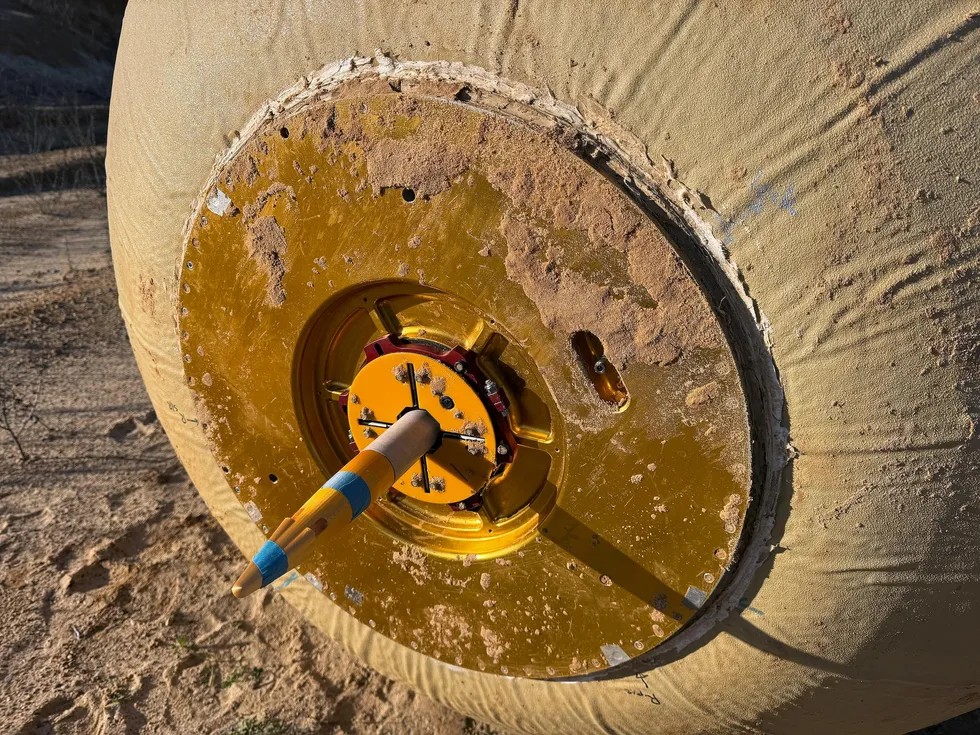
Close-up of a needle-shaped rocket protruding from the cargo bay of the large robotic ball
Source: spectrum.ieee.org
What the paper demonstrates and what the mission requires are still some distance apart, and the gap is not mainly about the robot. The aluminium parts with gold coating are space-grade; the rest of the materials are not. Space-rated electronics will cost more than what is in there now. The shell has to survive rolling over steel shards and temperatures down to minus 184 degrees Celsius, and its behaviour in lunar extremes has not been tested at all. The team wants to teach the ball to adapt its own driving to different slopes, and hopes to work with government agencies or space industry contractors to take the design further.
The harder unknown is the part of the concept that got the least testing. Descending a slope is the easy half; the mission only produces value if the samples come back, and sample return here means small rockets firing a payload up and out of a hole up to 4 kilometres deep to a rover that has to be hit. What has been shown is a simulated payload fired back out of a Texas quarry. There is also a question in the propulsion scheme itself: the pendulum works because gravity pulls an offset mass, and every test so far has run at full Earth gravity, on a Moon where that pull is a sixth as strong. The team is candid that the ball is clumsy — it is not built to pick a sample off a specific rock — and Jangale makes the right argument about scope, that the robot is not the point of the mission but a way of carrying one out. That means the next real milestone is instruments: the team wants to work with scientists building lunar science payloads, and whatever they build has to fit inside a space about the size of a carry-on bag and tolerate being rolled downhill.
Later this year Texas A&M opens a facility in Houston with the world's largest indoor simulated lunar and Martian terrain, about 190 kilometres from the quarry. It will close the gap on dust and slope. It will not close the gap on vacuum, cold or gravity, and at $250,000 a unit the cheapest way to find out how the shell behaves at minus 184 degrees may simply be to send one and lose it.