
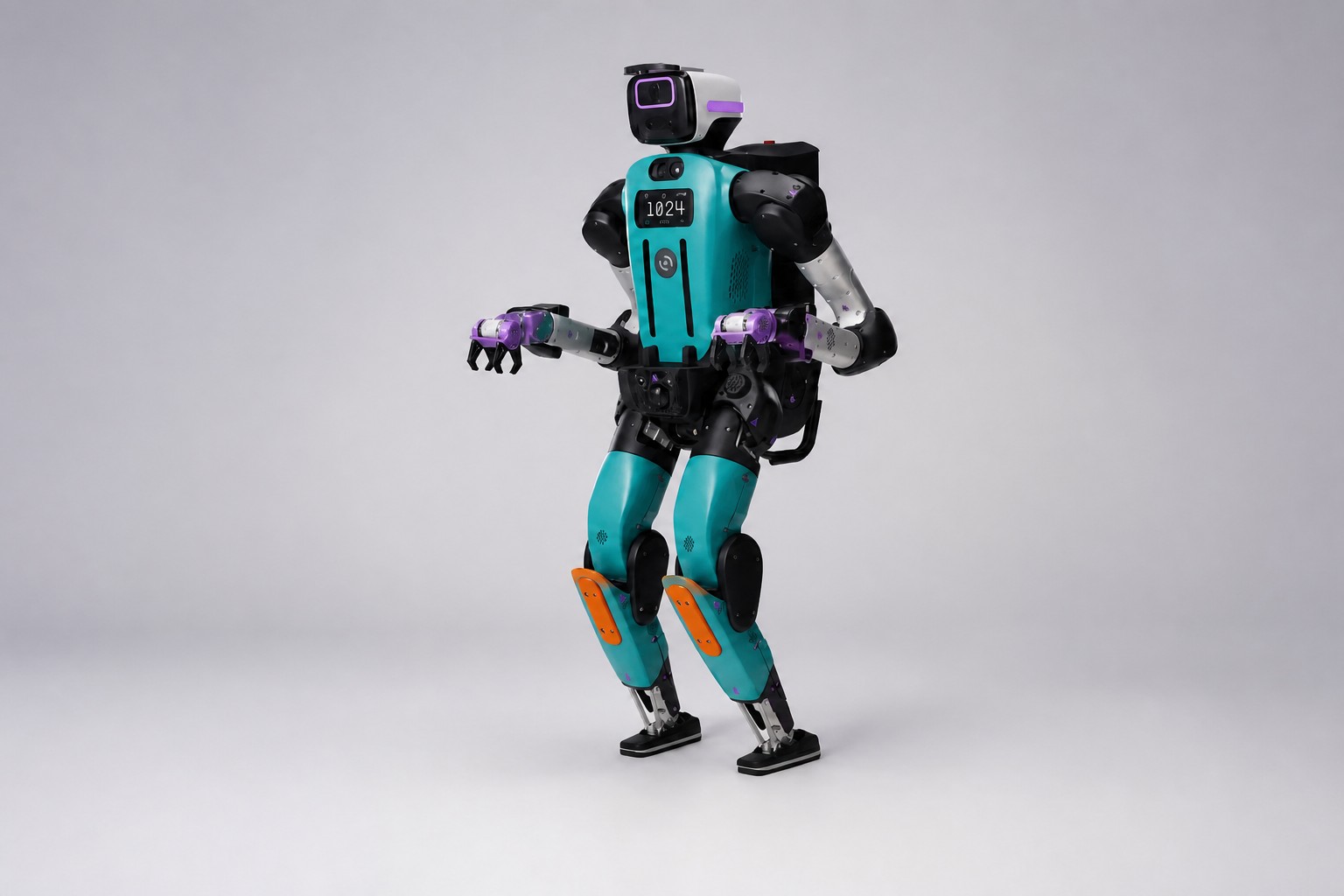
Agility Robotics introduced Digit 5, the next version of its humanoid for warehouses and manufacturing plants, and the headline capability is not strength or speed but permission: the company says the robot can work alongside people without safety fencing. Digit 5 detects people using AI and sensors and, according to Agility, stops or steps aside, warning anyone nearby with light and sound signals. First deliveries begin in early 2027, including to the European Union.
Removing the cage is the part that changes the economics. A fenced robot needs floor space, guarding hardware, and a work cell designed around it, which is why most warehouse automation ends up in dedicated zones rather than mixed into existing operations. A machine certified to share a walkway with a human being can be dropped into a facility that already exists.
Agility has been building the paperwork for that claim. The company is Nvidia's first partner on Halos, the safety platform for robotics, and says Digit 4 was the first humanoid robot to pass an independent OSHA safety review on a production line.
Digit 5 lifts up to 22.7 kg, 40% more than its predecessor. The battery charges in 9 minutes and then runs for 90 minutes, which the company says allows more than 20 hours of use per day. Swappable grippers let it move containers and load machines. The robot stands 1.81 m and weighs 129 kg.
Source: the-decoder.com
Work through the duty cycle and the 20-hour figure holds, barely: 90 minutes of work against a 99-minute cycle is roughly 91% uptime, or about 21.8 hours in a day. That assumes the robot does nothing but work and charge — no handoffs, no maintenance window, no waiting on a human. It is a ceiling being quoted as a capability, which is standard practice in this category and worth reading as such.
The track record behind the launch is the real asset. Agility says Digit 4 has logged more than 65,000 hours at customer sites, including GXO, Amazon and Schaeffler. At GXO facilities it moved roughly 100,000 containers at about 98% accuracy. The company also points to orders worth more than $300 million.
That 98% is the number I would ask about. Stated as a percentage it sounds like a pass; stated in units, it is roughly 2,000 containers out of 100,000 that did not go where they were supposed to. In a warehouse, every one of those is a human walking over to find out what happened. Agility does not say whether the figure improves in Digit 5, and the absence is conspicuous in an announcement that quantifies payload, charge time, runtime, height and mass.
Manufacturing runs out of Salem, Oregon, at a plant Agility says can build up to 10,000 units a year. Against a current order book of more than $300 million, that capacity is a bet rather than a constraint — it is sized for a market that does not exist yet.
The more interesting question is what the early 2027 date means. Digit 5 was announced now and ships in more than a year, which is a long gap for a product whose main selling point is a safety architecture that regulators, insurers and plant managers have to accept one site at a time. The delay reads less like a manufacturing schedule and more like the time it takes to turn "works without fencing" from a company claim into something a customer's safety officer will sign.