The material behind the jokes
The current wave spans formats that are easy to encounter and hard for the technology industry to control:
One video imagines a company CEO describing the best case as never having to do administrative work again, and the worst case as everyone dying. Another follows a young man climbing a beautiful mountain while thinking that AI will probably bring about the end of the world, but that excellent companies will appear before then. At the summit, he raises a sign: “Build a data center here.”
The premise is absurd, but the underlying language is real. The line about “excellent companies” belongs to Sam Altman. The fictional advertisements in New York’s subway are built from the same raw material: Cutlery.ai asks, “What if forks were spoons?”; Ziplink announces that it is now called Froggle.
The companies do not exist. The slogans are jokes. The anxiety does.
In a March Gallup poll, 79% of Americans said AI would lead to fewer jobs. In a CNN poll conducted this week, 81% said they were more concerned than excited about how the technology could “dramatically change the way we live.” Data from UMass Amherst found that only 11% of Americans would support building a data center in their neighborhood.
The satire attacks a familiar bundle of claims: that AI belongs everywhere, that its answers deserve trust, that its expansion is inevitable, and that its dangers are somehow part of its necessity. The more extreme the claims become, the easier they are to compress into a joke.
When the product is the punchline
Ty Ebeland targets AI doctors and AI recruiters: video bots that appear in situations such as a virtual medical appointment or a job interview. When one bot asks about marketing, he says he approaches everything skeptically—“with a grain of salt and possibly a little pepper.” The bot, depicted as an attractive blond man, seriously asks what that means for the brand’s social media strategy.
If these bots are approaching superintelligence, this one is visibly far behind.
Other comedians focus on the pressure to add AI to ordinary activities. Aya Hussein repeatedly leans around a door, playing a technology company trying to push users toward another feature:
Tom Nestor parodies how AI enthusiasts imagine other people see them. On a phone call, he tells a friend that he likes AI too: it does not work very well now, but eventually it will become so good that it will completely change people’s understanding of reality.
In The Atlantic, Alexandra Petri imagines a life optimized by AI, from Goldilocks and the 4.5 Bears to cereal whose recipe has been slightly altered. The nuts, for example, have become hard metal pieces.
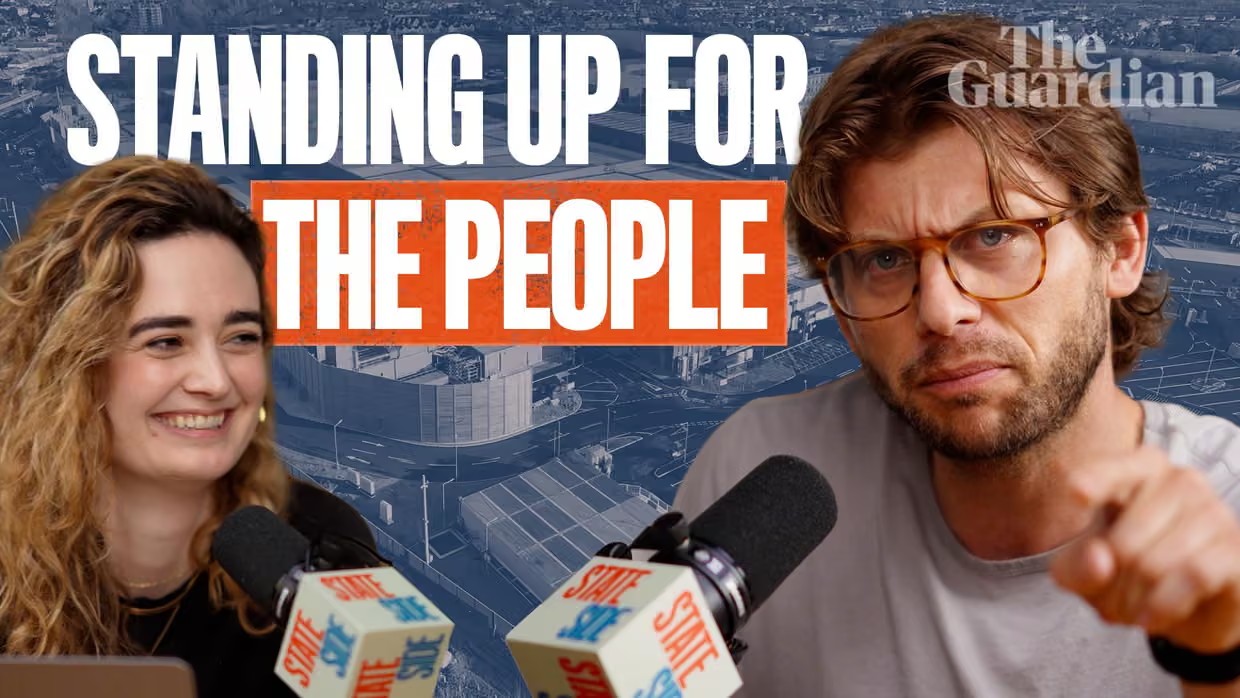
Can you stop AI datacenters? Comedian Charlie Berens thinks so – Stateside with Kai and Carter
Source: theguardian.com
That joke works because it does not require a technical critique. It turns product enthusiasm into a domestic nuisance, then pushes the nuisance until the promised convenience looks like an attack on ordinary judgment.
Human creativity, automated
The argument becomes sharper when comedians address AI’s artistic ambitions. In a serious episode of his podcast, Caleb Hearon said that someone who uses ChatGPT to make video, images, art or text—and asks it to write on their behalf—does not deserve to be taken seriously.
A comic titled “AI Design Logic” makes the same point more efficiently. A customer asks a waiter for a cheese pizza. When the pizza arrives, the customer claims credit: “Look what I made!”
Ayo Edebiri put an even shorter version on a T-shirt: “Don’t talk to me about AI. I’ll kill myself.”
The louder voices in the AI debate still belong to people such as Altman and Musk. But I think the cumulative effect of these jokes is less trivial than any single sketch. Marwan Shafi’s videos satirize Google for consuming water and mock its 2026 search results, which use Gemini and resemble impressions more than accurate answers. He hopes companies notice the absurdity of what they are producing.
Shafi argues that widely recognized jokes can influence how companies think about their own products. He believes attitudes are changing, although the process will take time. The claim is modest, and that is part of its strength: comedy is not presented as a replacement for regulation or engineering criticism. It is a way to make the criticism socially legible.
The unanswered issue is whether the companies can absorb that criticism without turning it into another marketing signal.
Why the jokes travel
Alberta Devore spent six and a half years as a software engineer at Google. In one recent video, she offers a simple response to the habit of consulting AI for every difficult question.
When a colleague asks what the abbreviation EOD means, Devore answers immediately. He is surprised that she asked Claude so quickly. She explains that she trained the model in her head by reading many materials and books.
Devore uses AI regularly herself. Her concern is excessive dependence on it, both for finding information and for programming. She wants people to understand what they are asking AI and what its limitations are.
Her serious videos on the subject often attract negative reactions. Humor, she says, usually reaches a more receptive audience. It draws people into a conversation before asking them to consider a difficult idea, such as the occasional value of using their own brains.
That may be the most practical role for this comedy. The joke does not need to defeat a model. It only needs to interrupt the assumption that every problem should be handed to one.
Subway posters and a small human victory
Harris Alterman and Dave Ross brought the satire into New York’s subway system with posters parodying the opaque, irritating language of technology advertising at San Francisco bus stops and billboards.
Ross said it was the fastest writing and production process he had ever gone through. Technology slogans were so obvious and so unlike human speech that they were easy to mock. The comedians collected recurring words, including “agents” and “democratize,” in a large Google Doc, then built 50 advertising templates:
They rearranged the pieces and filled the templates like a game of Mad Libs before printing the posters.
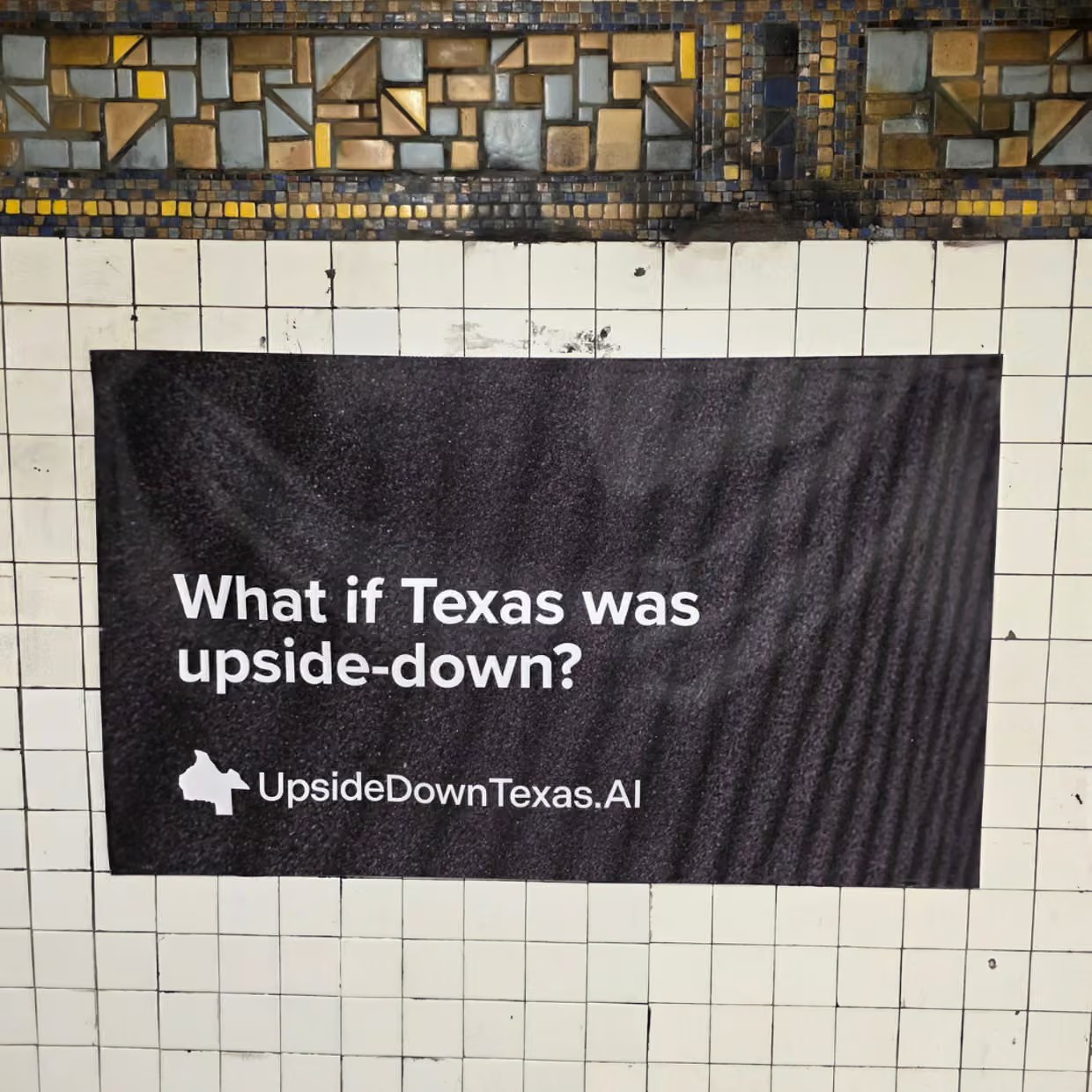
A fake tech subway ad by Harris Alterman and Dave Ross. Photograph: Harris Alterman/Harris Alterman and Dave Ross
Source: theguardian.com
At first, the idea seemed simply funny. After several months of discussing it, Ross realized how much the language itself irritated him. It “almost insults the human brain,” he said.
Other comedians are more direct. British comedian Cody Dahler attacks “tech bros” such as Palantir CEO Alex Karp, whom he calls “an evil Art Garfunkel.” Dahler says they are building systems intended to destroy everything people value in human life, and urges his followers to oppose them openly.
Charlie Berens of Wisconsin led a campaign against data centers in his state. In his parody news segments, he warns that it may soon be time to say goodbye to “America’s dairyland” and hello to “America’s motherboard.” He later became the main speaker at meetings attended by hundreds of people.
Ross does not expect comedy to overthrow a corporation worth a billion dollars. But he argues that humor should not be underestimated when it operates at scale.
Sam Altman, the face of ChatGPT, was recently shown a video featuring Husk, a former landscape designer who recently reached one million subscribers. Husk asked the bot to time a supposed long-distance run, and ChatGPT got the result badly wrong. Altman looked embarrassed and acknowledged that it was a known problem.
Ross does not think comedians should be treated as philosophers. The useful effect is smaller: a joke can help people recognize that they are dissatisfied with what is happening and encourage them to question the future being presented to them.
My guess is that this is why the comedy feels unusually pointed. It does not claim to offer a competing vision of humanity. It simply refuses to accept that a handful of loud executives get to define the future as inevitable. Against that certainty, a subway poster or a bad chatbot punchline is a small victory—but it is still a public act of resistance.
Daily AI news
Every day we pick what actually matters in AI and explain it plainly — no hype, no filler. Subscribe if you want to follow where the industry is going.
Only what matters — every day
Follow on X